
Snappit logo
Snappit
Get App
Generic illustration, not a photograph of this venueIllustration
ParkChubu, Japan

Kenrokuen Garden

Kenrokuen is best enjoyed at the speed of a garden, with time to pause whenever the view changes.

About

Kenrokuen is best enjoyed at the speed of a garden, with time to pause whenever the view changes. Make Kasumigaike Pond your starting point: the two-legged Kotoji lantern, broad water and spreading Karasaki pine put several of the garden’s most memorable sights close together. You can have a satisfying visit here without hunting down every numbered stop.

This is a strolling garden shaped by generations of the Maeda lords. Its hills, ponds, streams and carefully composed views are meant to unfold as you move. Try looking across the same water from two different places. A tree that filled the foreground a moment ago becomes part of the wider scene, and a pavilion or island suddenly takes on more importance. The garden’s name refers to six qualities, including both spaciousness and seclusion. Finding those contrasts is more rewarding than simply counting monuments.

There is plenty here for curious children, too. Find the lantern’s two unequal legs, notice how gardeners support a pine’s long branches, and look for the raised roots of Neagari Pine without stepping into its planted enclosure. At Hanamibashi, the Flower-viewing Bridge, the winding stream brings a different sort of detail: blossoms in season, moving water and the changing shapes of reflections. Keep a hand free for younger children near the pond edges.

Give the lower garden extra time if you want the sound of Midori Waterfall and the quieter scene around Hisagoike Pond. Or make your second act a seated tea break at Shiguretei. Kanazawa Castle Park is next door, but it is a separate outing; there is no need to rush through Kenrokuen just to fit both into one morning. This is a living, carefully maintained landscape, so flowers, pruning, repairs and replacement planting all change what you see. Explore the grounds like a pro—download the Snappit app to instantly identify animals and plants.

The garden grew from a villa and surrounding grounds developed for Maeda Tsunanori in 1676. Later lords rebuilt and enlarged it, combining older garden areas with the upper landscape around Kasumigaike. It received the name Kenrokuen in 1822, opened fully to the public in 1874 and became a nationally designated Special Place of Scenic Beauty in 1985. Shiguretei is a modern reconstruction, completed in 2000, rather than an untouched Edo-period building.

What to do here

Start with the pond and pine circuit, then choose either the lower garden’s waterfall and fountain or tea at Shiguretei. Pause for birds beside the water and compare the shapes of trained pines and leafy trees. Use the official map and current signs rather than trying to cross ornamental stepping-stone bridges.

Seasonal info

Winter’s yukitsuri ropes are striking even without snow. In spring, different blossoms arrive in succession rather than all at once. Summer suits an early, shorter walk with water and shade breaks. Autumn brings changing leaf colour and preparations to protect branches from heavy winter snow.

Accessibility

The operator recommends a flatter 500 m course and identifies the Kodatsuno Gate area as easier for wheelchair access. The wider garden has slopes and gravel surfaces that can be slippery. Ask staff about a suitable approach, current works and an open accessible toilet before setting off; the short course does not make every gate or attraction step-free.

Don't miss

1

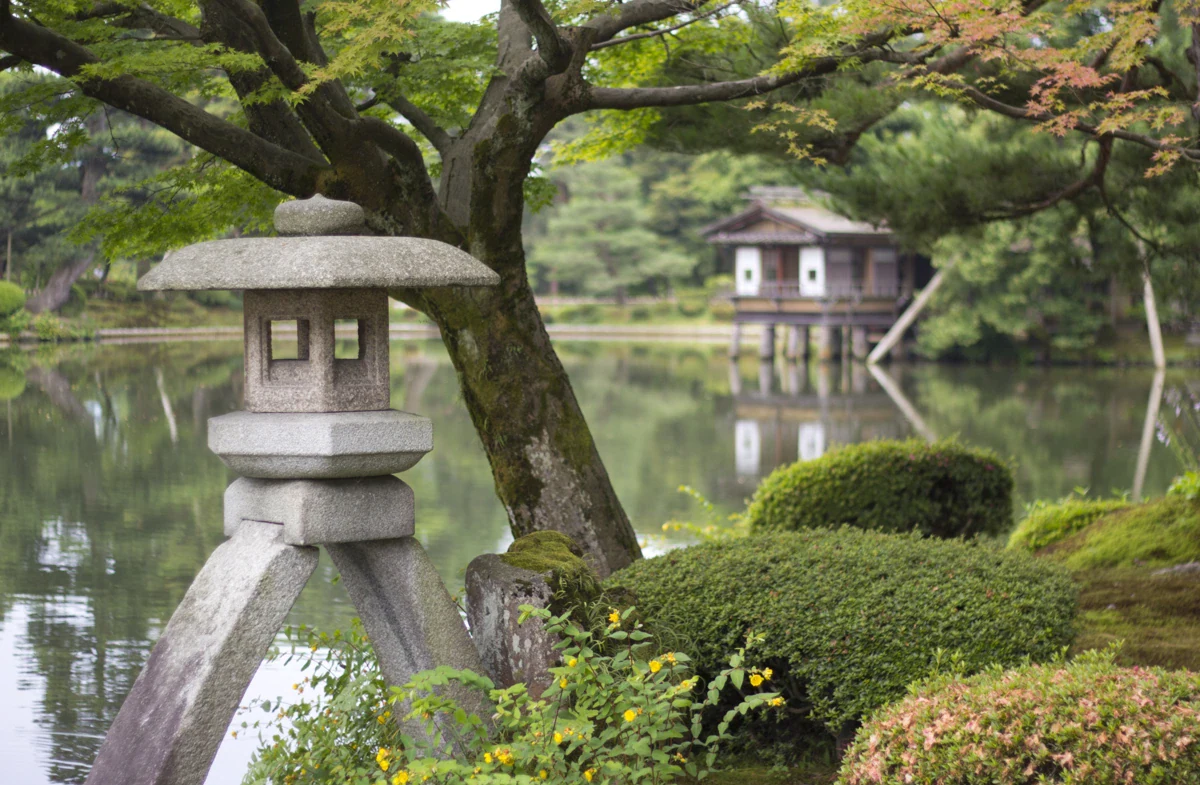
Kotoji lantern and the changing reflections of Kasumigaike Pond

2

The carefully tended Karasaki pine and winter snow-support ropes

3

Hanamibashi and the seasonal flowers along the winding stream

4

Hisagoike Pond and Midori Waterfall, if you have time for the lower garden

A two-legged stone lantern stands beneath a leafy tree beside a pond, with a waterside pavilion in the background.

The Kotoji stone lantern beside the pond at Kenrokuen Garden in June 2014. This historical view predates the removal of the old maple beside the lantern in September 2021.

Stone lantern Kenrokuen.jpg — Japanexperterna, CC BY-SA 3.0 (https://creativecommons.org/licenses/by-sa/3.0/). Source: https://commons.wikimedia.org/wiki/File:Stone_lantern_Kenrokuen.jpg. Proportionally reduced to a 1200-pixel width without upscaling; recompressed to WebP quality 92, method 6. No crop, retouching, added text or colour correction. EXIF omitted. · Creative Commons

Walks and routes

The pond and pine circuit

Use the operator’s clockwise flatter course, starting at Kotoji lantern. It takes in the lookout, Karasaki Pine and Kasumigaike, then passes Gankobashi, the Seven Lucky Gods stones, the Kiku-zakura cherry, the Meiji Monument and Neagari Pine before returning by Hanamibashi and Uchihashitei. The published circuit is about 500 m and 30 minutes; allow 60–90 minutes for a relaxed visit including your gate approach.

Ask staff to show you the best connection from Kodatsuno Gate. Stay on the surrounding path at Gankobashi; the bridge itself is closed. A wheelchair user may need help with slopes and gravel on the approach.


The pond and pine circuit

An optional lower-garden visit

If you still have energy after the pond, ask for the current open way to Hisagoike Pond, Midori Waterfall and the fountain. Give this extra area about 45–60 minutes, including the return. Enjoy the water from the paths, then return to your chosen exit without adding a hill climb.

This is a more demanding choice than the flatter pond course, with changes of level. Wheelchair users and anyone avoiding slopes should ask staff whether the open approach suits them, or stay with the upper garden.

An optional lower-garden visit

About 90 minutes: one good circuit

Go straight to the pond area, take the flatter course slowly and choose one quiet pause for birds or reflections. Leave enough time to return to the gate. This is the simplest plan with young children or limited energy.

About two hours: choose your extra

After the pond circuit, add either Shiguretei or the lower garden. Tea is the more restful choice; Hisagoike and the fountain add more walking. If a queue, weather or construction makes the extra awkward, finish with the pond rather than rushing.

Things to try

Try two versions of the same view

Take one photograph across Kasumigaike, then walk to another public viewpoint and look again. Which tree, island or pavilion now becomes the focus? Keep narrow paths clear and let other visitors enjoy the view.

Give children a three-shape challenge

Look for a two-legged lantern, a sweeping pine branch and a curved stream. Sketch them or describe them to one another. There is no need to collect anything or leave the path to complete the challenge.

Slow down over tea

Choose Shiguretei for tea and a sweet with a garden view. Time the stop before noon or after 1 pm, and ask about any private booking before counting on a seat. This is a served-tea break rather than a hands-on tea ceremony.

A shorter rainy-day garden visit

In light rain, keep to a short pond visit and consider Shiguretei when it is open. Wet greenery can be lovely, but slippery gravel and stone are a reason to slow down. In strong wind, heavy rain or snow, check notices and postpone if conditions or staff advice call for it.

Wildlife and habitats

Japanese black pine

Karasaki Pine is a named, carefully cultivated black pine beside Kasumigaike. Look at the dark bark, pairs of needles where visible and the spread of its supported branches. Its shape tells a story about years of gardening as much as natural growth.

Grey heron

The garden’s bird list includes grey herons. Scan the water margins from the path for a large, long-necked bird with a grey back; an adult has a pale head with a dark stripe. Give a resting bird plenty of room.

Common kingfisher

A kingfisher is a smaller, quicker possibility: look for a blue back and orange underside near water. It may perch on a branch or pass in a brief flash. Watching patiently from one place is better than trying to chase the next view.

The pines are cultivated garden trees; the birds come and go freely. Stand quietly on a public path, use binoculars if you have them, and enjoy whatever turns up without feeding or following it.

Stories and discoveries

Six qualities, arranged in contrasting pairs

The name Kenrokuen refers to spaciousness and seclusion, artifice and antiquity, and watercourses and broad views. Try choosing your own example of each pair as you walk.

The fountain uses a height difference

The fountain is driven by pressure from higher Kasumigaike Pond. Water engineering is part of the garden’s beauty, built into what looks like a natural scene.

Winter ropes have a practical job

Yukitsuri supports branches against Hokuriku’s heavy, wet snow. The conical rope patterns are beautiful, but they are also part of keeping these carefully shaped trees healthy.

When to visit

March and April

Choose the plum grove for March flowers and the cherry trees for April. Check the latest bloom information, since varieties and weather spread the season over several weeks.

May and early summer

Make Hanamibashi and the winding stream a focus for fresh leaves and kakitsubata irises. Later, rain brings rich green foliage and moss; admire the planted areas from the path.

Autumn

November is a useful planning window for leaf colour. Allow time simply to compare greens, yellows and reds rather than looking for one perfect tree. Snow-support work also begins as winter approaches.

Winter

Come for the outline of trained pines and yukitsuri ropes, with snow as a bonus rather than a promise. Wear warm layers and grippy footwear, and shorten the visit if surfaces are icy.

Getting there and practical advice

Toilets and everyday facilities

The official facilities map marks toilets, accessible and ostomy facilities, lockers, information points, AEDs, wheelchair loans and food outlets. Check which facility is closest to your route at the gate; opening arrangements can differ from the garden’s hours.

Wheelchair loans

Wheelchairs are available free at Katsurazaka, Renchimon, Kodatsuno and Zuishinzaka ticket offices. Contact the management office on 076-234-3800 if you need to discuss equipment or the route before visiting.

Arriving by bus

From Kanazawa Station, look for a service to Kenrokuen-shita / Kanazawa Castle. The garden’s Japanese access page gives about 12 minutes on the bus and another five minutes on foot to Katsurazaka Gate. These are normal-condition estimates; confirm the service and stop on the day.

Arriving by car or taxi

A taxi from Kanazawa Station is normally about ten minutes, depending on traffic. Drivers can use the nearby Kenroku Parking facility; check current charges and restrictions through the official access page. For designated accessible parking near Kodatsuno, call Ishikawa’s traditional crafts museum in advance on 076-262-2020.

Choose the entrance as carefully as the walk

The easiest section inside the garden does not remove the climb from every bus stop or gate. Kodatsuno is the operator’s suggested easier approach. Discuss slopes, gravel, wheelchairs and the return journey with staff, especially after rain or snow.

Keep alternatives simple

The lower garden and hill paths are optional. If walking becomes tiring, return by a suitable open path. Do not use ornamental stones or a closed bridge as a shortcut.

Visitor information

Path works around Sazaeyama

The September 1, 2026 notice reports dismantling of stonework damaged in the 2024 Noto Peninsula earthquake. Construction traffic and narrower paths affect the area. Follow staff directions; the notice does not give an end date.

October 25, 2026: marathon disruption

The Kanazawa Marathon brings traffic restrictions and significant disruption to buses and cars. Check the event’s road information before travelling to the garden that day.

Sources and useful links

Wildlife you might spot

3

Each card links to a full Explore page with photos, traits, and fun facts.

Snap map for this place

Start with the big picture, then zoom in to explore individual wildlife observations around this place.

Loading map…

Good to know before you go

Check current notices before visiting. Work around Sazaeyama is narrowing some paths, and the October 25, 2026 Kanazawa Marathon will disrupt city access.

Wear shoes with grip. Gravel, wet stone and winter ice call for slower steps, particularly beside water.

For the gentler visit, ask about entering at Kodatsuno Gate. Katsurazaka is convenient from the main bus stop, but the approach climbs into the garden.

Look at Gankobashi, the Flying Geese Bridge, from the path. Its worn stones are closed to crossing.

Keep to paths and outside planted enclosures. Leave needles, flowers, moss and other natural material where they are.

Use a tea shop for a food break. Picnic mats and picnic-style meals are not permitted in the garden.

Pets, smoking and riding two-wheeled vehicles are not allowed inside. Plan pet care before arriving.

If you choose free early entry, use Renchimon or Zuishinzaka only and leave before the daytime session begins. Check the seasonal gate times rather than arriving at any entrance.

Frequently asked questions

Normally daily: March 1–October 15, 7 am–6 pm, last entry 5:30 pm; October 16–the end of February, 8 am–5 pm, last entry 4:30 pm. Severe weather can cause closures, and special evening openings have their own arrangements.
Standard admission is ¥320 for adults aged 18 and over and ¥100 for children aged 6–17. Visitors aged 65 and over enter free with official proof of age. Tea and separately managed nearby attractions cost extra. Check the operator’s admission page for other exemptions and free-opening dates.
Yes, during the designated early-opening session. Only Renchimon and Zuishinzaka gates are used. Starting times vary by season, and everyone must leave 15 minutes before ordinary opening; last entry is 30 minutes before ordinary opening. For October 16–31, the published session is 5–7:45 am, with last entry at 7:30 am.
Shiguretei serves tea with a sweet, but it does not offer a tea-making experience. Current prices are ¥1,000 for matcha or ¥500 for sencha. It opens 9 am–4:30 pm, with last reception at 4 pm, but closes noon–1 pm for cleaning, December 29–January 3, and sometimes for private use.
Choose it for a garden stroll and a tea-shop break. You cannot spread a picnic mat or hold a picnic-style meal here.
These are separate places. Check their own access and ticket arrangements if you want to add them; the visit described here stays within Kenrokuen.

Recent snaps at this place

Recent snaps will appear here as new observations are added.

View all ›

Take the discovery with you

Exploring Kenrokuen Garden?

Identify the wildlife you spot, learn as you go, and keep a collection of the adventure.

  1. 1Spot it
  2. 2Snap it
  3. 3Keep the discovery




