
Snappit logo
Snappit
Get App
Generic illustration, not a photograph of this venueIllustration
ParkKR

Namsan Park

Namsan works best when you choose the kind of visit you want before setting off.

About

Namsan works best when you choose the kind of visit you want before setting off. The tower is an obvious landmark, but you can have a satisfying park outing without going to the top. Start with the North Ringway if your priorities are trees, conversation and a walk you can shorten easily. Choose the Sky Forest Trail for a purpose-built deck through the woods, or head to the Korean Forest Garden for a closer look at designed planting.

The main decision is how much climbing to add. Subway stations sit below the park, and a short line on a map can hide a substantial uphill approach. A shuttle can save energy for the part you actually want to explore. Keep the summit optional, especially with children, a stroller or someone who finds descents uncomfortable. Turn your visit into a safari! Use the Snappit app to scan and log wildlife sightings here.

Namsan was the southern mountain of the old capital, also known as Mongmyeoksan. Beacon fires near the summit once formed part of the capital’s communications system. The city wall was damaged during the Japanese colonial period and later restored in sections. More recent restoration also changed the park: the 1990s Namsan restoration project removed buildings and returned space to greenery, including the outdoor botanical garden. Today’s forest, memorial spaces and visitor attractions reflect those different layers of history.

What to do here

Walk a section of the North Ringway, take an unhurried break under the trees and use the signed junctions to decide whether to continue. For a different visit, explore the Korean Forest Garden on the southern side. Add the outdoor summit viewpoints only if the weather, daylight and your energy make it worthwhile.

Seasonal info

The same hill offers very different outings through the year. Summer calls for shade, water and a shorter plan; winter calls for caution on frozen slopes and steps. Blossom and autumn colour vary with the weather, so keep your route more flexible than your photography plans.

Accessibility

The North Ringway is the gentler main option, but its approaches are not all level or step-free. The Sky Forest Trail is designed as a barrier-free deck route; the city’s opening guidance describes an 8% gradient, which can still be demanding. Check the exact entrance, surface and onward connection for your needs.

Don't miss

1

A tree-lined North Ringway walk that can be shortened without aiming for the summit.

2

The Sky Forest Trail’s deck route between Sowol Garden and Health Garden.

3

The Korean Forest Garden, opened in June 2026 in the former outdoor botanical-garden area.

4

Outdoor summit views and traces of Seoul’s historic city wall.

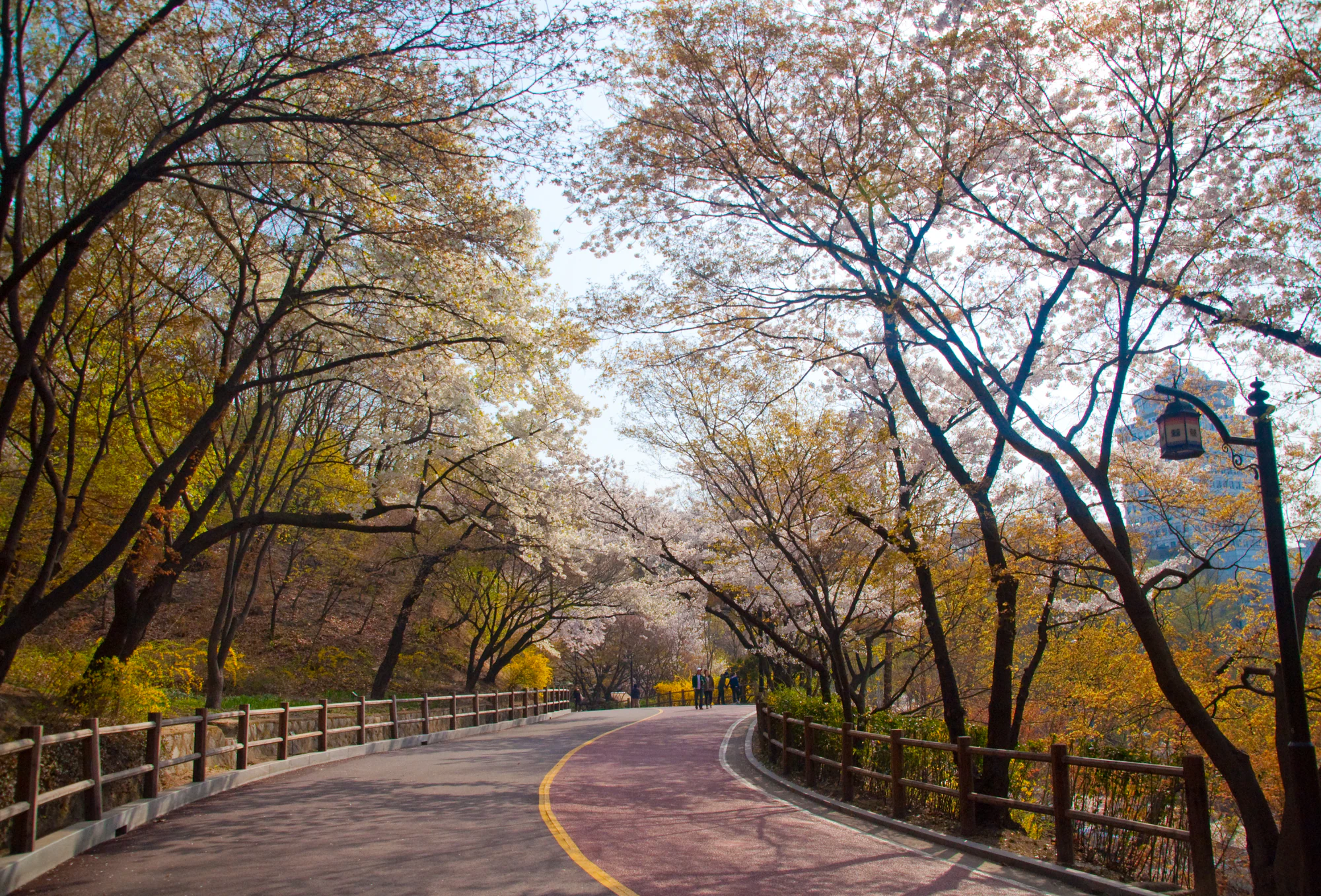
A curving paved path beneath pale blossom, with wooden railings, yellow-flowering shrubs and a few distant walkers.

Spring blossom over a Namsan park path, photographed on 20 April 2011. The exact path segment is unconfirmed; this historical view does not show current conditions.

Photo: [Lifetime Travelmates / Flickr](https://www.flickr.com/photos/sunxez/5656662730/), [CC BY-SA 2.0](https://creativecommons.org/licenses/by-sa/2.0/deed.en). Unchanged original. · Creative Commons 1 · Creative Commons 2

Walks and routes

The main choice: North Ringway

The official trail leaflet gives this northern section as 3,420 m, between the entrance rest area on the cable-car side and the entrance by the National Theater side. It is a broad, gently graded walking road with cars and bicycles excluded. Use the official trail map to identify the northern road; the similarly named Northern Forest Trail is a different path.

For a low-commitment visit, start at either end, walk until you feel ready for a break and return the same way. For a one-way walk, choose your onward transport first. The map marks Waryongmyo Shrine, the Jo Ji-hun poetry monument and Seokhojeong archery ground along this side of the hill. Treat them as optional pauses; entering a facility is a separate question from passing it on the walking road.

The road itself is the easier option. Approaches from Myeongdong or the National Theater side can still involve slopes; a short accessible section does not certify the whole station-to-park journey. Stay on the main road if you need to avoid forest steps.


The main choice: North Ringway

A deck through the trees: Sky Forest Trail

This route links Sowol Garden beside Namsan Library with Health Garden higher on the hill. Opened in October 2025, its deck winds through the trees with places to pause for forest and city views.

Start from the library side if you want to climb gradually and judge the effort early. Use the city’s entrance guidance and current signs to find the correct deck, rather than a neighbouring staircase.

Seoul calls it a barrier-free forest trail, but its published opening guidance describes an 8% gradient. Wheelchair users may need assistance or a powered chair; suitability depends on individual needs. Confirm the complete approach and exit, and turn back if the grade is too much.

A deck through the trees: Sky Forest Trail

Optional extra: the summit and city-wall side

If city views are your priority, treat the summit as a deliberate uphill outing. The signed city-wall approaches include substantial stair climbing, while the southern road carries permitted traffic and shuttles. Neither is a continuation of the gentle northern road at the same effort level.

One practical combination is to take the shuttle toward the summit, enjoy the outdoor viewpoint area and choose a descent suited to your knees and daylight. Walking down can be as tiring as going up. The Palgakjeong pavilion and beacon-site area provide historical context without requiring a tower-observatory ticket.

Expect stairs on the city-wall approaches. Taking a shuttle reduces the climb but does not remove every gradient between the stop and your chosen viewpoint. Check the precise connection if step-free access is essential.

Optional extra: the summit and city-wall side

A short woodland break

Arrive on the National Theater side, find the North Ringway entrance and stay on the northern road. Choose a turnaround before you feel tired. A short out-and-back lets you enjoy the trees without committing to the cable-car-side exit.

A half-day with a clear priority

Pick the summit and heritage side, or the southern garden and forest side. Build in a sit-down break and transport time. Leave the other half of the mountain for another day unless you actively want a longer, hillier outing.

Things to try

Explore the Korean Forest Garden

The former outdoor botanical-garden area on the southern slope was renewed as the Korean Forest Garden and opened on 27 June 2026. Its three themes and 11 garden spaces draw on Korean forest and garden traditions. Come here if you enjoy comparing planting, enclosure and views, rather than pursuing a summit.

The planted garden is a different setting from the conservation woodland. Look for labels before identifying trees, and let the planting guide a slow visit. Older maps may still use “Namsan Outdoor Botanical Garden”; the new name is useful when checking current notices.

Give the western heritage side its own time

Baekbeom Square, the Ahn Junggeun Memorial Museum and the city-wall remains offer a history-focused outing on the western side. Read the outdoor interpretation before deciding whether to add an indoor visit.

Check museum opening arrangements separately. The park’s open paths do not mean that an exhibition building is open, and moving between the lower memorial area and the summit involves climbing.

Choose a forest program deliberately

If you would like interpretation rather than a self-guided walk, look through the current park program listings. Namsan offers forest and garden activities at different times, with language, age and booking conditions attached to individual sessions. The northern Pine Healing Forest has had controlled program access to protect its trees; do not assume every signed forest area is freely enterable. Check the current session or ask the park office.

When the weather changes

If rain becomes heavy, abandon the woodland extension rather than searching for an unsigned shortcut. An indoor attraction can be a separate backup only after you have checked its opening hours, access and admission. In strong wind, lightning or icy conditions, reschedule the hill walk.

Wildlife and habitats

Oaks

The city’s Namsan conservation listing highlights oak woodland as part of the mountain’s ecological value. Enjoy the canopy from the path and look for leaves and acorns without collecting them. The protected forest is a habitat to leave intact, even where the city feels very close.

Pines

Pine woodland is one of Namsan’s characteristic landscapes. The stands are actively cared for, and restoration planting helps maintain them. Compare the evergreen canopy with nearby broadleaved trees from an open path. A fence or a program-only entrance is a reason to keep to the public route.

Crape-myrtle

Crape-myrtle is among the trees named in the city’s planting description for the Korean Forest Garden. Look for it in the designed garden, using plant labels when available. This is a cultivated-tree opportunity; it is not evidence that the species grows wild throughout Namsan.

Stories and discoveries

A park restored in stages

The outdoor botanical garden was created in 1997 on a former residential site cleared during Namsan’s restoration. The Korean Forest Garden continues that reuse of urban land within the park.

When to visit

Spring

The North Ringway is a good focus for blossom and fresh woodland growth. Flowering dates shift, so choose your day for comfortable weather as well as flowers. Keep space for other walkers when stopping beneath the trees.

Summer

Favour a shorter shaded outing and carry enough water for the approach as well as the park walk. During heavy rain, postpone steep paths and exposed sections; wet decking and steps deserve particular care.

Autumn

Foliage makes the northern road especially appealing. On busy weekends, allow extra time for transport and choose a shorter section if the paths feel crowded. For 2026, selected Night Festival events are advertised between 23 October and 14 November; check the event notice before planning a quiet evening around Baekbeom Square, Yejang or the pavilion.

Winter

Choose a conservative route when temperatures are near freezing. Shaded slopes and stairs can remain slippery even if nearby streets look clear. Prefer a short daytime walk with an easy retreat.

Getting there and practical advice

Toilets, breaks and information

The official park map marks toilets, rest areas and information points. Find the ones near your chosen entrance before starting, especially if you will stay on the northern road. Carry what you need between facilities, and do not assume that an indoor rest space, drinking fountain or shop is available whenever the paths are accessible. For route and facility questions, the park office is listed at 02-3783-5900.

Use the shuttle to match your walk

Current official guidance lists Namsan shuttle buses 01A and 01B, with connections from Chungmuro and Dongguk University stations and the Yejang transfer area. The park’s access page specifically describes 01B from the stop behind Dongguk University Station Exit 6 to the North Ringway entrance. Confirm the stop name and direction before boarding.

For the Sky Forest Trail’s lower entrance, Namsan Library is the useful landmark. For the Korean Forest Garden, plan a southern-side approach instead of crossing the mountain from the north. Check the tower operator’s bus page for current shuttle details; fares, frequency and last departures can change.

Check the whole journey

Ask about the approach from your actual stop, the steepest section, places to rest and an accessible toilet on that side of the park. If you use a manual wheelchair, check whether assistance is needed before committing to a long deck ascent or descent. If steps are the main difficulty, avoid choosing a city-wall route simply because it appears shorter on a map.

Sources and useful links

Wildlife you might spot

3

Each card links to a full Explore page with photos, traits, and fun facts.

Snap map for this place

Start with the big picture, then zoom in to explore individual wildlife observations around this place.

Loading map…

Good to know before you go

Choose a named entrance or bus stop, rather than navigating to the park’s management-office address.

Carry water before entering the woods; do not build your route around an unverified shop or drinking fountain.

Save the official trail map, but follow current signs and barriers where they differ.

Wear shoes with grip and leave enough energy for the descent, not just the climb.

Step aside for photographs without blocking the path, and leave flowers, cones and fallen wood where they are.

Frequently asked questions

No. The park itself has no entrance fee. The tower observatory, cable car and some activities have their own charges and operating arrangements. You can enjoy the woodland paths and outdoor viewpoints without buying an observatory ticket.
No. It is the northern section of the wider Namsan trail network. Its published length is 3.42 km one way. Returning along the same path doubles the distance you have walked, and getting to and from the entrance adds more.
Ordinary cars and taxis cannot simply drive up to the summit. Plan around the public shuttle or a walking approach. If you need disability-related vehicle access, ask the park office about the current requirements before travelling.
Start by comparing a short North Ringway section with the Sky Forest Trail. Check the full journey from your transport stop, including gradients, crossings and the return route. A barrier-free trail label does not guarantee that every connecting path is suitable.
It is better to choose one main area. The northern road, southern gardens and summit are on different parts of the hill. Trying to collect all three can turn a gentle outing into a much longer walk.

Recent snaps at this place

Recent snaps will appear here as new observations are added.

View all ›

Take the discovery with you

Exploring Namsan Park?

Identify the wildlife you spot, learn as you go, and keep a collection of the adventure.

  1. 1Spot it
  2. 2Snap it
  3. 3Keep the discovery




