
Snappit logo
Snappit
Get App
Generic illustration, not a photograph of this venueIllustration
ParkHauts-de-France, FR

Somme Bay and Maritime Picardy Regional Nature Park

The regional park brings together the coast and the inhabited countryside of maritime Picardy, in the Somme department of Hauts-de-France.

About

The regional park brings together the coast and the inhabited countryside of maritime Picardy, in the Somme department of Hauts-de-France. Created in 2020, it works across 135 communes. Its identity includes wetlands and beaches, but also farming, villages and local skills. There is no single entrance through which you visit the entire territory. For a practical first outing, choose Parc du Marquenterre at Saint-Quentin-en-Tourmont, a paid, managed site within the Baie de Somme national nature reserve.

Here, nature and land use have a particularly visible relationship. Marquenterre occupies a former agricultural polder, land reclaimed from the sea. Water, marsh, reeds, dunes and meadow now form a patchwork used by wild birds for feeding, resting and breeding. The hides let people watch without spreading out through those habitats. A visit becomes much more interesting when you ask why a bird chooses a particular water edge, rather than treating each stop as another name to tick off.

Beyond the coastal visit, notice the region’s villages-courtils. On the Ponthieu and Vimeu plateaux, belts of hedged pasture and orchards wrap around settlements, between houses and open farmland. They reflect a history of mixed farming and livestock, while providing shelter and connections between habitats. That green village edge is as much a part of this regional park’s story as a sweeping beach. The contrast is worth remembering when planning a longer stay: coast, working countryside and built heritage belong together. Be ready to snap and learn! Get the Snappit app to identify any nature species you find here.

After the Second World War, Michel Jeanson developed a 200-hectare polder for flower growing. The water attracted birds, and the land’s purpose gradually changed. Marquenterre opened for bird observation in 1973; today it belongs to the Conservatoire du littoral. The national reserve followed in 1994, while the much wider regional park was created in 2020. These different dates tell a useful story: a visitor site, a protected coastal reserve and a living regional landscape each have their own role.

What to do here

Start at the Marquenterre reception, collect the current route plan and ask which observation posts suit the day’s conditions and your group. Follow the managed pedestrian circuit, spending longer at a few productive hides rather than trying to hurry through them all. Guides along the route can help with identification and behaviour. Keep the public circuit separate from any outing into the tidal bay; this visit needs no independent crossing of sandbanks or channels.

Seasonal info

Cold wind matters when you are sitting still in a hide. In summer, bring water and sun protection: stretches of the route have little shade. Heavy rain can leave paths wet. Opening days shorten outside the main season, so a winter weekday needs particular care when planning.

Accessibility

The full circuit has compacted-sand surfaces, but it is not uniformly level. Wheelchair users should come with an accompanying person and discuss the two inclines and suitable hides with reception. The shortcut by post 9 has a difficult sandy section; see the route details below.

Don't miss

1

A managed 6 km birdwatching circuit with 13 observation posts

2

Wild birds using a landscape once reclaimed for flower cultivation

3

The relationship between coastal wetlands and inland farming villages

4

Naturalist guides who help turn silhouettes into recognisable birds

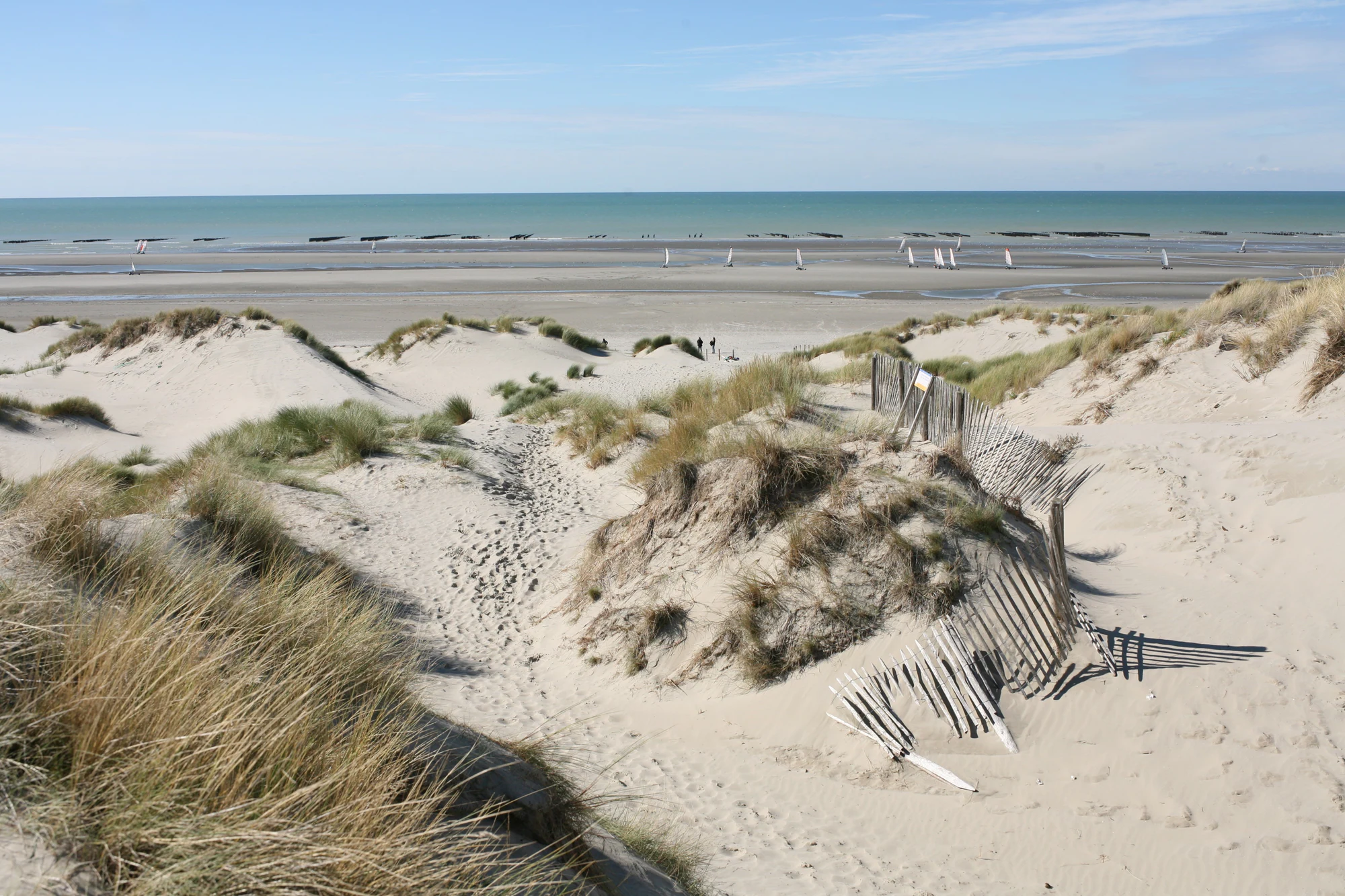
Grass-tufted sandy dunes and a wooden fence overlook a broad beach, distant land-yacht sails and the sea.

Dunes and beach on the Marquenterre coast, photographed in September 2024. This coastal view is separate from the managed birdwatching circuit.

“Aux dunes du Marquenterre” — Jeanne Menjoulet, CC BY 2.0. Source: https://www.flickr.com/photos/jmenj/54055471421/. License: https://creativecommons.org/licenses/by/2.0/. Original unchanged. · Creative Commons

Walks and routes

Parc du Marquenterre: the full birdwatching circuit

Follow the current on-site plan from the Maison du Parc around the managed 6 km circuit. Thirteen observation posts offer different views over the wetland. At the first good view, spend a few minutes learning the shape of one bird; the next hide then becomes a chance to recognise it in another setting. Ask a guide about what is actually present that day. A full circuit is a substantial outing for small children, so ask about the two signed shortcuts before committing. There is no need to reach every hide to have a worthwhile visit. Allow 3–4 hours if you want unhurried stops and time to ask questions. The route plan linked here is the operator’s published leaflet; collect the current version at reception and follow any local diversions.

The 6 km route uses compacted Marquise sand. There is an incline near the start and another before post 2; the operator requires a wheelchair user to be accompanied. Avoid the shortcut by post 9, where loose sand is difficult. Posts 1, 3, 5 and 6 have wheelchair-height viewing openings; post 13, the Héronnière, is also described as easily accessible. Ask reception to help choose a workable route.

Parc du Marquenterre: the full birdwatching circuit

An unhurried half-day at Marquenterre

Arrive near opening, with tickets and the onward journey sorted. First use the toilets, collect the map and decide whether the full circuit suits everyone. Spend the first hour settling into observation rather than walking quickly. Continue through the open hides, asking a guide one question about behaviour or habitat. Use a signed shortcut if the group is tiring. Finish with food or a drink near the Maison du Parc. Keep the rest of the day flexible instead of adding a second long walk by default.

Things to try

Learn a bird’s way of feeding

Give one observation stop a simple theme: bills. Compare the shape of an avocet’s upturned bill, a spoonbill’s flattened tip and a shelduck’s broader bill, if those species are present. Watch first, then ask a guide what the movement tells you. Children can sketch one outline rather than compete to collect names; a small notebook works even when birds are distant.

Make photography part of the visit

The operator offers photography and ornithology activities in its programme. Choose a booked session if learning technique is the main aim; ordinary admission does not imply a dedicated guide or private hide. On a normal visit, share viewing space, let others use the openings and keep equipment inside. A phone can tell the landscape story even when distant birds need more magnification.

Read the wider regional landscape

On a longer stay, balance the coast with a village or heritage stop. Look for orchard and pasture belts around plateau villages, and for the different materials and functions of rural buildings. The PNR’s heritage work also covers places such as the Saint-Esprit chapel in Rue. Choose a separately confirmed opening or guided visit, rather than assuming every historic building is freely accessible.

When the forecast turns

Light rain need not rule out birdwatching if the circuit is open and you have waterproofs, but the walk between hides remains outdoors. In sustained bad weather, shorten or postpone it. Use the PNR’s current heritage programme to choose a separately confirmed indoor visit; the Maison du Parc is a useful arrival base, not a substitute for several hours of outdoor birdwatching.

Wildlife and habitats

Eurasian spoonbill

The flattened end of the long bill is the giveaway. A feeding spoonbill sweeps it from side to side through shallow water, a lovely behaviour to watch from a hide. The park’s seasonal guide highlights March to September; ask staff where birds are being seen, rather than searching near nests.

Pied avocet

Black-and-white plumage and a thin, upturned bill make the avocet a satisfying first identification. The park’s guide highlights spring and summer, roughly March to August. Look across the water from the hides, and use binoculars to appreciate the bill without needing a closer approach.

Common shelduck

An adult shelduck combines a red bill, dark green head, white body and chestnut band. The operator lists it throughout the year. Its nesting habit is a surprise for many visitors: shelducks use underground cavities, often rabbit burrows. Enjoy any feeding birds from the circuit; leave potential nesting places undisturbed.

Stories and discoveries

The tide changes the birds’ address

The sea can influence what happens inside the birdwatching park. As rising water covers feeding grounds in the bay, birds move to resting places; during high tides, Marquenterre offers some of that refuge. Different birds use its meadows, water margins and shallow pools. Ask a guide how the tide is affecting that day’s movements, then watch from the managed circuit.

Small habitat changes matter

The national reserve protects more than open water. Wet hollows between dunes, salt meadows and dune grasslands are all important habitats. Their edges create variety across a comparatively small space. From permitted paths, notice changes in height, wetness and vegetation; those boundaries help explain why the coast supports more kinds of life than a distant view of sand and sea suggests.

When to visit

Spring

Migration overlaps with nesting and courtship. This is a good choice if you enjoy watching behaviour rather than only counting birds. Keep movements gentle around observation openings, and let guides indicate the best places to look.

Summer

Young birds and family groups bring a different rhythm. Plan around your group’s comfort as well as the wildlife: carry water, wear a sunhat and use observation stops as real rests. Shade is not continuous.

Autumn

Migrants change the cast of birds on the water and in the air. Ask what has arrived recently rather than expecting a fixed species list. A repeat visit can feel very different even when you walk the same circuit.

Winter

Waterbirds remain a reason to visit, but available opening days and daylight are more limited. Dress for waiting, not just walking, and choose a confirmed open day with enough time before last entry.

Getting there and practical advice

Admission and booking

Prices checked on 18 October 2026: adult €12; child aged 6–17 €8.60; under-6s free. Binocular rental is €5 with identification. Book ahead for a chosen date, particularly during busy periods; special outings have their own booking and price.

Opening calendar

On 18 October 2026, the operator displayed 10:00–18:00, last entry 16:00. The tourism office lists Saturday and Sunday opening, 10:00–17:00, from 2 November to 20 December 2026. Check the operator for your exact date, including holiday exceptions and weather-related changes.

Before and after the circuit

The Maison du Parc has toilets, a shop and food facilities; dry toilets are provided part-way round. Bring a filled water bottle, with refills available at the bar. Picnic in the permitted area near the Maison du Parc, not on the circuit, and take your litter away.

Arriving by road or cycle

Use Parc du Marquenterre, 25 bis chemin des Garennes, 80120 Saint-Quentin-en-Tourmont as your destination. Parking and cycle racks are available. Park your bike before entering the walking circuit. Check the homepage for temporary access notices as well as the opening hours.

A rail-based visit

SNCF names Rue and Noyelles-sur-Mer as rail gateways. Arrange the final leg and return journey before booking admission: the station is not the park entrance. A cycle transfer may suit confident riders, while others should organise a taxi. If using a bus, check the exact stop, remaining walk and return timetable rather than assuming a door-to-door link.

Plan the route, not just the entrance

Five designated parking spaces connect to the Maison du Parc by a 150 m path. Wheelchair availability should be confirmed in advance. Tell reception which surfaces, gradients, distances and viewing heights work for you; the published route details above are more useful than a general accessible label. Contact the park on +33 (0)3 22 25 68 99.

Sources and useful links

Wildlife you might spot

3

Each card links to a full Explore page with photos, traits, and fun facts.

We are still adding species preview cards for this place.

Snap map for this place

Start with the big picture, then zoom in to explore individual wildlife observations around this place.

Loading map…

Good to know before you go

Bring binoculars, or arrange a rental at reception; practise focusing before the first hide.

Use quiet voices and keep cameras and hands inside hide openings.

Choose footwear for damp sand and carry an extra layer for sitting still.

Plan a meal near the Maison du Parc rather than a picnic on the birdwatching circuit.

Check opening and last-entry times before setting out, especially in winter.

Leave room in the day for a second look at one bird instead of chasing a long list.

Frequently asked questions

Marquenterre is one managed visitor site inside the wider regional park, and forms part of the Baie de Somme national nature reserve. Its ticket, hours and walking circuit apply to that site, not to every village or landscape in the regional park.
The operator does not admit dogs, even on a lead, to the Marquenterre circuit. If you travel with an assistance dog, discuss your specific access needs with the operator before booking.
This is a birdwatching circuit. Do not plan it as a seal-viewing walk or leave it to approach animals on the bay. Any separate tidal outing needs its own suitable guided arrangements.

Recent snaps at this place

Recent snaps will appear here as new observations are added.

View all ›

Take the discovery with you

Exploring Somme Bay and Maritime Picardy Regional Nature Park?

Identify the wildlife you spot, learn as you go, and keep a collection of the adventure.

  1. 1Spot it
  2. 2Snap it
  3. 3Keep the discovery
