
Snappit logo
Snappit
Get App
Generic illustration, not a photograph of this venueIllustration
ParkKR

Suncheon Bay Wetland

The pleasure here is the change of scale.

About

The pleasure here is the change of scale. At walkway level, reed stems screen the horizon; from Yongsan, channels and plant colonies become patterns across the bay. Give the wetland its own unhurried visit. Suncheon Bay National Garden is a separate attraction inland, even though the two share standard admission arrangements. Explore the grounds like a pro—download the Snappit app to instantly identify animals and plants.

Suncheon’s conservation story includes changing the way people use the bay, not simply fencing nature off. Reed harvesting once supported local livelihoods. Later measures included relocating restaurants from the conservation area, reusing buildings as visitor facilities and restoring former hard-surfaced space to wetland. The Natural Ecology Museum opened in 2004. Suncheon Bay received Ramsar designation in 2006, and its tidal flats form part of the larger Getbol World Heritage property first inscribed in 2021 and extended in 2026. The visitor grounds covered here are only one gateway into that much wider landscape.

What to do here

Start with the Natural Ecology Museum, cross Mujingyo Bridge into the reed walkways, and decide whether to continue uphill to Yongsan. Birdwatchers can add a guided programme for help finding and identifying birds from permitted observation places.

Seasonal info

Exposed mud at low water and broader water surfaces at high water produce different views. Ask staff about the tide and current bird-observation areas for your date. For sunset, plan the return walk and transport before starting uphill.

Accessibility

The lower visitor area is the practical starting point for reduced-mobility visits. The official map flags a slope at Mujingyo where wheelchair users may need companion assistance. Yongsan is a steep mountain-path extension.

Don't miss

1

Reed walkways reached across Mujingyo Bridge

2

Yongsan’s elevated view over channels and salt-marsh vegetation

3

Winter waterbirds and the farmland–wetland relationship

4

The Natural Ecology Museum’s introduction to life in the bay

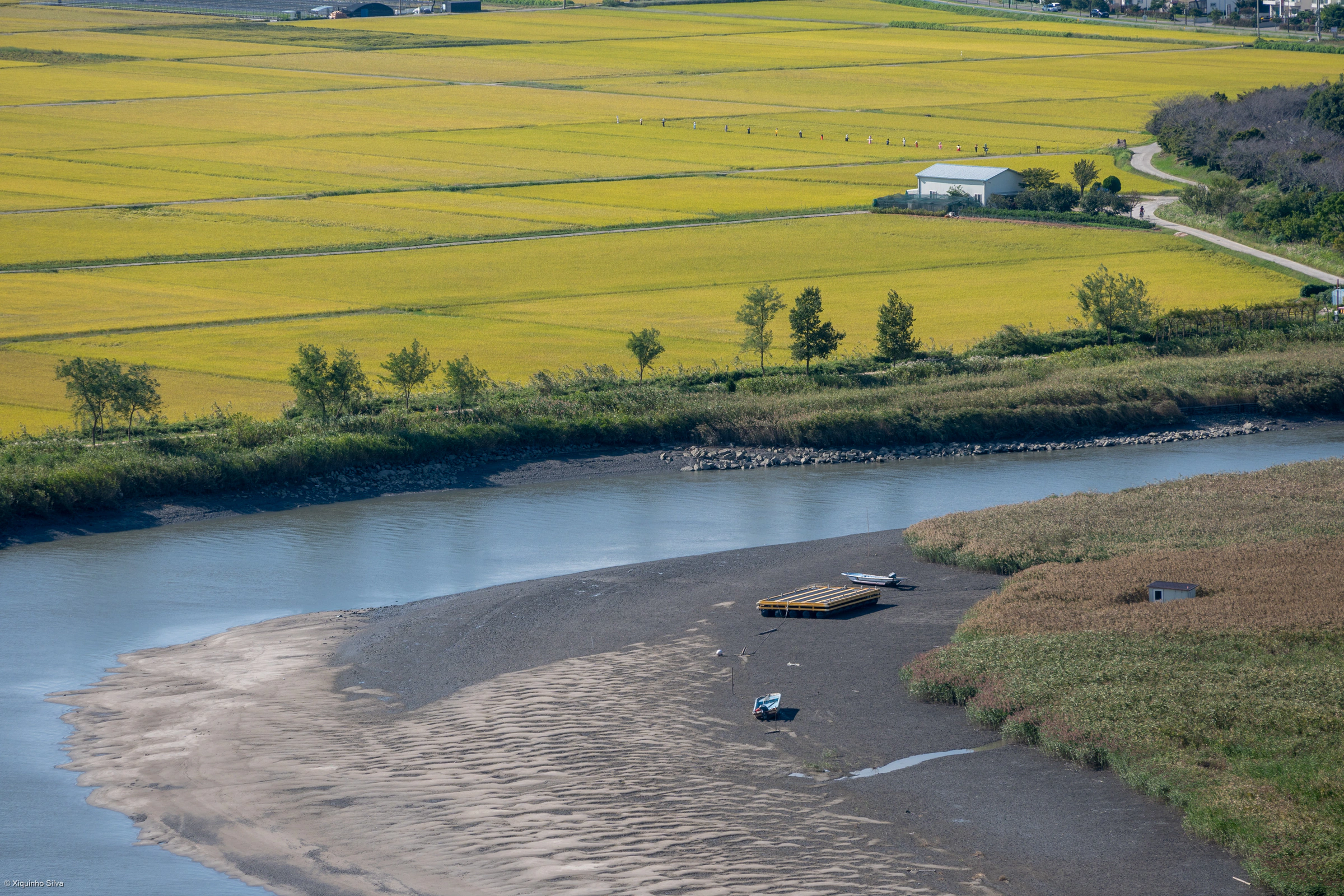
Blue tidal channel beside rippled exposed mud and reeds, with small boats and broad yellow-green agricultural fields beyond; the photographer’s copyright mark remains at bottom left.

A tidal channel, exposed mud, reeds and neighbouring fields at Suncheon Bay, photographed on 29 September 2024. This historical view does not show today’s tide or confirm boat operations. “Suncheon Bay Wetland Reserve” by Xiquinho Silva, CC BY 2.0. © Xiquinho Silva; original image unchanged.

“Suncheon Bay Wetland Reserve” by Xiquinho Silva (xiquinhosilva), Flickr, CC BY 2.0. © Xiquinho Silva. Unmodified. · Creative Commons 1 · Creative Commons 2

Walks and routes

Reeds without the hill

The operator’s shorter course links the entrance, Ramsar Path Course 1, Mujingyo, the reed walkways and the Natural Ecology Museum before the exit. Its detailed listing gives 3 km round trip and one hour of walking. Allow 90–120 minutes to enjoy the walk without hurrying; a substantial museum visit needs additional time. Use the official course page and the signs on arrival to choose the open way through.

This avoids the mountain climb, but the bridge approach is sloping. Ask staff which parts best suit your wheelchair, pushchair or walking tolerance.

Reeds without the hill

Continue to Yongsan Observatory

For the broad channel-and-reed panorama, follow the signed route beyond the reed walkways toward Yongsan and return through the wetland. The operator calls this its two-hour course, but its page gives conflicting distances: 5 km round trip in the detailed heading and 3 km one way in the tab. Treat it as the longer option rather than a precisely measured walk. The separate viewpoint page estimates about 30 minutes from the Yongsan entrance to the observatory; this does not include reaching that entrance from the ticket gate.

The official map describes a steep mountain path from Yongsan Small Park. Do not extend a wheelchair or stroller itinerary uphill on the assumption that the whole route is decking.

Continue to Yongsan Observatory

A comfortable half-day

For an unhurried half-day, visit the museum and walk through the reeds. Continue toward Yongsan only if everyone has the energy and enough daylight remains. Leave flexibility for a birdwatching stop instead of placing a fixed boat departure immediately after the climb. This is a suggested visit sequence using the published route.

Things to try

Understand the bay before walking

The Natural Ecology Museum explains local history, tidal-flat creatures and migratory birds. The operator suggests about 50 minutes. It is a useful beginning for families: knowing what lives in the mud makes the outdoor walk more rewarding. Ask about interpretation on arrival; an English-language session is not assured.

A boat trip, if the day allows

The ecological boat offers a different angle on the channels. Published options are the S-channel trip, 6 km return and about 30 minutes, and the Byeollyang Hwapo trip, 12 km return and about an hour. Adult fares are ₩7,000 and ₩12,000 respectively, separate from admission. Tickets are sold on site, with no advance reservation; bring identification and complete the boarding form. Sailings require at least four passengers and may change with conditions. The boat closes on Mondays, or the following day when Monday is a public holiday. Check the date-specific boat calendar or call 061-749-4059 before relying on a trip.

Book a guided look or a night-sky session

The official programme calendar lists bird walks, bird exploration, general nature activities and astronomy experiences. Choose a session for your date and check its meeting point, fee, age conditions and language. The astronomical observatory is a different facility from Yongsan’s landscape viewpoint. Night programmes have their own reservation and entry arrangements; an ordinary daytime ticket does not grant a general after-dark wetland walk.

Choose interpretation over a slippery climb

On a damp day when the site is operating, favour the museum and a shorter walk. Drop the exposed route in heavy rain, strong wind or thunder. Boat sailings are weather-dependent too, and building availability should be checked separately.

Wildlife and habitats

Hooded cranes: the winter headline

Hooded cranes are the bird most closely associated with this visit. The city documented them at Suncheon Bay in February 2025, and its tourism information describes winter arrivals. Ask a guide where visitors may watch on the day. Feeding fields and resting sites need space: do not chase birds, play calls, bait them or try to trigger a flight for a photograph. A distant flock can be a much better encounter than a close, disturbed one.

Common Shelduck

The operator lists Common Shelduck among Suncheon Bay’s waterbirds; the 2006 Ramsar inventory records Tadorna tadorna in earlier surveys. Scan permitted views of open water and exposed feeding areas with binoculars. These are bay-wide records, not sightings beside a particular boardwalk today.

Dunlin

Dunlin appears in the operator’s bird information and historical surveys as Calidris alpina. Small shorebirds may be far out on the mud, so a scope or guided session is useful. Tide and season affect what is visible from the paths.

Whooper Swan and Eurasian Spoonbill

The city names Whooper Swan and Eurasian Spoonbill among winter visitors; both also appear in the historical Ramsar inventory. Treat them as possibilities rather than a checklist. Eurasian Spoonbill and Black-faced Spoonbill are different birds, so ask for identification help if uncertain.

Reeds, salt marsh and smaller life

Freshwater from Dongcheon and Isacheon meets the bay in the reed-growing zone. Beyond it, salt-marsh vegetation includes reddish patches locally called chil-myeon-cho. At exposed mud, watch for small animals that support the food web. Observe from the walkway and leave organisms where they are; a distant photograph may not support a firm identification.

Stories and discoveries

A view rebuilt in 2025

Yongsan’s current wooden observatory was completed on 11 July 2025. It replaces an older platform removed after a safety inspection. Older travel accounts and photographs may therefore show a different structure. The new building does not remove the steep approach or make present-day access automatic.

Why the reed colonies look rounded

Reeds spread through underground growth as well as seeds. The operator explains that expanding colonies and the accumulating sediment around them help produce the rounded patches visible from above. At ground level, the tall stems can hide the walkways; from the hill, you can appreciate how water and vegetation fit together.

Farmland belongs in the picture

The bay’s ecology includes the adjacent fields as well as the tidal flats. Suncheon has supported conservation-minded farming and removed utility poles to reduce crane collision risks. In winter, feeding areas and quiet resting places work together. Watch from permitted viewing points rather than walking into fields for a closer photograph.

When to visit

Spring and summer

For a greener wetland walk, consider spring or summer. In hot weather, choose a cooler part of the opening day and carry sun protection. Shorten the exposed walk if heat or approaching thunderstorms make it uncomfortable; the winter crane gatherings belong to a different season.

Autumn and winter

Autumn suits reed photography; winter shifts attention toward waterbirds. Dress for wind and allow time for stationary watching. On busy days, leave room in your schedule to linger. Check notices for events and conservation-related restrictions.

Getting there and practical advice

Tickets and opening times

Checked 18 October 2026: standard individual admission is ₩10,000 for adults aged 19–64, ₩7,000 for ages 13–18 and ₩5,000 for ages 7–12. Discounts and free-entry categories require the relevant proof. The standard ticket covers both venues on the same day; present it at the other entrance. The garden’s discounted night ticket excludes wetland entry. One re-entry is allowed with an exit stamp.

Entry starts at 08:00. Last admission is 17:00 in November–February, 18:00 in March–April and September–October, and 19:00 in May–August; viewing ends one hour later. The grounds normally close on the last Monday of each month. Check current hours and notices for exceptions or weather changes.

Rest stops and things to leave behind

The operator lists a rest area and toilets near the visitor facilities; use the facilities before the longer outing. It specifically notes that there are no drink or snack sales at Yongsan Observatory. General rules prohibit brought-in food, smoking and drinking alcohol. Ask staff about permitted drinks, essential dietary items and designated refreshment areas rather than planning a picnic in the reeds. Wheelchairs and pushchairs are listed for loan near the ticket office, subject to availability and the operator’s conditions.

Arrive at the wetland gateway

Use 513-25 Suncheonman-gil, Suncheon-si, and the destination 순천만습지 for navigation or a taxi. The operator lists city bus 66 from Suncheon Station and the intercity/express bus terminal to the wetland. Check the current stop, direction and return departures on your travel day; the website’s service-span summaries are not consistent enough to use as a precise timetable. Parking is shown on the official visitor map; verify the current vehicle charge before arrival.

If you are connecting from the National Garden

SkyCube links Garden Station with Suncheonman Station in about 10 minutes. Its users can take the free reed train onward to Mujingyo, about seven minutes; that train is not sold separately. Standard adult/teen SkyCube fares are ₩8,000 return or ₩6,000 one way, in addition to admission.

The service normally closes on Mondays, moving to the next weekday if Monday is a public holiday. The last reed train from Mujingyo is 18:20 in March–October or 17:20 in November–February, ten minutes before the last SkyCube departure from Suncheonman Station. Check the operator’s calendar and booking guidance before relying on the connection, especially for sunset; queues and walking time still matter.

Plan around the bridge, not just the hill

Beyond Mujingyo, the map describes level ground before the Yongsan mountain section. Confirm current surfaces, loan availability, accessible toilets and powered-mobility-aid arrangements before travel. Ask staff to help choose a comfortable lower-level turnaround; the map is useful planning information rather than a full accessibility audit.

Sources and useful links

Wildlife you might spot

4

Each card links to a full Explore page with photos, traits, and fun facts.

We are still adding species preview cards for this place.

Snap map for this place

Start with the big picture, then zoom in to explore individual wildlife observations around this place.

Loading map…

Good to know before you go

Bring binoculars if birds are a priority. Let distance be part of the experience; never approach a flock to make it move.

Wear shoes with grip. Wet decking and the steeper Yongsan path call for more care than a city promenade.

Keep a windproof layer handy in cool weather and sun protection in summer; the open wetland offers little shelter.

Check the last admission, the grounds’ monthly closure and each transport service’s separate operating day.

Keep your admission ticket if visiting the National Garden too, and ask at the exit about the stamp needed for re-entry.

Use the marked visitor paths. The exposed mud is habitat, not an invitation to make your own shortcut.

Frequently asked questions

No. This is the coastal wetland visitor site; the National Garden is a separate landscaped garden inland. Standard tickets cover both, but the garden’s discounted night ticket excludes wetland entry. Allow time for the transfer.
Ordinary gate admission is published without a general walking reservation requirement. Guided ecology and bird programmes and nighttime astronomy use a separate booking calendar; check your chosen activity before travel.
Plan around winter for hooded cranes. They are migratory visitors, and a summer reed walk offers a different experience. Even in winter, they choose their own feeding and resting places.
The operator warns that the walking trail has no lighting. Allow daylight for the descent and remaining walk, follow staff instructions and check your return transport in advance.
The published wetland rules prohibit pets, bicycles and drones, as well as recreational powered riding equipment. If you use a mobility aid or have an assistance-animal access question, confirm the applicable arrangements directly with the operator.

Recent snaps at this place

Recent snaps will appear here as new observations are added.

View all ›

Take the discovery with you

Exploring Suncheon Bay Wetland?

Identify the wildlife you spot, learn as you go, and keep a collection of the adventure.

  1. 1Spot it
  2. 2Snap it
  3. 3Keep the discovery
