Snappit logo
Snappit
Get App
Generic illustration, not a photograph of this venueIllustration
ParkKR

Wando Arboretum

Wando Arboretum gives a coastal trip a different rhythm.

About

Wando Arboretum gives a coastal trip a different rhythm. The attraction is the meeting of a living warm-temperate forest and a managed botanical collection: woodland outside, plants from warmer climates under glass, and a museum that connects the forest with local life. You can enjoy that contrast without climbing a mountain.

Start by deciding how much walking your group wants, rather than aiming to cover the whole property. A museum-and-greenhouse visit suits a shorter stop; adding the waterside and forest sections makes the landscape the main event. Leave time to read labels and sit down. An arboretum is more rewarding when the plants are the reason for the walk, rather than scenery you hurry past. Planning to visit? Download the Snappit app to identify the wildlife you spot in real-time.

Opened in 1991, Wando Arboretum combines plant conservation, research and public visits. Its warm-temperate forest is part of the reason it is here, rather than a backdrop added to a display garden. Research continues alongside tourism: an official 2026 notice describes work on conserving forest plants vulnerable to climate change.

What to do here

Choose one of the existing signed garden courses, visit the subtropical greenhouse, and use the forest museum to put the outdoor landscape in context. Ask the entrance staff which sections are available before committing to a longer walk.

Seasonal info

Evergreen woodland gives Wando a green backdrop outside the usual leaf season. Come for the southern forest character rather than expecting every slope to turn red in autumn. Wet boards, summer heat and winter frost can all change which walk feels comfortable.

Accessibility

The operator identifies two short options for wheelchair and stroller users. Use those as a starting point for planning, then confirm today’s surfaces, slopes and building access. They do not establish a step-free route through the entire arboretum.

Don't miss

1

Broadleaf evergreen forest beside cultivated plant collections

2

Waterside scenery and a choice of garden-walk lengths

3

A subtropical greenhouse and a museum devoted to warm-temperate forest

4

Early spring flowers with a local Wando connection

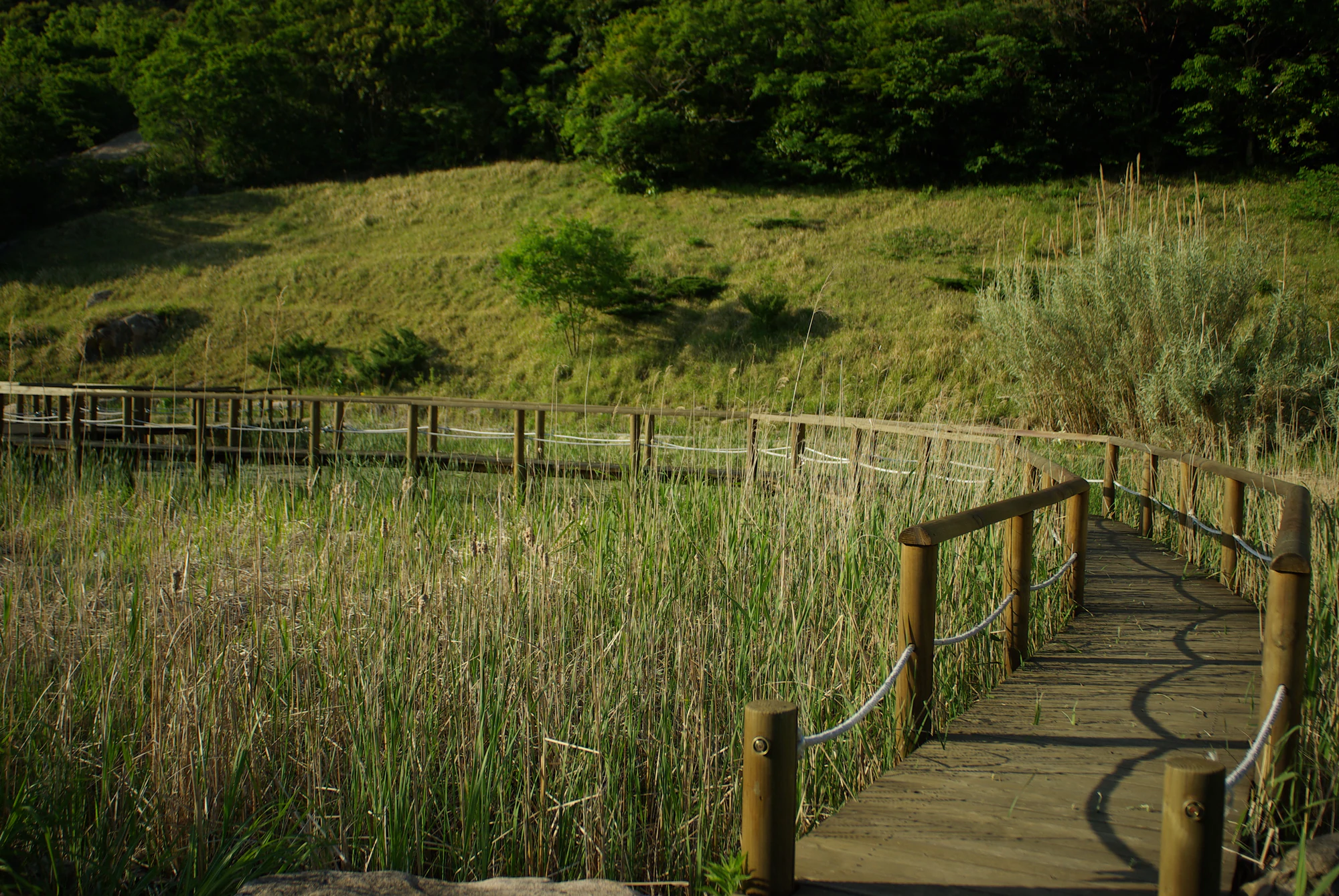
A wooden boardwalk with rope rails curves through tall grassy vegetation below a sunlit slope and dark green woodland.

A boardwalk at Wando Arboretum, photographed on 11 May 2008. This historical view does not establish today’s route or access conditions. Photo: “SG104221” by egg (Hong, Yun Seon), Flickr source, CC BY 2.0. Unchanged original; no crop or retouching.

“SG104221” by egg (Hong, Yun Seon), CC BY 2.0. · Creative Commons 1 · Creative Commons 2

Walks and routes

Course 1: gardens, greenhouse and museum

The operator’s one-hour course follows the central observation way toward the greenhouse, then continues via Hakrim Bridge to the forest museum and local craft garden. Choose it when indoor collections are your priority. Add time for exhibits rather than treating one hour as a deadline.


Course 1: gardens, greenhouse and museum

Course 2: waterside and forest

The 90-minute course adds the Four Seasons Garden, waterside deck, waterside rest area and warm-temperate forest trail before the museum and greenhouse. This is a useful first choice when you want more outdoor walking. Check that the forest section and return connections are open.

Course 2: waterside and forest

Course 3: a longer garden circuit

The two-hour option extends the waterside-and-forest visit through Sagunjawon, the second canopy deck and rock garden. Choose it only with enough daylight and energy for the return. Follow the current official course guide and on-site signs; this summary is not turn-by-turn navigation.

Course 3: a longer garden circuit

A relaxed first visit

Arrive with the main walk still ahead of you, check the map and pick one course. Use the first stretch to judge the pace of the group. If the weather holds and everyone is comfortable, keep the outdoor section; if not, shorten it and give the exhibits more time. Take a seated break before the return rather than waiting until the youngest or oldest walker is worn out. Leave a buffer for reaching your car or meeting a taxi.

Things to try

Join a forest interpretation session

For a more focused introduction, enquire about the roughly one-hour forest programmes. The operator lists March–December sessions for groups of 5–15, with booking at least a week ahead by telephone and application form. The programme itself is free; admission and parking are separate. Call 061-550-3545 to confirm dates, group suitability and language support before making plans.

Make the museum part of the walk

The forest museum brings together natural-history specimens, warm-temperate forest interpretation and local woodcraft. Visit before heading out if you like having context, or save it for later if everyone needs an indoor pause. Decide on one or two themes to follow rather than trying to absorb every label.

A shorter visit when showers arrive

If the buildings are open, make the museum and greenhouse your priorities and reduce outdoor walking. You still need to move between them, so this is not a fully sheltered itinerary. Wet decking is a reason to slow down or turn back; severe-weather restrictions take priority over any suggested plan.

Wildlife and habitats

Camellia

Camellias are part of the native flora, and there is also a specialist display garden. Ask where the labelled examples are easiest to see. A plant beside a visitor path may be planted even when the same kind grows naturally in the surrounding forest.

Bird of paradise

Look for this labelled greenhouse plant, whose scientific name is Strelitzia reginae. It belongs to the cultivated collection here. Seeing it under glass tells you about the arboretum’s collection, not what grows wild on Wando; flowers and display positions can change.

Wando’s tassel-like spring flowers

In March, ask about Stachyurus praecox, locally called Wando-sulkkotnamu. Plants outside the greenhouse were raised from seed collected on a Wando island and were flowering with pale-yellow hanging blooms in March 2025. Ask staff about this year’s flowering and display location; the delicate flower clusters make a distinctive seasonal stop.

Stories and discoveries

The green forest is the main collection too

Wando’s outdoor forest is central to its identity. Native warm-temperate trees include bulgasi oak and hwangchil. Look for labelled examples or ask a guide to point them out along a currently open path. Keep the leaves and branches intact so the next visitors can enjoy the same trees.

Conservation happens behind the scenes

The arboretum collects, propagates and conserves plants as well as displaying them. That helps explain why some working areas are not part of the visit. Respect barriers around nursery, research and collection-management spaces even when a path seems to continue beyond them.

When to visit

Spring: leave room for a flowering stop

Choose a flexible morning visit if early flowers are your priority. Ask what is in bloom that week and build the walk around that answer. A dated bloom photograph can help you decide what interests you, but weather shifts the season from year to year.

Summer: keep the walking commitment modest

Carry water, use shade and take breaks before heat becomes uncomfortable. Do not mistake a greenhouse for an air-conditioned refuge. If thunderstorms, heavy rain or strong wind are forecast, postpone the forest section instead of trying to complete a planned circuit.

Autumn and winter: enjoy the evergreen character

Cooler days suit an unhurried forest visit, with the evergreen backdrop still present. Keep a warm layer handy for rests. In winter, start early enough to finish comfortably in daylight, and ask about frost or ice on shaded paths before choosing the longer option.

Getting there and practical advice

Hours, admission and closing days

Published hours are 09:00–18:00 from March through October and 09:00–17:00 from November through February; ticket sales end one hour earlier. Individual admission is ₩2,000 for adults aged 19–64, ₩1,500 for teenagers aged 13–18 and ₩1,000 for children aged 7–12. Bring proof for any concession. The first Monday of each month is normally closed, with a shifted closure when it coincides with specified public holidays. Confirm the holiday calendar and any works-related restrictions at 061-552-1544.

Rest stops and food

The facilities listing includes toilets, a visitor information point, waterside seating and a shop selling snacks and local products. Bring the essentials rather than depending on a particular shop being open. A packed lunch is useful for a slow visit; carry out your rubbish and keep food away from the collections.

Arriving by car

Set your destination to Wando Arboretum, 156 Chopyeong 1-gil, Gunoe-myeon, Wando-gun. The free entrance car park is about 300 m from the main gate, so include that walk in your plans. Operator-listed paid parking is ₩1,500 for light cars, ₩3,000 for small vehicles and ₩5,000 for large vehicles. Confirm the right parking or drop-off arrangement if walking that approach is difficult.

Using public transport

Bus approaches described by the operator run from Gwangju or Mokpo through Gangjin or Haenam toward Wando’s Wondong area. Plan the final connection to the gate separately. Before buying tickets, check where your service stops, how you will reach the arboretum and how you will return. Avoid assuming a bus to Wando town stops at the entrance, or that taxis will be waiting when you leave.

Shorter options for wheels and limited stamina

The operator recommends the exhibition hall–central observation way–greenhouse route and a second option from Yukrim Bridge through the exotic-plant garden to the museum for wheelchair and stroller users. Ask staff which is currently usable. Check the steepest gradient, any step or kerb, toilet access and the return path before starting. A companion may still find pushing tiring, and the longer forest courses should not be assumed equivalent.

Sources and useful links

Wildlife you might spot

2

Each card links to a full Explore page with photos, traits, and fun facts.

Snap map for this place

Start with the big picture, then zoom in to explore individual wildlife observations around this place.

Loading map…

Good to know before you go

Save a photograph of the entrance map and mark the route back before setting off.

Wear shoes with grip; choose a shorter outing when decking or paths are wet.

Carry water and a snack, especially if someone in your group needs regular breaks.

Keep children close beside water and leave room for others when stopping for photographs.

Check the return journey before entering if you are relying on buses or a taxi.

Frequently asked questions

No. Keep a first visit within the managed visitor grounds and signed garden walks. The surrounding mountain routes require their own planning, current access advice and equipment; they are not a necessary extension to this visit.
The national conversion is a development project with an announced 2026–2030 construction programme. Do not plan around a new monorail, treetop route or other proposed facilities. Ask which existing areas are available during the work.
Simple packed lunches and drinks are allowed; cooking and smoking are prohibited. Pets are not admitted under the published visitor rules. If you use an assistance dog, confirm the applicable arrangements directly before travelling.
No. The operator prohibits water play and swimming, and asks visitors not to catch fish or freshwater snails. Enjoy the water from the paths and leave plants, seeds and other natural material in place.

Recent snaps at this place

Recent snaps will appear here as new observations are added.

View all ›

Take the discovery with you

Exploring Wando Arboretum?

Identify the wildlife you spot, learn as you go, and keep a collection of the adventure.

  1. 1Spot it
  2. 2Snap it
  3. 3Keep the discovery