
Snappit logo
Snappit
Get App
Generic illustration, not a photograph of this venueIllustration
ParkKR

World Cup Park

For a first visit, enjoy Pyeonghwa Park, then add Haneul if the weather and your legs are willing.

About

For a first visit, enjoy Pyeonghwa Park, then add Haneul if the weather and your legs are willing. Above, open grassland meets a skyline of dense city buildings: an arresting view from land built over Seoul’s former waste. Eager to name that creature? Identify any animal you find during your visit using the Snappit app.

Nanjido received Seoul’s waste from 1978 to 1993. After stabilization work, World Cup Park opened in May 2002 alongside the city’s World Cup preparations. The hills are part of that history: this is a landscape made by covering and managing a landfill, not a natural mountain range. [The city’s heritage account](https://futureheritage.seoul.go.kr/futureHeritageMeet/futureHeritage/view.do?htNo=325) gives the historical background.

What to do here

Walk around Nanji Pond in Pyeonghwa, explore a stretch of Nanjicheon, or choose Haneul for grassland and viewpoints. Treat Noeul as another substantial outing rather than a quick final stop.

Seasonal info

Spring and summer favour shorter walks with shade breaks; autumn invites longer pauses at the grassland. In winter, let wind and ice decide how far you go. Flower displays and grass cutting vary, so old photographs are not a bloom calendar.

Accessibility

Pyeonghwa is the sensible first choice for visitors avoiding a hill climb. Haneul involves steps or an uphill alternative; the electric shuttle can reduce walking, but confirm boarding arrangements for your particular mobility aid before relying on it.

Don't miss

1

Nanji Pond and Pyeonghwa’s gardens

2

Haneul’s autumn grassland and skyline views

3

The landfill-restoration story beneath the greenery

4

A longer woodland walk toward Noeul

Walks and routes

A gentle start: Pyeonghwa and Nanji Pond

From the stadium side, make the pond your anchor. Follow its public edge paths, pause at the gardens and plazas, then decide whether to continue. This is a good place to slow down with children, watch reflections change and take a proper rest before any climb. Allow 60–90 minutes with breaks, shortening the walk whenever you like.

Choose broad lower-level paths and turn back before a surface or slope becomes awkward. If step-free access is essential, ask the park to confirm a suitable entrance, path and toilet for your visit.
A gentle start: Pyeonghwa and Nanji Pond

Optional climb: Haneul’s grassland

After the lower park, head toward the signed Haneul access area. Choose the eastern stairs if sustained steps suit you, the hill road if you prefer a longer ascent, or the shuttle from Nanjicheon. Once above, choose a manageable stretch of grassland path and a viewpoint, then return by your planned descent. Allow about 2–3 hours for this add-on with access, photographs and rests; queues can add more. The current Haneul visitor page puts the walk from World Cup Stadium Station Exit 1 to Haneul at 1.9 km; that is an approach distance, not a summit circuit.

The stairs are unsuitable for wheeled access. The uphill road also takes effort, especially when pushing a chair or stroller; check gradients and the shuttle option first.

Optional climb: Haneul’s grassland

A different mood: the metasequoia corridor

The wooded route below the hills offers an alternative to more summit walking. The city announced a 1.0 km Noeul extension in May 2026, making the combined metasequoia corridor 2.3 km. That is the corridor length, not a round trip from the subway. Walk a section and retrace it if you want a simple return. The southern Z-shaped stairs, completed in November 2025, provide another connection to Haneul’s top; they are an optional climb, not part of a level woodland stroll. See the city’s corridor and staircase update before choosing the connection.

The city describes decked entrances and benches. For wheeled access, confirm the surfaces and gradients of your chosen section before setting off.

A different mood: the metasequoia corridor

One comfortable half-day

Start at Pyeonghwa, then choose Haneul in comfortable weather or an indoor visit and a little of Nanjicheon on a lower-energy day. Leave room for an unhurried return to the station. A good pond walk can be the whole outing; you do not need to collect all four parks.

Things to try

Give Noeul its own afternoon

Choose Noeul for open lawns, sculpture and a late-day outlook. Select a viewpoint and a short wander, leaving enough time for the descent. Camping and park golf have separate booking arrangements. If either is your priority, settle the reservation first and build the day around it. With young children or tired legs, give Noeul its own outing rather than combining both hilltops.

Explore the stream side at Nanjicheon

Nanjicheon offers a different scale from the hilltops: a restored stream landscape rather than a panorama. Choose a short public-path section and look along the water from the path edge. This is a good companion to Pyeonghwa if a summit would make the day too tiring. Stay out of the channel and leave bank vegetation undisturbed. On wet days, turn around well before water or mud makes the route uncertain.

Seoul Energy Dream Center

In Pyeonghwa, the Energy Dream Center offers an indoor change of pace. Current viewing hours are Tuesday–Sunday, 09:30–17:30, with last entry thirty minutes before closing; Monday and specified holiday closures apply. Independent viewing uses on-site reception, while guided visits and education normally need advance booking. Some programmes may charge for materials. Check the center’s visitor information before counting on it as a rain plan. On a day when it is closed, keep the outing short if the weather is deteriorating.

Wildlife and habitats

Miscanthus (silver grasses)

Haneul’s silver grasses have a documented planting history, with several grasses sharing the landscape. Autumn plumes are especially rewarding in low, slanting light. Find a position on the path where the sun lights them from behind, and let the breeze change the picture. Keep out of the planted stands even when a gap looks tempting.

Black locust

The 2021 slope survey recorded naturally established black locust. This fast-growing tree tolerates poor, dry ground, helping explain its success here. It also shows why managers consider which plants are spreading, as well as how green a slope looks. View the woodland from public paths and leave research plots undisturbed.

Eurasian kestrel

Seoul’s monitoring summary, based on 2019 results, records this small bird of prey within World Cup Park. A sighting is a bonus, so enjoy the landscape even if none appears. Keep your distance from birds and suspected nests; binoculars are more useful than a closer approach.

Other lives in the restored landscape

The same municipal summary records narrow-mouthed toads and other wildlife. Respecting night restrictions leaves these animals time without visitors. Keep observation to public paths, avoid playback and leave stones, plants and waterside cover undisturbed.

Stories and discoveries

The engineering is part of the ecology

Restoration addressed four linked problems: landfill gas, polluted drainage water, the cover over the waste and the stability of the slopes. Gas collection and leachate treatment work below and beside the walking landscape; the cover creates a growing surface while limiting water infiltration and gas escape. Seeing green grass does not mean the buried material disappeared. This is a useful place to think about the long afterlife of everyday rubbish, and why paths and protected slopes matter.

Restoration keeps changing

The wooded slopes and open summit show two different sides of recovery. Trees such as black locust have spread naturally on the hillsides, while managed grasses help keep Haneul’s familiar open character. Plants compete, storms alter the woodland and gardeners make choices about what to retain. Restoration continues through all of these changes. As you move from a planted bed to a tree-lined path, look at how much of the sky remains visible: the park’s habitats are a patchwork, with different conditions for the life within them.

When to visit

Autumn 2026: grassland and festival

The 25th Seoul Silver Grass Festival is scheduled for October 17–23, 2026, 10:00–21:00, at Haneul. Admission is listed as free. The programme includes evening lighting, performances and hands-on activities; some activities use their own booking or on-site registration. For a quiet grassland walk, choose a different time from the evening programme. For the festival atmosphere, allow extra time for crowded approaches and agree on a meeting place. Check the official festival notice and programme details before leaving. These dates describe the event, not a guarantee of peak flowers.

Heat, rain and wind

On a hot day, make the lower park or a short shaded corridor your main outing and save the exposed top for another visit. In heavy rain, lightning or strong wind, postpone the hill climb and obey closures. Rain can make steps and wooden surfaces slippery; an umbrella is a poor reason to continue into gusts. In unsettled weather, call the shuttle operator before leaving; park opening alone does not tell you whether vehicles are running.

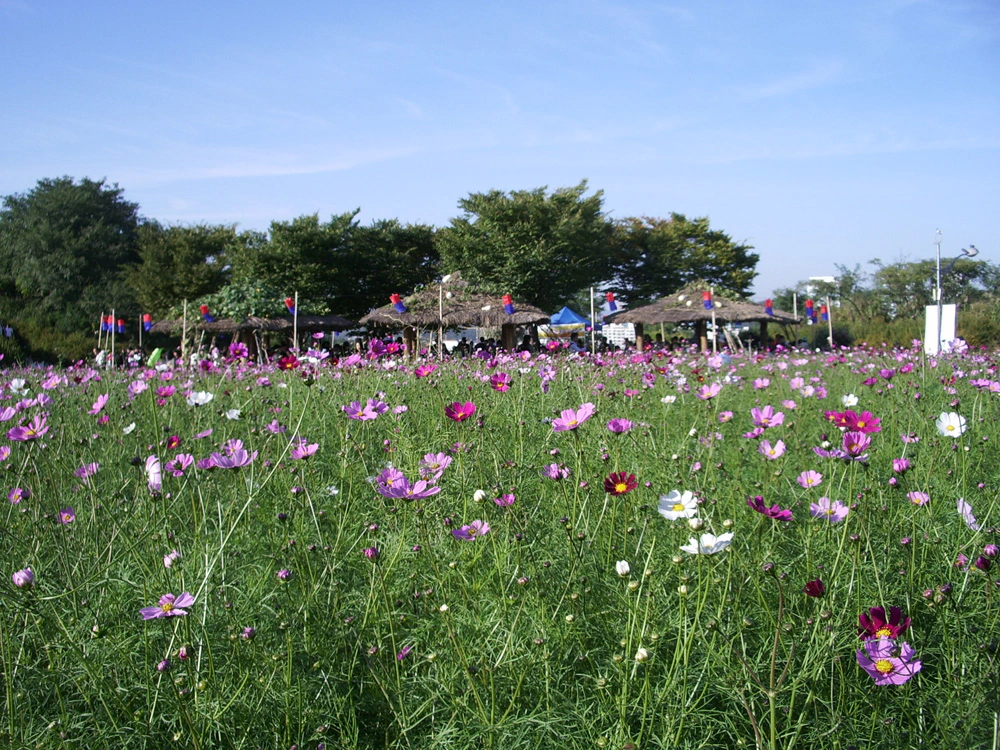
Pink and white cosmos fill the foreground at Haneul Park, with distant visitors, thatched shelters, trees and blue sky.

Cosmos planting at Haneul Park, photographed on October 11, 2008. This historical scene does not show current planting or bloom conditions. Photo: Scarlet Sappho / Flickr, CC BY-SA 2.0. Unmodified original.

Photo: Scarlet Sappho / Flickr, CC BY-SA 2.0 · Creative Commons 1 · Creative Commons 2

Getting there and practical advice

Hours and small practicalities

The operator’s posted access schedule is 06:00–21:00 in October–March and 06:00–22:00 in April–September. The brochure specifically identifies Haneul and Noeul as night-controlled areas. Follow current gate signs. Toilets and rest points are marked on the map; use a convenient one before ascending. Carry essentials rather than depending on a particular shop being open. Park enquiries: 02-300-5500. Check current park information for facilities, local rules and changes.

Learn the Nanjido story indoors

The Nanjido Story Museum is in the Western Parks Leisure Center at 243-60 World Cup-ro. Posted hours are Tuesday–Sunday, 10:00–17:00, with free entry. Its landfill-history displays make a useful introduction to the landforms outside. Check temporary and holiday closures.

Arriving by subway

Use Line 6 to World Cup Stadium Station. Exit 1 is the standard walking reference; visitors needing an elevator should check the accessible station exit before setting off. The park brochure allows about ten minutes to the complex, while the 2026 festival notice allows roughly forty minutes on foot to Haneul from World Cup Stadium or Mapo-gu Office stations. These timings have different destinations. Keep the park map ready and navigate to your chosen park or shuttle stop, not simply to the stadium.

Electric shuttle: check the return first

The published Haneul service runs 08:00–20:00 in March–September, 09:00–19:00 in October–November and 10:00–18:00 in December–February. The last uphill departure is thirty minutes before service ends. General fares are KRW 2,000 one way or KRW 3,000 return. Ask about current queues, the last downhill departure and any weather suspension. Operator contact: 010-6702-5460. The official operating table is the planning reference; event hours do not extend shuttle service by implication.

If you drive

Choose parking for the part you intend to visit: Pyeonghwa for the lower park, or the signed Nanjicheon area for the Haneul shuttle. Save the car-park name before walking away. Festival traffic is specifically warned about by the city; public transport is the safer planning choice. Parking is separate from any shuttle fare, and event arrangements can change the usual payment pattern.

A plan that can shrink comfortably

Begin with Pyeonghwa if stamina or balance is a concern. Visit Seoul lists accessible toilets at Haneul; check their location along with the approach you plan to use. Ask the shuttle operator about boarding, whether a chair or stroller must fold, and whether you can remain seated in it. Agree on a meeting point before anyone takes a different approach.

Sources and useful links

Wildlife you might spot

3

Each card links to a full Explore page with photos, traits, and fun facts.

We are still adding species preview cards for this place.

Snap map for this place

Start with the big picture, then zoom in to explore individual wildlife observations around this place.

Loading map…

Good to know before you go

Choose your turnaround point before adding another park. The journey back to the station is part of the outing.

Carry water, a sun hat and a wind-resistant layer for Haneul; a pleasant temperature at the bottom can feel different on an exposed hill.

Keep to public paths. Planted beds, stream margins and restoration slopes are habitat, not shortcuts.

Use the current park map alongside on-site signs; older maps may omit the newer southern staircase and woodland connections.

Bring binoculars if wildlife matters to you. Observe quietly from paths and do not feed, catch or handle animals.

For photographs, stay on paths and leave room for others to pass. Professional or organized filming requires separate park permission; check current filming notices.

Frequently asked questions

Haneul is one part of the complex. The other three managed parks are Pyeonghwa, Noeul and Nanjicheon. Decide which part you mean when arranging a meeting; “World Cup Park” alone is too broad.
No. There is an uphill road approach and a paid electric shuttle as well as stair approaches. Avoiding stairs still leaves a hill, and shuttle availability or boarding suitability should be checked before you commit.
Do not assume the festival and shuttle finish together. Check the last downhill departure at the ticket office before going up; if you need the shuttle, make that departure your firm deadline.
For a simple break, use a designated picnic area and follow its current signs. Camping is a separate reserved activity at Noeul, with its own rules; a day visit is not permission to pitch a tent anywhere.

Recent snaps at this place

Recent snaps will appear here as new observations are added.

View all ›

Take the discovery with you

Exploring World Cup Park?

Identify the wildlife you spot, learn as you go, and keep a collection of the adventure.

  1. 1Spot it
  2. 2Snap it
  3. 3Keep the discovery
