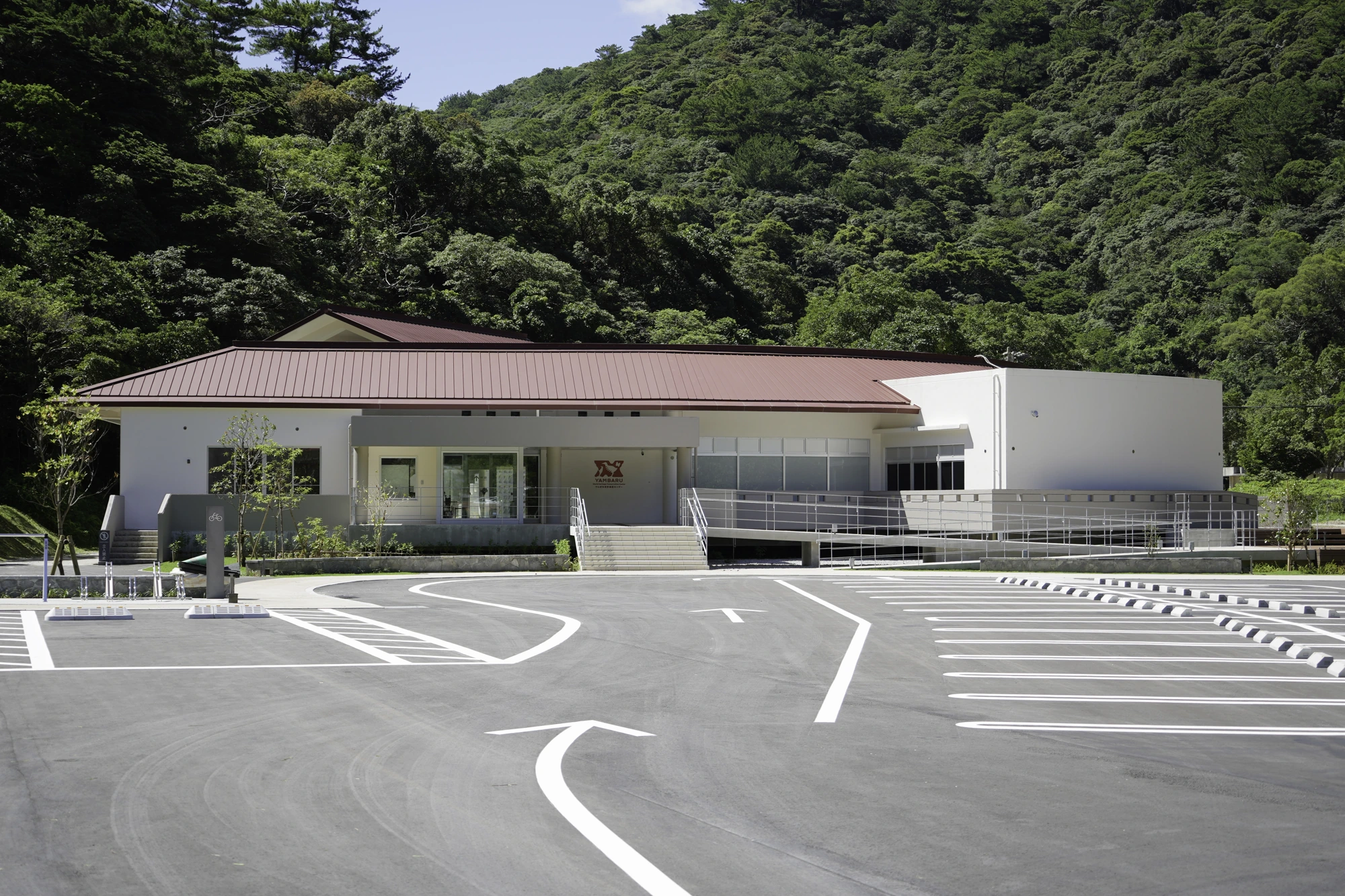
Yambaru rewards slowing down. In the north of Okinawa Island, broad-leaved evergreen forest fills the hills, and a short walk can reveal very different shapes of green: spreading fern fronds, glossy leaves and a shaded forest floor. For a manageable first visit, start at Ufugi Nature Museum in Hiji, then travel separately to Kunigami Village Forest Park. Keep the walking part modest and leave time to stop and listen.
Ufugi reopened on 16 July 2026 as the Yambaru World Heritage Conservation Center. Older maps may still call it the Yambaru Wildlife Conservation Center; the familiar Ufugi name and Hiji address have stayed. Its renewed displays make a useful introduction to a landscape where many species have a very limited range. A four-screen forest film and woodland dioramas let you look closely before you head outside. The museum does not display live Okinawa rails or other living animals, and it has no outdoor visitor trail.
The forest park is a separate hilltop destination with maintained walking paths. Ask the office about the lake-and-forest circuit shown as approximately 1.1 kilometres on the village walking map. It gives a small group a sensible starting point among trees and beside the water, with the option to shorten the outing. The paths include changes of level, steps and surfaces that can become slippery. Choose your route with staff rather than assuming that a short distance means an easy, level walk.
Look at the forest as a whole before looking for its rare inhabitants. Itajii trees help form the evergreen canopy, while tree ferns bring a very different outline to the vegetation. Oaks and camellias add further variety. Try a quiet pause without conversation, then notice which sounds seem close and which come from farther into the trees. Wildlife sightings are a matter of chance; the museum is the dependable place to learn about the animals you may never see outdoors.
This is also a good place to understand why enjoying nature and protecting it need to happen together. Road traffic, invasive animals and illegal collecting all put pressure on Yambaru’s wildlife. An unhurried drive, keeping food to yourself and leaving plants and fallen branches in place are useful contributions. Keep rare-species locations out of public posts. The larger national park reaches beyond this outing into other forests, coasts and mangroves; save those journeys for another day rather than trying to cover the whole north in one rush. Eager to name that creature? Identify any animal you find during your visit using the Snappit app.
Yambaru National Park was designated on 15 September 2016. Parts of northern Okinawa Island joined Amami-Oshima, Tokunoshima and Iriomote Island in a single UNESCO World Natural Heritage property in 2021. Ufugi began as a wildlife conservation center in April 1999, gained its locally chosen nickname in 2010, and reopened as a World Heritage center in July 2026. “Ufugi” means a large tree in Okinawan speech. The national park, the World Heritage property and the surrounding visitor facilities have different boundaries.