
Snappit logo
Snappit
Get App
Generic illustration, not a photograph of this venueIllustration
ParkKR

Apsan Park

Start with the kind of outing you want.

About

Start with the kind of outing you want. Keungol is the practical choice for the main park approach, war-history sights and cable-car access. Anjiranggol suits walkers heading uphill toward Apsan Observatory. Gosangol offers a different family outing, with a dawn-redwood avenue, dinosaur displays and forest paths. These are entrances to one varied park landscape, rather than interchangeable names for the same starting point.

The reward of going higher is seeing how Daegu sits among its surrounding mountains. But the foothill woodland is a worthwhile destination in its own right: you can choose a short out-and-back, pause beneath the trees and leave the summit for another day. Apsan Observatory, the cable-car viewpoints and Apsan’s summit are separate stops, so keep your destination clear when reading signs. Turn your visit into a safari! Use the Snappit app to scan and log wildlife sightings here.

Apsan has been part of Daegu’s formal park plans since 1965, with boundaries recorded in 1971. The park’s development has made the mountain edge a place for everyday recreation as well as more ambitious walks. Its many entrances help explain why a local family outing and a summit hike can feel like quite different visits. The landscape also holds older stories. Anilsa Temple and Wang-gul cave are associated in local tradition with Wang Geon, the founder of Goryeo, taking refuge after defeat. Treat that connection as a legend. In Keungol, the Nakdong River Victory Memorial Hall and Chunghontap memorial tower recall the Korean War and give a walk a more reflective dimension.

What to do here

For a first visit, approach through Keungol and decide between a lower forest walk and the cable car with an onward walk to Apsan Observatory. Keen walkers can instead begin at Anjiranggol. If young children would enjoy dinosaur displays more than a climb, make Gosangol your starting point.

Seasonal info

Autumn changes the woodland colour, while spring brings fresh foliage and flowers. A clear winter day may offer crisp views, but shaded paths can hold ice. Do not plan a steep descent around sunset unless you are equipped and experienced for the conditions.

Accessibility

There is documented step-free access at the main park entrance, but that does not extend automatically to the mountain trails, cable-car boarding or observatory approach. For a wheelchair or stroller visit, arrange a short lower-level route with the park office and check every transfer separately.

Don't miss

1

Woodland walks close to central Daegu

2

City views from Apsan Observatory

3

Gosangol’s dawn-redwood avenue and dinosaur displays

4

A foothill trail that can be enjoyed in sections

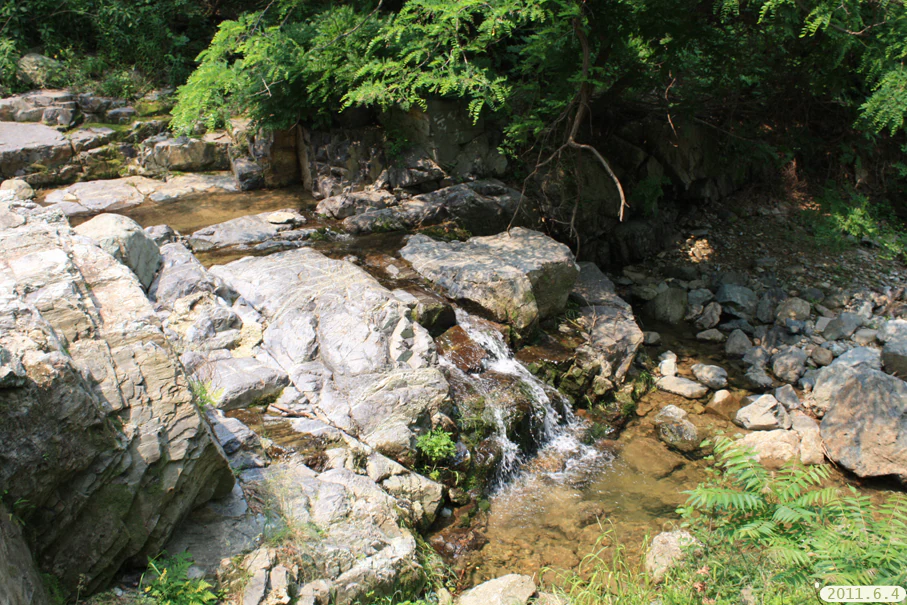
A small cascade flows over pale exposed bedrock into a shallow pool beneath leafy branches; an embedded date stamp remains visible at the lower right.

An Apsan stream in June 2011. The embedded date stamp is preserved; the exact valley is unconfirmed, and this historical photograph does not indicate present water levels or access.

“apsan” by namju lee, via Flickr, CC BY 2.0. No changes. · Creative Commons 1 · Creative Commons 2

Walks and routes

A short foothill section from Gosangol

Jarak-gil follows the lower slopes rather than aiming for a summit. Its first published section runs from Gosangol’s dawn-redwood avenue to Gangdanggol: 1.9 km, about 35 minutes in the city’s guide. That is a one-way section. Turn back earlier for a short outing, or budget separately for returning along it. See the foothill sections.

A contour-following trail can still have uneven ground, narrow places and gradients. It is not a verified step-free route.

A short foothill section from Gosangol

Anjiranggol, observatory and summit

City route 7 links Anjiranggol entrance, Apsan Observatory and Apsan summit over a published 2.5 km. The observatory is an intermediate stop; 2.5 km is not its return distance. You can make the viewpoint your turnaround if that suits your energy and daylight. Check the hiking-route page.

Treat this as an uphill mountain walk, with a descent to plan, rather than a city promenade.

Anjiranggol, observatory and summit

Keungol toward Apsan summit

City route 5 runs from Keungol entrance via Daedeok Shelter to Apsan, with a published distance of 3.2 km. Use it for a walking-focused half-day if you are comfortable with climbing. The distance covers the listed ascent-side route; add a return plan before setting off.

This is a mountain route. Carry what you need for the whole walk and turn around while you still have ample energy.

Keungol toward Apsan summit

A relaxed first visit

Choose Keungol, check the day’s conditions and walk slowly through the lower park. If visibility and the operating schedule are favourable, add the cable car and observatory; otherwise stay with the woodland and memorial surroundings. Allow two to three hours if you include the ride, with extra margin for queues.

A walk with an easy stopping point

Start at Gosangol, enjoy the avenue and nearby displays, then follow only as much of Jarak-gil’s first section as feels comfortable. Return by the same route while everyone still has energy. A shorter walk and a proper break often work better for a mixed-age group than a full trail target.

Things to try

Use the cable car as an option

The ride from Keungol saves much of the ascent, but leave time for walking at the top. For budgeting, KTO’s April 2026 guide listed return fares of ₩14,000 for adults and ₩10,000 for children; confirm current prices and child-age rules before buying. Monthly and weekday schedules vary, and weather can change operation. Check the operator’s information or call 053-656-2994, then confirm the last downhill departure at the station.

Make Gosangol a family outing

Dinosaur models, forest-learning spaces and the dawn-redwood avenue give Gosangol a different rhythm from a summit hike. Keep the visit to a few nearby stops and let children’s energy set the turnaround. Displays and organised activities may have separate operating arrangements; the woodland setting is enough for a simple outing.

Pause at the memorials

The Nakdong River Victory Memorial Hall and Chunghontap add historical context to Keungol. Approach memorial spaces quietly. If an indoor visit is important, confirm the hall’s opening before travelling; otherwise include the exterior surroundings without letting them dictate the whole walk.

Keep the mountain optional

If low cloud hides the city, a short lower-park visit may be enough in safe conditions. Heavy rain, thunder or strong wind is a reason to choose a separate indoor city activity. Do not use the cable car as a workaround for hazardous weather or enter a closed trail to reach a viewpoint.

Wildlife and habitats

Dawn Redwood

Gosangol’s planted avenue is a good place to meet this deciduous conifer. Its soft, feather-like foliage changes colour in autumn before falling, unlike the familiar evergreen image of a conifer. Enjoy the trees from the path and use any labels to confirm individual specimens.

Oak (genus-level)

Oak woodland is documented along the Keungol approach. Different leaf shapes and fallen acorns can make a slow woodland walk interesting, but the published account does not identify a particular oak species. Leave fallen material where it is and avoid treating every broadleaved tree as an oak.

Stories and discoveries

A pagoda in Gosangol

Beopjangsa’s three-storey stone pagoda adds a quiet cultural stop to the Gosangol side. The city describes a damaged structure restored when the temple was rebuilt in 1961, with stylistic features related to Unified Silla pagodas. View it respectfully within the temple setting and follow signs about access and photography.

A protected flowering shrub

The park describes a stand of gachimbakdal near the summit and records protection of its genetic resources in 2000. Its white spring flowers are a reason to appreciate the vegetation from the trail, never to enter a protected patch or collect a branch. There is no need to reach it to enjoy the lower park.

Several viewpoints, different destinations

Apsan Observatory is the mountain viewpoint reached from the walking trails or cable-car approach. The cable-car station’s Sopra viewpoint and the separate sunset tower at Ppallaeteo Park have their own locations. Naming the exact viewpoint helps avoid an unexpected transfer.

When to visit

Spring and autumn

Use mild weather for a longer walk, while leaving room for changes in flowering and leaf colour. Autumn’s mix of green conifers and changing broadleaved trees is part of Apsan’s character. Dry-weather fire controls can affect mountain access, so check your route rather than assuming a whole season is open.

Summer and winter

In summer, favour shaded lower walks and reduce the distance in heat or humid weather. During rain warnings, postpone the mountain outing. In winter, shorten your plan when ice or wind makes footing uncertain; turning back before a slippery descent is a sensible way to keep the day enjoyable.

Getting there and practical advice

Water, toilets and a place to pause

The city lists toilets, benches and some food facilities around the park’s valleys, with more services around the main visitor approaches. Use facilities before climbing and carry drinking water. Do not assume a café, tap or toilet will be available at your next junction or open late.

An unhurried stop in Keungol

Nanum Forest in Keungol has landscaped walking paths and a lawn, making it a useful lower-park choice when the group wants time to rest. Keep a little space in the day for this kind of pause instead of filling every hour with uphill walking.

Arrive at the right valley

For the main Keungol approach, use the park-office address, 574-87 Apsansunhwan-ro, Nam-gu, as a reference. The city’s August 2026 access page lists buses 300, 410, 410-1, 600, 750, Nam-gu 1 and Nam-gu 1-1 for the Apsan Park public-parking area. Confirm the current stop and direction in a journey planner. These buses do not mean every valley has the same connection. Official arrival information.

Driving and the return journey

The city identifies paid parking at Keungol, paid and free options at Gosangol, and limited free space at Anjiranggol. Check signs and current charges on arrival. Public transport can avoid the search for a space; for a one-way foothill walk, decide how you will get back before leaving your car.

Plan from the entrance outward

KTO’s accessibility page, updated in June 2026, describes step-free access to the main entrance, one designated accessible parking space at the victory memorial hall and an accessible toilet beside Daeseongsa. It does not establish a continuous accessible route to the observatory. Ask the park office on 053-803-7449 about surfaces, gradients and toilet access for your exact visit.

Check the cable-car transfer separately

Before relying on the ride, ask the cable-car operator about boarding steps, wheelchair dimensions, assistance, stroller handling and the onward path. A short ride does not remove all walking or steps. Choose a lower-park plan if the complete outward-and-return journey cannot be confirmed suitable.

Sources and useful links

Wildlife you might spot

2

Each card links to a full Explore page with photos, traits, and fun facts.

We are still adding species preview cards for this place.

Snap map for this place

Start with the big picture, then zoom in to explore individual wildlife observations around this place.

Loading map…

Good to know before you go

Save the Korean entrance name as well as “Apsan Park” before arranging transport.

Wear shoes with grip and carry water; do not rely on a mountain spring being drinkable.

Check the return journey before starting, especially if you plan to leave by a different valley.

Keep to signed paths and respect barriers around restoration areas, rock edges and heritage remains.

For dusk visits, bring a light and an extra layer, and leave a generous margin for the last descent.

Use designated paths beside streams; slippery rock pools are not an invitation to paddle.

Frequently asked questions

There is a further walk after the upper station. A 2021 Korea Tourism Organization guide describes roughly ten minutes, but allow more for your pace and any route changes. Confirm the signed connection and return before leaving the station; the summit is a separate destination.
No. The city gives about six hours for the complete Jarak-gil, from Gosangol’s dawn-redwood avenue to the Dalbigol youth centre. Choose a section if you have only an hour or two, and include the return to your entrance or onward transport.
Yes. Lower woodland walks and the signed hiking routes offer independent ways to enjoy Apsan. Walking access still depends on local controls and conditions, so a cable-car closure does not by itself tell you whether a trail is open.
No. The sunset tower at Apsan Ppallaeteo Park is a separate nearby attraction. For the mountain panorama described here, search for Apsan Observatory and your chosen Keungol or Anjiranggol approach.

Recent snaps at this place

Recent snaps will appear here as new observations are added.

View all ›

Take the discovery with you

Exploring Apsan Park?

Identify the wildlife you spot, learn as you go, and keep a collection of the adventure.

  1. 1Spot it
  2. 2Snap it
  3. 3Keep the discovery
