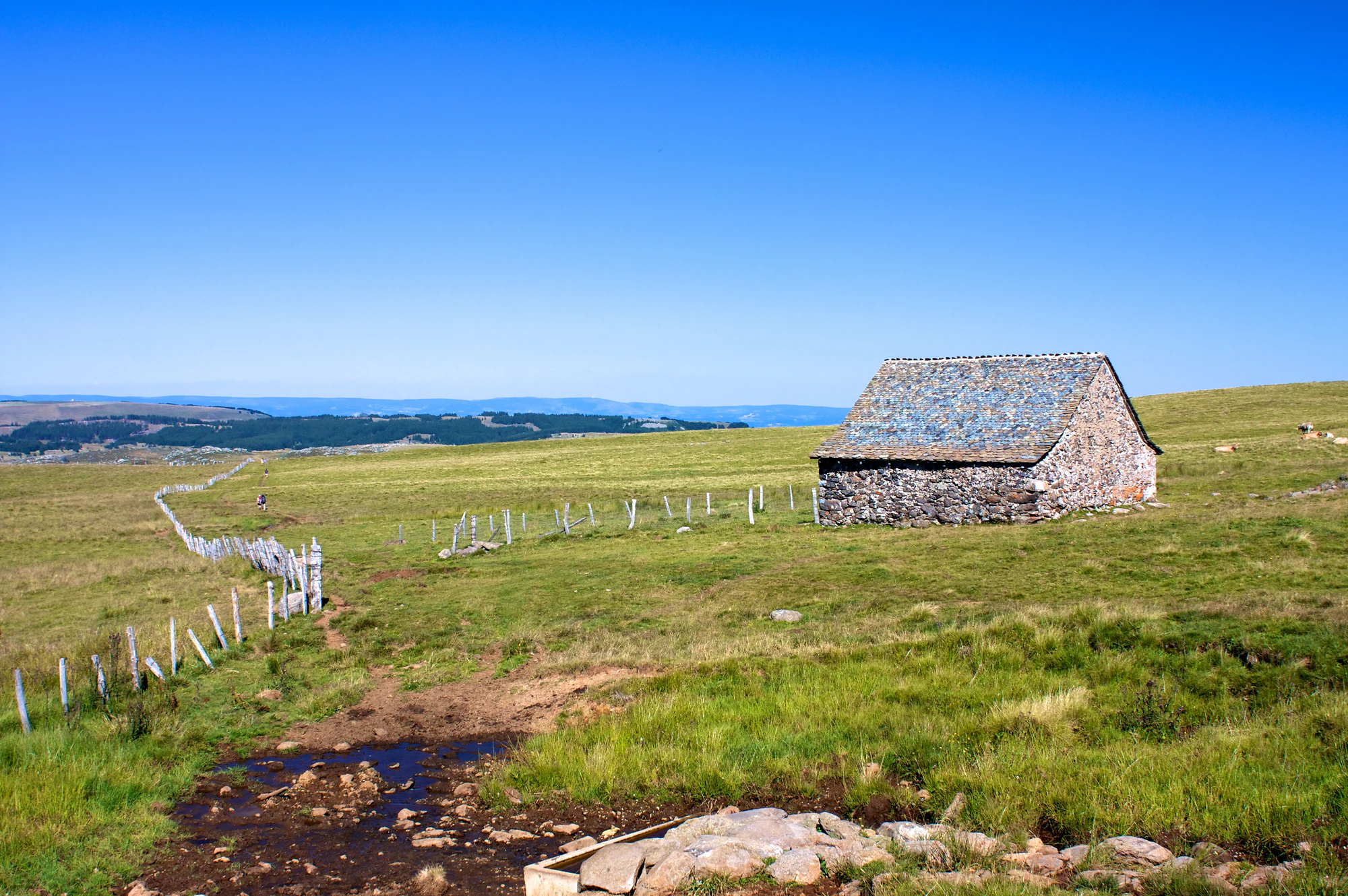
The open country around Aubrac village is a worked landscape. Summer grazing and haymaking help maintain its grasslands, while wet hollows, woodland and rocky ground create very different homes for plants. The Grande Prairie d’Aubrac, beside the village, brings that relationship into focus: its sensitive-natural-area designation recognises a living pastoral landscape, not an invitation to wander across every field.
The regional nature park extends across Aveyron, Cantal and Lozère, in both Occitanie and Auvergne-Rhône-Alpes. It was designated in 2018 and includes 64 classified communes. This guide starts in one small part of it, at Aubrac village in the commune of Saint-Chély-d’Aubrac. It is a useful first visit, not a substitute for planning journeys elsewhere in the park.
The scenery has a much older foundation than the pasture. Ancient granite lies beneath a volcanic landscape, and later ice reshaped the plateau, leaving hollows, scattered blocks and the settings for lakes and peatlands. At the botanical garden, a geological display lets you compare rocks before trying to read them in the wider view. You do not have to understand every geological period to notice that soil, water and plants change together.
Inside the Maison, the emphasis shifts to the people who live and work here. Exhibitions connect farming, cheese, craftsmanship and journeys through the plateau. Outside, the garden presents local flora in reconstructed habitats, from pasture and rockery to woodland and bog. These are managed collections: seeing a plant in a labelled bed does not mean it grows wild beside the next path. Be ready to snap and learn! Get the Snappit app to identify any nature species you find here.
Aubrac’s former monastery-hospital places the village on a long history of travel and hospitality along the Compostela route. The botanical garden began in 1988 through Francis Nouyrigat’s initiative, originally near the Domerie, and reopened in its present setting below the Maison in 2011. Its habitat displays make that historic village a practical starting point for understanding the countryside around it.