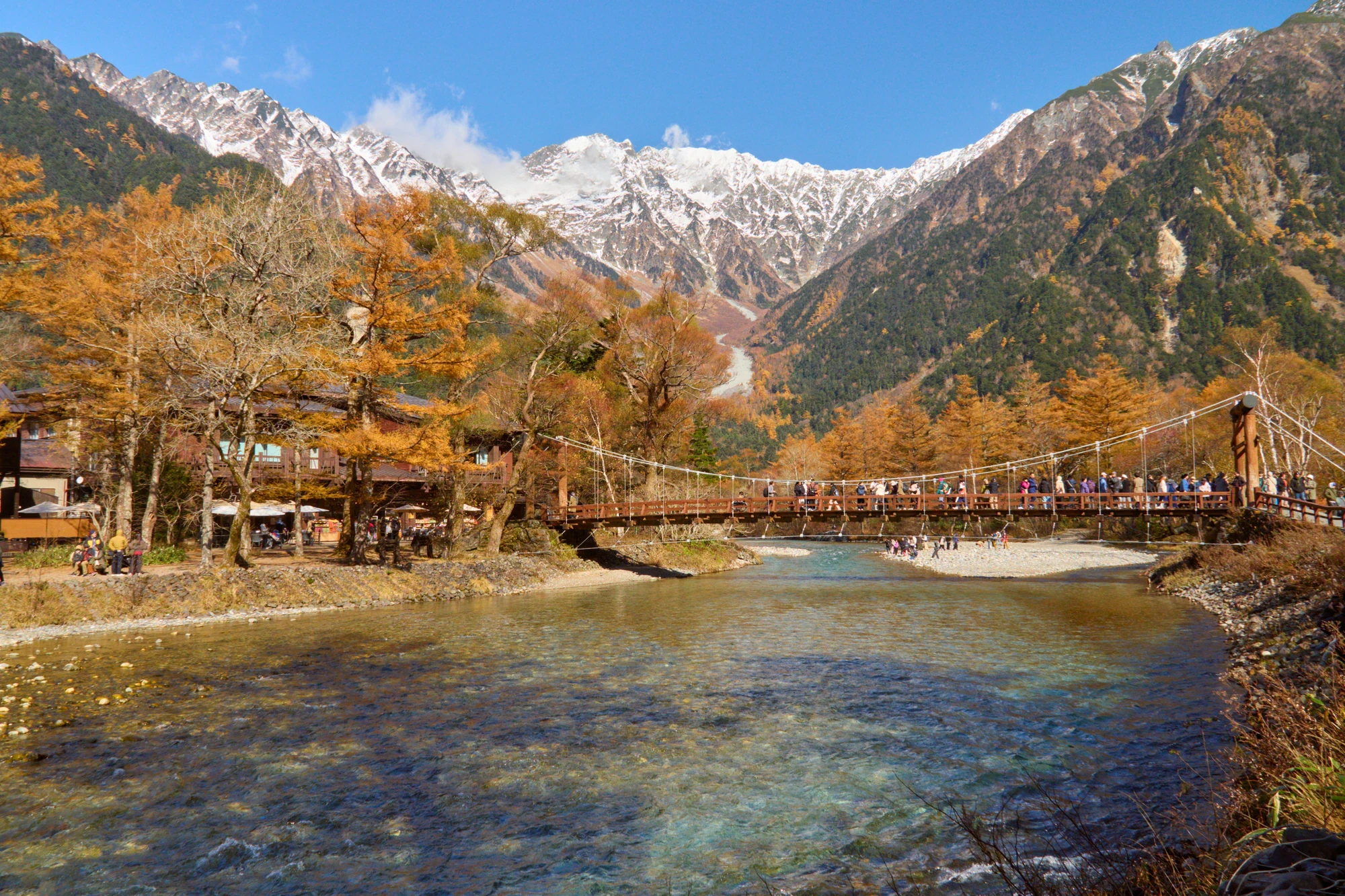
Chubusangaku National Park stretches across four prefectures and much of the Northern Japan Alps. Its high ridges, deep valleys and alpine habitats would take many journeys to explore. For a first visit, choose Kamikochi in Nagano: a high valley where the Azusa River runs below the Hotaka mountains. You can enjoy a satisfying day here without climbing toward a summit or staying overnight.
Begin with a quick conditions check at the Information Center beside the bus terminal, then visit Kamikochi Visitor Center near the Kappa Bridge area. These are two different buildings. The Visitor Center gives the landscape a little context: look up for life-size wooden birds, compare the local tree specimens, and watch a film about the valley's seasons. Ask which paths suit the weather and how much time you have before your return bus.
Kappa Bridge is a good place to slow down. The wooden suspension bridge spans the Azusa River, with the Hotaka peaks rising beyond it and shops and cafés nearby. Look along the water as well as up at the mountains. Pale gravel, flowing channels and riverside trees make the valley floor interesting even when clouds hide the highest ridges. Keep photographs to the path and bridge, leaving room for other people to pass.
For a manageable walk, return to Kappa Bridge after the exhibits and follow the riverside circuit toward the Weston Monument and Tashiro Bridge, coming back on the opposite bank toward the terminal. The monument adds a human story to the mountain scenery: Walter Weston helped introduce the Japanese Alps to readers abroad. There is no need to keep adding destinations. A pause beside the river, a little birdwatching and a warm drink can fill the time between the main sights very nicely.
If your group wants another small outing, the valley path upstream from Kappa Bridge reaches Dakesawa Marsh. Its water and woodland offer a different mood from the open river. Turn back there for a short visit. Myojin is a longer valley walk with a pond and shrine, while paths climbing toward Dakesawa Hut and the high peaks are mountain hikes requiring a separate plan. Similar names on a sign do not mean similar walks.
Nature rewards attention more than a checklist. Listen for a tiny Eurasian wren near damp woodland, look for Mandarin ducks without feeding them, and give any Japanese macaques plenty of space. In autumn, larch needles turn yellow before falling, adding a softer color beneath the rock faces. None of these encounters is guaranteed. The valley is also bear habitat, so check local notices and keep food and rubbish securely packed. Don't forget to bring the Snappit nature identification app along to scan local species.
Chubusangaku National Park was designated on 4 December 1934. Kamikochi’s landscape carries both a geological and a human history. An eruption of Yakedake dammed the Azusa River in 1915, creating Taisho Pond farther down the valley. The Weston Monument recalls the English missionary and mountaineer who helped publicize the Japanese Alps, while Kappa Bridge appears in Ryunosuke Akutagawa’s 1927 novel Kappa. Private-car restrictions began in 1975 as visitor traffic grew.