Snappit logo
Snappit
Get App
Generic illustration, not a photograph of this venueIllustration
ParkMie, Japan

Mie Prefectural Citizens' Forest

Mie Prefectural Citizens' Forest makes a good case for slowing down.

About

Mie Prefectural Citizens' Forest makes a good case for slowing down. Rather than a single landmark to tick off, this roughly 45-hectare park in Komono offers a sequence of small discoveries: a bird moving through the branches, a pond worth stopping beside, or a sunny patch of grass where lunch can last as long as you like. Its setting is at the foot of Mount Shaka in the Suzuka Mountains, but you do not need to climb a mountain to enjoy it.

Start at the Nature Learning Exhibition Hall, where you can ask about conditions and collect a walking map. Then choose the mood of your visit. An energetic family might head towards the forest play course; a quieter group can take a woodland walk and linger with binoculars. Young children may enjoy a reserved wooden-toy session before a short outdoor exploration. Keeping the first plan modest leaves space for the place itself to catch your attention.

The park also tells a story about caring for forests. It developed from the site of the 1980 National Tree-Planting Festival, and its present-day mix of recreation, nature learning and woodland management continues that theme. Look beyond the trees as scenery: notice differences in shade, the space between trunks and the little habitats around water. You can have a satisfying visit without knowing the names of everything you see.

Nature Forest, Bird Forest and Adventure Forest are areas within this one park. Choose between them rather than treating each as a separate destination. Some paths are much more demanding than the central lawns suggest, so let the official route descriptions, current signs and your group's energy decide how far to go. Wondering what that bird or insect is? Find out on your visit using the Snappit nature app.

What to do here

Choose a marked woodland course, watch for birds, explore the play area, look closely at pond life or enjoy a picnic and a little unhurried outdoor time.

Seasonal info

Seasonal maps describe typical possibilities, not a live forecast of flowers, foliage or wildlife. Check recent park notices before setting out.

Accessibility

The operator identifies the exhibition building and areas around the squares as wheelchair-usable, while warning that natural forest terrain can be difficult. Ask staff about a suitable route.

Don't miss

1

Woodland walks with three official course choices

2

Bird Forest and quiet observation stops

3

Adventure Forest play equipment

4

Tonbo Pond and waterside habitats

Walks and routes

Course A: the balanced choice

The operator gives approximately 2,000 metres and 55 minutes. It combines relatively level walking with some rises and falls; the map places its start/finish beside Tsudoi Square. Add time for birds, children and pond-side pauses. It is not certified step-free.
Course B: a shorter woodland circuit

Approximately 1,500 metres and 50 minutes, starting and finishing near the exhibition hall on the official map. Woodland and the neighbouring river give it its character. Shorter distance does not mean a smooth pavement: check the actual surface and follow the marked course.

Course C: the more demanding walk

Approximately 2,845 metres and 70 minutes, with steep climbs, descents and natural paths. The map marks steep stairs in the forest and a start/finish near the exhibition hall. Choose it for confident walkers in suitable conditions; allow longer than the published estimate if stopping often.

A flexible family morning

For an editorial 2–3-hour outing, start with the exhibition hall, choose a short open path or suitable play equipment, then settle down with a picnic. Keep the pond as an optional extra. This is a loose plan, not a measured route: turning back early is entirely reasonable.

Things to try

Make a small nature notebook

Give everyone one page for three things: something moving, something patterned and something they heard. Sketch rather than collect. Comparing your pages over lunch is often more fun than trying to complete a long wildlife checklist.

Let children set the walking pace

A good family walk can be short. Let a child choose a leaf shape to look for or count how many different bird sounds they notice. Stay together at junctions, and stop the game whenever a road, water edge or piece of play equipment needs full attention.

Book a wooden-toy session

Inside the exhibition hall, the Forest Education Station offers wooden toys and play equipment. Sessions are 09:30–11:00 and 13:30–15:00, with a guardian required. Booking ahead is best; same-day admission depends on spare capacity. It closes Thursdays, or the next day when Thursday is a holiday, and 29 December–3 January.

Photograph the scale of the forest

Try an overall woodland scene, a medium view of a path and one close detail taken without leaving the trail. A distant person can help show scale only with appropriate consideration for privacy. Avoid blocking paths with equipment, and check permission rules for a paid shoot or drone.

Wildlife and habitats

Long-tailed tit

The park lists this small woodland bird among its wildlife. Look patiently through the canopy from a safe stopping place, and enjoy any flock that comes your way without following it off the path. The name does not promise a particular subspecies or a sighting today.

Japanese maple

Iroha-momiji is listed among the park plants and is noted near the flagpole area for autumn colour. Look for the lobed leaves, then compare their colour in sun and shade. Trees in a managed park can have different histories; this guide does not label these particular trees as wild-grown.

More than two things to notice

The operator also lists blue-and-white and narcissus flycatchers, and plants such as sasayuri lilies. Use the park displays and seasonal pages to broaden your search. Flowers, insects and birds appear at different times, and sensitive wildlife is best enjoyed without sharing nest locations.

Stories and discoveries

A welcoming central base

The exhibition hall, nearby lawn and squares give you a straightforward starting point. Pause here to organise bags, check the map and decide on one outdoor goal. Having a familiar place to return to can make a family visit feel much less rushed.

Woods with different personalities

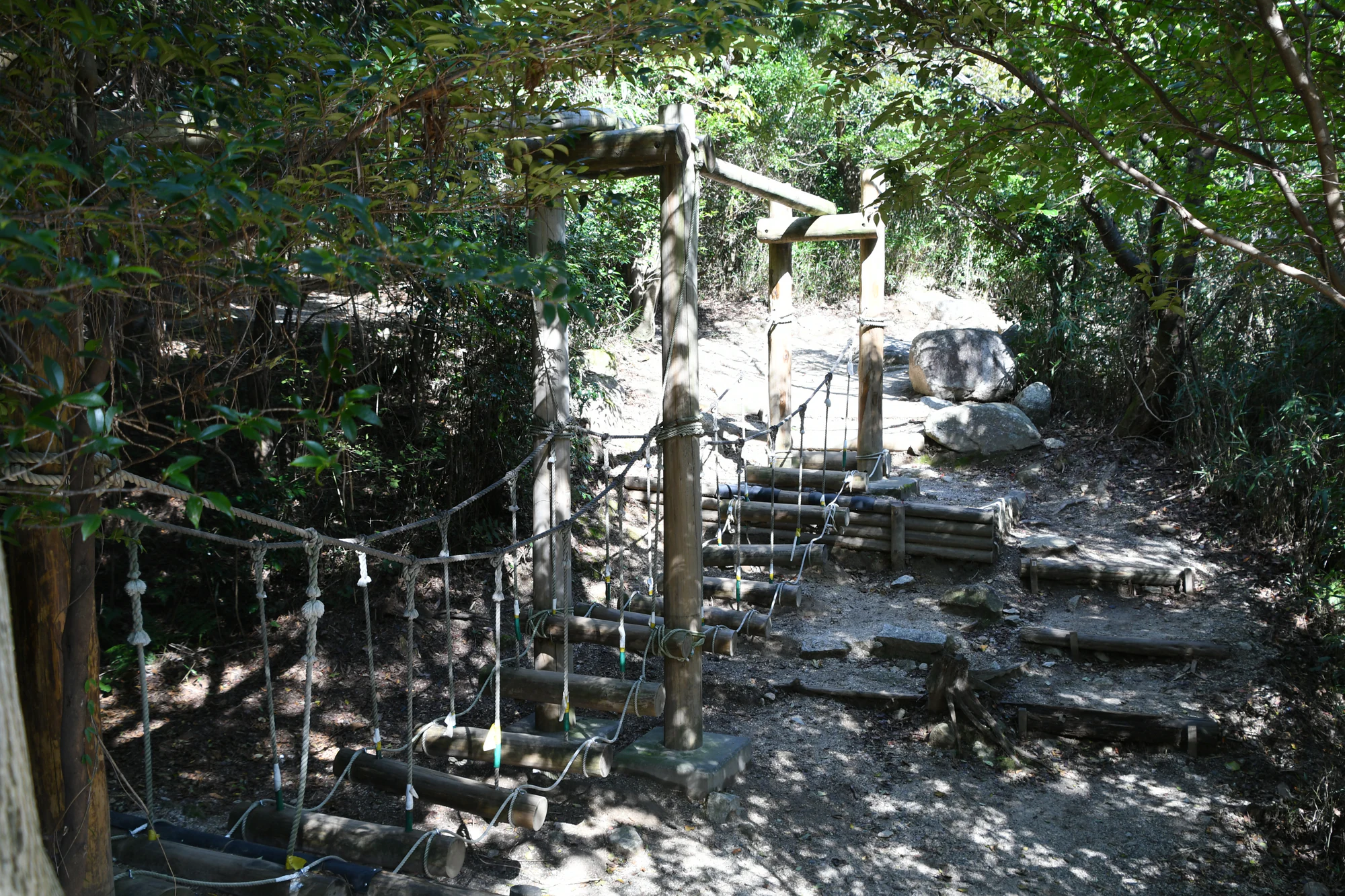
Bird Forest is the quieter choice, while Nature Forest has a network of paths and small clearings. Adventure Forest includes a woodland athletic-play course. These are useful starting ideas, not guarantees that one area will be empty or every piece of equipment available.

Tonbo Pond and the waterside

Tonbo Pond is a biotope, a small habitat area rather than just decoration. Try watching one patch of water for a full minute. Notice movement, reflections and the changing edges between vegetation and open water; leave animals and plants where they are.

A view when conditions allow

The park describes views towards Ise Bay and the Chita Peninsula from the lookout. Clear weather helps, but access matters first: check the deck notice and use only open paths. If it is unavailable, let the forest itself be the destination.

A tree-planting legacy

The prefecture records a May 1980 opening and a connection with the 31st National Tree-Planting Festival. The recreation and learning spaces grew from that event site.

At the foot of the Suzuka Mountains

The park lies around 200 metres above sea level, at the foot of Mount Shaka. It is a place to enjoy the Suzuka foothills at an unhurried walking pace.

A cared-for forest

The operator describes conservation and satoyama management as part of its work. Volunteers also help with woodland care and events. The landscape is a living place maintained for both nature and people.

Suspended wooden logs and rope handrails form a play crossing among trees, beside a rough stepped path and scattered rocks.

Wooden and rope play equipment at Mie Prefectural Citizens' Forest, photographed on 28 October 2021. Equipment and conditions may have changed.

“20211028_三重県民の森 (5)”, CC BY 4.0, via 三重県菰野(こもの)町オープンフォト (Komono Town OpenPhoto). https://openphoto.app/c/komono/photo/7217 · Creative Commons

When to visit

Spring

The park FAQ describes Yoshino cherry blossom from late March into early April, followed by later cultivars. Choose blossom as a pleasant possibility, and keep a woodland walk as your backup if the timing shifts.

Early summer and summer

Fresh foliage, summer birds and active insects change what there is to notice. Start with realistic plans for the heat, bring water and rest before anyone becomes exhausted. Any stream play depends on safe conditions that day.

Autumn

Look for colour at different heights rather than expecting every tree to change together. Japanese maple is included in the park plant list. Take photographs of fallen leaves and fruits where they lie instead of stripping branches.

Winter

The park recommends winter for birdwatching, including mixed flocks. Shorter daylight and chilly stopping time matter: a layer you can put on while waiting is useful, even if you warm up quickly while walking.

Getting there and practical advice

The Nature Learning Exhibition Hall and main parking are listed for 09:00–17:00, closed 29 December–3 January. Toilets are shown around the central facilities and squares. There is no meal outlet; bring a picnic to eat outdoors. Drink vending is in the exhibition hall. Baby-changing facilities and a nursing space are available; ask staff for access. Fureai no Yakata rooms need an application, with room use listed until 16:30. Do not assume buildings remain accessible after their hours.

Wheelchair loans are available at the exhibition hall. The operator supports use of the exhibition facilities and areas around the squares, but explicitly cautions that forest terrain can be difficult. The walking map contains steep-stair warnings. No complete step-free circuit, maximum slope or accessible-parking specification was verified. Tell staff what your group needs and agree a manageable out-and-back option before setting off.

The address is 7181-3 Chikusa, Komono, Mie; telephone 059-394-2350. The operator publishes driving approaches from Komono Interchange on the Shin-Meishin and Yokkaichi Interchange on the Higashi-Meihan. The prefectural directory lists roughly 200 parking spaces. For public transport, the park FAQ says the community-bus stops named 草里野 and 尾高駐車場 are about a 30-minute walk away, with infrequent service. It recommends taxis or a prebooked town shared taxi; eligibility and current services need checking. Arrange the return journey before arrival.

Follow closures and stay on permitted paths. Be especially cautious around steep stairs, wet roots, streams and play equipment; supervise children closely. Leave during deteriorating weather and avoid woodland in strong winds. Smoking, fire, overnight camping, plant collection and harm to wildlife are prohibited. Dogs need leads. Drone filming requires permission, and paid photography needs advance discussion with the park, normally at least a month ahead.

Visitor information

Checked 20 October 2026: ask about the viewing deck

A 20 September notice planned to close the viewing deck for painting on 21–23 September, with possible weather-related extension. Those dates have passed, but an explicit reopening was not confirmed. Ask staff before making it the focus of your walk.

Keep an eye on the trees above you

The 21 September notice warned of falling branches after strong wind. Check the latest conditions and avoid woodland walking during high winds; an older notice is not an all-clear for today.

A dated family event example

The park lists an Enagakko nature session for 27 October 2026, 10:00–11:30, for children roughly 2–4 with a guardian. It is free, requires advance booking and is cancelled in rain. This session meets at Fureai no Yakata. Check remaining places and later dates directly.

Sources and useful links

Wildlife you might spot

2

Each card links to a full Explore page with photos, traits, and fun facts.

Snap map for this place

Start with the big picture, then zoom in to explore individual wildlife observations around this place.

Loading map…

Good to know before you go

Bring lunch, drinking water and a bag for your rubbish; do not rely on finding a meal for sale.

Use closed, grippy shoes, and take extra time if roots, steps or fallen leaves are wet.

Pack binoculars if you have them, but try a short listening stop even without equipment.

Collect a current walking map and check local restrictions before choosing the longer forest course.

Frequently asked questions

General admission and park facilities are free. Some organised programmes may charge or require booking, so read the particular event page.
An individual park walk does not need the wooden-toy session reservation. Book the Forest Education Station separately, and contact the park for organised group use.
Dogs are allowed outside the exhibition facilities on a controllable-length lead. Clean up after them and give wildlife and other visitors space.
No. Fires, barbecues and overnight camping are prohibited inside the park. Neighbouring campsites are separate businesses with their own arrangements.
No. The operator identifies shallow stream-play spots suited to younger children. Check the water and notices on arrival, supervise closely and stay out after heavy rain.
Do not assume so. Build the visit around the central facilities and ask about current surfaces, gradients and steps before entering the woods.
They are possibilities recorded by the park, never a promise. A quiet walk can be rewarding even when you mainly hear birds rather than see them.

Recent snaps at this place

Recent snaps will appear here as new observations are added.

View all ›

Take the discovery with you

Exploring Mie Prefectural Citizens' Forest?

Identify the wildlife you spot, learn as you go, and keep a collection of the adventure.

  1. 1Spot it
  2. 2Snap it
  3. 3Keep the discovery