
Snappit logo
Snappit
Get App
Generic illustration, not a photograph of this venueIllustration
ParkBourgogne-Franche-Comté, FR

Morvan Regional Nature Park

The Morvan is Burgundy’s wooded upland, an inhabited landscape of farms, villages, forests and water rather than a single enclosed attraction.

About

The Morvan is Burgundy’s wooded upland, an inhabited landscape of farms, villages, forests and water rather than a single enclosed attraction. The regional nature park reaches across Côte-d’Or, Nièvre, Saône-et-Loire and Yonne. Its small-scale variety is the attraction: a shaded forest can give way to a hedged pasture, a spring or a wet hollow within one outing. Farming and forestry have shaped these transitions, so a pasture or plantation belongs to the story as much as an apparently wild corner.

For a first family visit, Saint-Brisson makes that large landscape manageable. The Maison du Parc is a base with visitor information and cultural stops, but the main nature experience here is outdoors: the Étang Taureau trail enters wet woodland beside an artificial pond. You can explore a genuine protected wetland without committing to an all-day hill walk. The raised walkway also makes a useful point visible: water, trees and the thin strip of shore support different ways of living.

Across the wider Morvan, many small streams drain towards the Seine, while southern waters feed the Loire basin. Springs and seepages help sustain wet meadows and peat-forming ground. The great reservoirs are only one part of this watery landscape. Begin with a small pond and its margins, and the much bigger map starts to make sense. Eager to name that creature? Identify any animal you find during your visit using the Snappit app.

Created in 1970, the regional nature park protects a lived-in rural territory as well as its natural heritage. Étang Taureau makes that relationship particularly tangible. Its embankment dates to the Middle Ages, and the pond was adapted in the eighteenth century for fish farming and timber floating. Water released from ponds helped move firewood down the rivers towards Paris. Today the park manages this pond for ecological purposes: the same water that once served transport now supports a protected habitat.

What to do here

Walk the Étang Taureau loop, pause in the bird-observation hide, then choose one extra stop: the herbularium for plants, the sensory path for children, or the Maison des Hommes et des Paysages for the human story. Keep a longer forest hike for another outing rather than adding it automatically to this short circuit.

Seasonal info

The outdoor discovery trail is advertised as freely accessible year-round. Indoor services follow seasonal calendars. Check the forecast and temporary notices before setting out, especially after heavy rain, strong wind or frost.

Accessibility

The park identifies the Étang Taureau trail as accessible to people with reduced mobility and mentions adapted equipment through the Maison du Tourisme. Contact the team about arrangements for your chair or mobility aid. Accessibility varies elsewhere in the Morvan.

Don't miss

1

The 1 km Étang Taureau loop through wet woodland

2

A bird hide beside a historic timber-floating pond

3

Plant discovery in the Maison du Parc’s herbularium

4

A landscape shaped by both water and generations of rural life

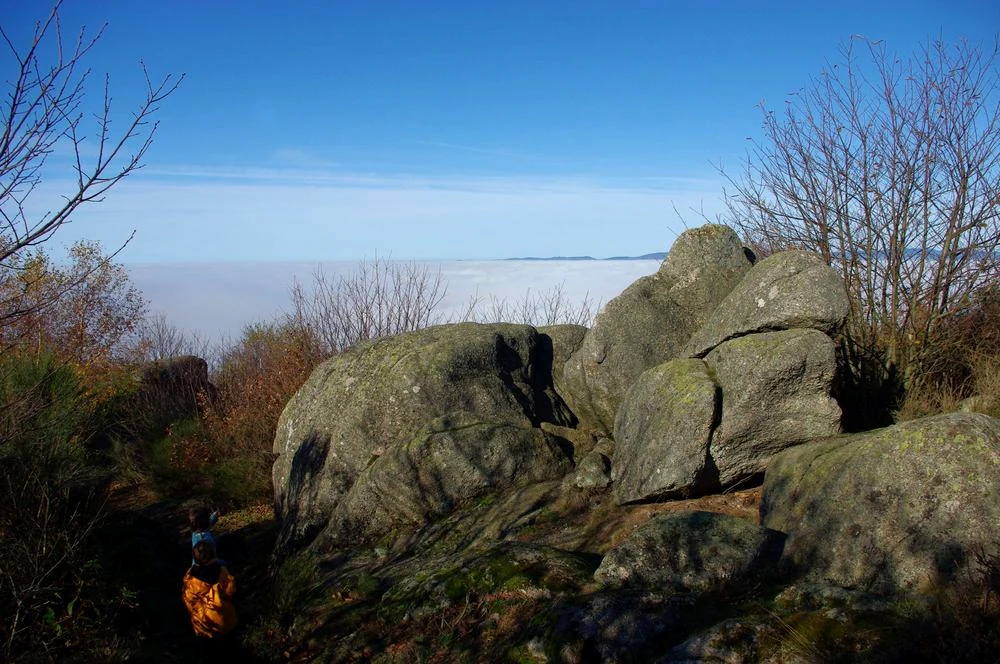
Rounded granite boulders among sparse autumn shrubs, with two small visitors at the lower left and a layer of low cloud in the distance.

Granite boulders at Uchon in November 2011, with low cloud beyond the rocks. This is a historical view from a different part of the Morvan, not the Étang Taureau trail.

“Rochers du chaos rocheux de Uchon” — JLuc, CC BY-SA3.0. https://www.geodiversite.net/media605. Original unchanged. · Creative Commons

Walks and routes

Étang Taureau discovery loop

Start from the Maison du Parc grounds and follow the signed discovery circuit towards the pond. Its boardwalk threads the marshy woodland at the pond’s upper end; the bird hide gives you a place to watch without approaching the shore. Follow the marked circuit, which explores this particular edge of the pond.

For children, the illustrated interpretation is a useful way into an unfamiliar habitat. Choose a panel, look for what it describes in the surrounding vegetation, and carry that idea to the next stop. At the hide, give everyone a turn with the binoculars. A quiet patch of water is still worth looking at: compare the open surface with the densely vegetated edge. Allow longer than the published walking time if these stops become the main event.

For wheelchair access, ask about current surfaces and the parking-to-trail connection. The discovery leaflet does not give detailed gradients, thresholds or turning-space measurements.

Étang Taureau discovery loop

An easy half-day at Saint-Brisson

Begin with the discovery loop while everyone is fresh, allowing 1–2 hours with stops. Return to the visitor base for lunch. Then choose the gardens or the Maison des Hommes et des Paysages. If you prefer the museum first, check its lunch closure so the walk fits naturally around it.

If you have a full day

Give the grounds and one museum more time, or choose a separately planned outing from the official Morvan route service. Read the distance, ascent, difficulty and current notices before setting off: the short Taureau boardwalk does not describe the effort required by the forest loops leaving Saint-Brisson. A large lake can be another day’s focus, rather than an extra destination reached in a rush.

Things to try

Try the sensory path

Near the approach to the pond trail, a purpose-built sensory course of about 200 m invites a different kind of exploration. The designed barefoot sections introduce textures and sensations. Follow the instructions there, then put your shoes back on for the wetland walk.

Use the gardens as a living field guide

The herbularium gathers plants associated with the Morvan in a designed garden. Compare leaf shapes and growth forms, then notice similar patterns on your walk. The arboretum adds trees used in the region’s forests and gardens, including introduced species. Both are managed collections, offering a different perspective from the wild wetland.

Read the working landscape

Look beyond the largest trees. Hedges, wet meadows and woodland edges are useful clues to how the Morvan fits together. The park’s habitat mosaic reflects rural work as well as geology and water. Ask children to pick the sharpest visible boundary between two habitats, then consider what changes across it: light, shelter or dampness. You can do this from the path without disturbing anything.

A museum with a landscape story

The Maison des Hommes et des Paysages explores how people, exchanges and migration shaped the Morvan. It is a useful companion to the outdoor visit rather than just shelter from rain. Its published 2026 season runs from 28 March to 11 November. For 1 October–11 November, hours are 10:00–13:00 and 14:00–17:00, closed Tuesdays and Saturday mornings. The listed individual adult ticket is €4.50, with children under eight free. Recheck the calendar and tariff for your visit; outside the season, group access is by arrangement.

Wildlife and habitats

A white visitor on migration

The park records great egrets stopping at Étang Taureau to feed during migration, though you cannot count on seeing one. Look for a large, entirely white bird with a long neck and legs; a yellowish bill is a useful clue outside the breeding season. The hide offers a discreet place to watch.

Summer colour at the water’s edge

Purple loosestrife is highlighted locally for its pink summer flowers and their attraction to pollinating insects. Its upright growth makes a good subject for a photograph from the walkway. Try framing the flowers against the pond rather than reaching into the vegetation for a closer view. Leave the plant standing for the insects that use it.

The inconspicuous damselfly

The common winter damselfly is brown and easily overlooked among stems. The park names it among the insects of the pond margin. Its life cycle is unusual: adults survive winter, then breed the following spring. A patient look at nearby vegetation may reveal more than scanning only the open water. Stay on the boardwalk, and do not handle an insect to identify it.

Stories and discoveries

An old rocky backbone

The Morvan is a north-eastern extension of the Massif Central. Its crystalline bedrock includes granite and ancient volcanic formations, with a long history of uplift and erosion. Rounded hills can conceal a complicated geological story. Uchon’s exposed granite boulders illustrate that wider rocky character; the historical photograph below is from Uchon, a different part of the Morvan, not from the Saint-Brisson walking route.

Peat as an archive

The regional peatland reserve brings together a network of separate sites. Layers of peat can preserve evidence of earlier vegetation and environments over thousands of years. That gives a small, unshowy wetland a second importance: it holds clues to the landscape’s past as well as habitat for today’s wildlife. The public trail lets you encounter this kind of environment while leaving the vulnerable ground intact.

When to visit

Spring and summer

In the growing season, combine the wetland with the herbularium and leave time for insects around flowering plants. A warm, still period is more useful for close observation than marching to complete the loop. Take sun protection for the open parts of the grounds as well as a layer for the woodland.

Autumn and winter

With less foliage, the structure of the wood becomes easier to read, but leaves and frost can make timber slippery. Finish in daylight. Before any additional woodland walk, ask about local hunting activity and check the relevant forest’s notices. The ONF publishes state-forest calendars; it is not a complete calendar for all land in the park. Never interpret an unlisted date as a guarantee that no hunt is taking place.

Getting there and practical advice

The visitor base

The Maison du Parc is at Les Petites Fourches, 530 route de Saulieu, 58230 Saint-Brisson. The operator lists parking, picnic space and toilets, together with a shop and the Bistrot du Parc. The Maison du Tourisme can help with maps and practical questions on +33 (0)3 86 78 79 57. Check service hours before relying on a staffed welcome, a meal or accessible facilities.

Seasonal indoor services

Outdoor entry is free. The main visitor page gives an April-to-mid-November season for the tourism desk, museums and bistrot, but their individual calendars matter. For a booked activity, confirm the meeting point, age guidance, price and cancellation arrangements with the organiser. Bring a picnic if you need certainty about lunch.

Getting to the chosen gateway

Navigate to the Maison du Parc at Saint-Brisson in the Nièvre. From the Saulieu side, the park’s leaflet directs drivers along the D977 bis towards the Maison du Parc. From Quarré-les-Tombes, it uses the D10, continuing as the D20 towards Saint-Brisson. Use the visitor parking and continue on foot; roadside wetland access is not the starting plan.

Planning without a car

Avallon and Montbard are among the rail gateways suggested by the park, with regional connections to towns including Saulieu. Do not assume a direct connection to the trail. Check your exact date through Mobigo and arrange the final leg to Saint-Brisson, including the return, before buying onward travel.

Ask about the complete visit

If step-free access is important, ask about the journey from the parking space through the grounds to the boardwalk, not just the trail surface. Confirm accessible toilets, rest opportunities and any loan equipment directly. The Maison des Hommes et des Paysages also states that it is accessible to people with reduced mobility and offers French easy-read materials. Choose your combination of stops around the facilities that meet your needs.

Sources and useful links

Wildlife you might spot

3

Each card links to a full Explore page with photos, traits, and fun facts.

We are still adding species preview cards for this place.

Snap map for this place

Start with the big picture, then zoom in to explore individual wildlife observations around this place.

Loading map…

Good to know before you go

Bring binoculars if you have them; they are more useful at the pond than trying to get closer to a bird.

Wear shoes with grip and take a layer for pauses in the shade.

Keep children beside you on the boardwalk and at the water’s edge.

Leave plants and animals where they are, and keep dogs on a lead.

Pack drinking water and a snack if your visit depends on services being open.

Download the official discovery leaflet before travelling; use local signs for the route on the day.

Frequently asked questions

No. It is a visitor base at Saint-Brisson within a much larger regional park. This guide uses its wetland trail for a feasible first outing; the surrounding forests, lakes and villages need their own travel and access planning.
The operator advertises free year-round access, with no booking requirement stated for the self-guided trail. Guided activities, museums and adapted equipment have separate arrangements. A barrier or closure notice on site takes precedence over a general opening listing.
Plan this visit for walking and watching the wetland. For swimming elsewhere in the Morvan, choose a specifically authorised bathing place and check its current water-quality and supervision information; the presence of a lake or reservoir is not enough.
Make the pond loop the whole visit. Read a few panels that catch your interest and keep time for the return. Save the museum and gardens for a less rushed day.

Recent snaps at this place

Recent snaps will appear here as new observations are added.

View all ›

Take the discovery with you

Exploring Morvan Regional Nature Park?

Identify the wildlife you spot, learn as you go, and keep a collection of the adventure.

  1. 1Spot it
  2. 2Snap it
  3. 3Keep the discovery
