
Snappit logo
Snappit
Get App
Generic illustration, not a photograph of this venueIllustration
ParkKR

Odaesan National Park

Odaesan has several quite different days out within one national park.

About

Odaesan has several quite different days out within one national park. The Woljeongsa valley suits forest walking and temple visits; Birobong rises above Sangwonsa; Sogeumgang has granite scenery and waterfalls on the Gangneung side; and Gyebangsan is a separate high-mountain outing to the west. Pick one gateway rather than trying to connect them all in a day. The forest-and-temple visit below starts on the Jinbu/Pyeongchang side. Explore the grounds like a pro—download the Snappit app to instantly identify animals and plants.

Woljeongsa traces its foundation to the monk Jajang in 643, during the Silla kingdom. Its religious story is closely connected with Manjushri, the bodhisattva of wisdom. The temple was devastated during the Korean War and rebuilt, so an old religious foundation does not mean every building is ancient. Odaesan became Korea’s eleventh national park in 1975. Its protected landscape also includes the site where a copy of the Annals of the Joseon Dynasty was kept, adding an archival history to its better-known Buddhist one.

What to do here

Walk the Woljeongsa fir forest, leave time for the temple courtyard, and add an out-and-back taste of Seonjaegil if the path is open. Choose the full valley trail or a summit on another, properly planned day.

Seasonal info

Autumn colour varies with altitude and weather, so use the park’s dated foliage updates rather than a fixed “peak” date. In spring and autumn, fire-prevention controls can close mountain sections while lower temple paths remain accessible. Heavy rain or snow can change either plan.

Accessibility

The short fir-forest visit is the gentlest focus here, but the complete outing is not verified as step-free. Seonjaegil includes wooden steps, decks and uneven ground; its description as mostly level is not a wheelchair-access guarantee.

Don't miss

1

The vertical trunks and evergreen canopy of Woljeongsa’s fir forest

2

Woljeongsa’s octagonal, nine-story Goryeo stone pagoda

3

A manageable taste of the streamside Seonjaegil path

4

Sangwonsa’s historic bronze bell, for a separately planned upper-valley visit

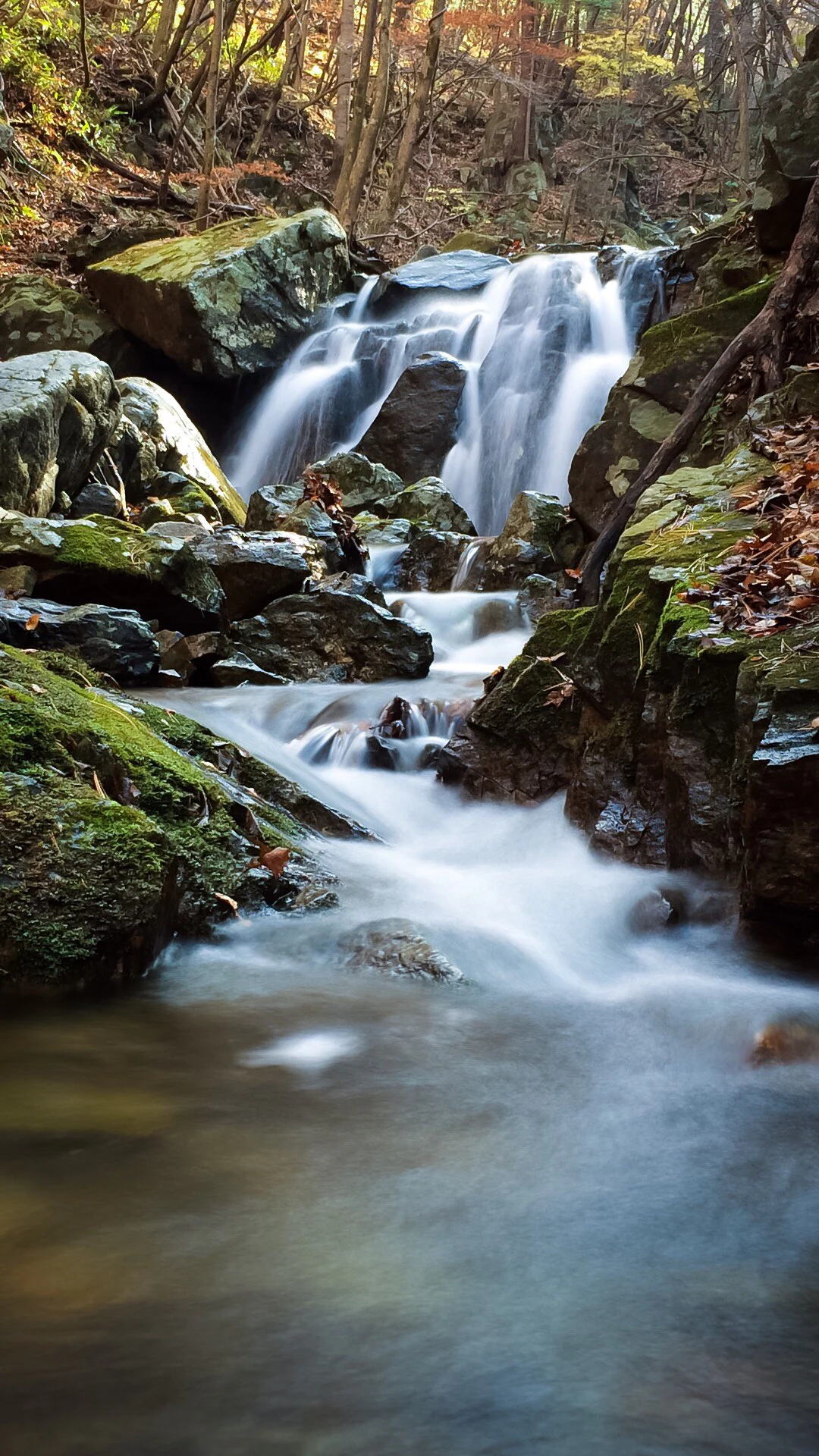
Water flows in smooth white ribbons over dark rocks through a wooded ravine, with moss, exposed roots and scattered autumn leaves.

A cascading forest stream in Odaesan National Park, photographed on 25 October 2014. The exact stream and viewpoint are unverified; this historical image is not a picture of a specifically recommended trail or present water conditions.

Photo: [“계곡”](https://www.flickr.com/photos/cucustudios/15441889417/) by [Sung Hoon Lee](https://www.flickr.com/photos/cucustudios/), Flickr. [CC BY 2.0](https://creativecommons.org/licenses/by/2.0/deed.en); original file unchanged. · Creative Commons 1 · Creative Commons 2

Walks and routes

First visit: fir forest and Woljeongsa

Head for the Woljeongsa fir-forest entrance and Iljumun gate, then follow the signed woodland paths toward Geumgang Bridge and the temple. The county publishes a 1.9 km forest outing taking about an hour; use the local route board to choose your return to your actual starting point. Allow 90–120 minutes with the courtyard and photographs. This distance describes the forest itinerary, not every possible parking-to-temple combination.

The lower forest has a more manageable scale than the long valley trail. Ask about current surfaces, slopes and the most convenient access point before bringing mobility equipment.

First visit: fir forest and Woljeongsa

Add a short Seonjaegil out-and-back

From Woljeongsa, follow the Seonjaegil signs toward Hoesageori and the upper valley. Choose a simple time limit: walk outward for 20–30 minutes on the open, marked path, then retrace your steps. There is no need to reach Dongpigol or Sangwonsa. Read any interpretation you encounter about former forest livelihoods, and turn earlier if the footing, water level or remaining daylight makes the walk less comfortable.

This short selection can still involve rough surfaces, steps and decks. It is an optional walking extension, not an accessible through-route.

Add a short Seonjaegil out-and-back

A longer day: the full Seonjaegil visitor course

KNPS divides its 9 km one-way course into Woljeongsa (Iljumun)–Dongpigol, 5.4 km and 2 hours 10 minutes, then Dongpigol–Sangwonsa, 3.6 km and 1 hour 20 minutes. Those published sections total 3½ hours of walking before stops. Arrange your return first, add time for temples and lunch, and follow current signs where the footpath meets the vehicle road. Dongpigol’s native-plant observation garden is a possible pause; its restored plantings are different from a chance wildflower sighting.

Mostly level does not mean continuously smooth: expect wooden structures and sections of uneven forest path. The length alone makes this a different commitment from the fir grove.

A longer day: the full Seonjaegil visitor course

A separate mountain outing: Sangwonsa to Birobong

The published Birobong course runs from Sangwonsa through Jungdae/Sajaam and Jeokmyeolbogung to the summit and back: 6.8 km, with an official 3 hours 10 minutes–3 hours 30 minutes round-trip estimate. Add generous time for rest and conditions. Above Jeokmyeolbogung the route climbs steadily, and the final staircase is strenuous. Choose this with hiking preparation and a mountain-weather check, rather than as an extra after the full Seonjaegil walk.

Repeated climbing and steps; not step-free. The 1,563 m summit environment is a different proposition from the lower temple forest.

A separate mountain outing: Sangwonsa to Birobong

Arrive at the Woljeongsa gateway, check the route board and notices, locate the toilets and settle your return transport before walking.

Give the fir forest about an hour, then visit the courtyard at a respectful pace. If the forest and temple are enough for your group, finish here.

If everyone still wants to walk and conditions are good, add the timed Seonjaegil out-and-back. Return to the same gateway with a margin before your bus or onward appointment.

Things to try

Spend time with the pagoda

In Woljeongsa’s courtyard, look at how the pagoda’s eight-sided plan continues through its nine stories. Its form belongs to the Goryeo period, much later than the temple’s foundation. Stand back to see the whole structure and its finial, then notice the stone detailing from the permitted visitor area. Leave room for worshippers rather than treating the courtyard only as a photo stop.

Sangwonsa and its bronze bell

If you plan the upper valley separately, Sangwonsa offers a remarkable cultural focus without requiring you to climb Birobong. Its bronze bell was cast in 725 and is the oldest Korean bell with a confirmed date. Look for the dragon-shaped suspension and the flying musicians in the decoration. The heritage interpretation distinguishes the protected original behind glass from the model bell beside it; do not assume a bell you hear is the ancient original.

Sogeumgang: make the gorge its own visit

From the Gangneung-side entrance, the official Mureunggye–Guryong Falls leg is 2.5 km one way, with a published uphill walking time of about one hour. Returning on the same leg gives a calculated 5 km outing; allow additional time for the descent and breaks. Expect steps, slippery rock and rockfall warnings; choose it only when that section is open. The complete Jingogae–Noinbong–Sogeumgang traverse is 13.3 km one way, with a published 7–8 hour estimate and steep rocky sections. It requires an experienced hiking plan and different-end transport.

Gyebangsan: another gateway and another day

Gyebangsan, at 1,577 m, is the park’s highest peak. Its Unduryeong approach is a mountain hike, not a continuation of the Woljeongsa stroll. The official first course describes a summit-and-Nodong-valley journey with yew woodland and a rough descent. Snow scenery is a major attraction, but winter needs suitable equipment, experience and current clearance. Choose a specific open course and transport plan before leaving for this western sector.

Book a slower temple experience

Woljeongsa offers templestay programmes, including rest-oriented stays; its programme descriptions also introduce meditation, forest walking and the temple museum. Check the actual programme and language offered on your dates. These are organised experiences with their own schedule, rather than drop-in activities automatically included in a forest walk.

Change the day rather than chase an open path

If the valley is closed or heavy rain is forecast, choose an indoor outing and return another day. Woljeongsa’s museum may suit a cultural visit when its opening and the access road are confirmed, but it is not a guaranteed alternative during a park-wide weather closure. Booked temple and mobility programmes can also be affected.

Wildlife and habitats

Fir

The firs are the stars of the short forest visit: tall trunks give the approach its distinctive vertical rhythm. A scientific study of this grove identifies Manchurian fir, Abies holophylla. Enjoy the trees from the path, including the younger growth around them; the appearance of an old forest does not mean every trunk has the same age.

Ural Owl

Odaesan’s flagship bird is a rare woodland resident, so treat an encounter as a bonus rather than a goal for this walk. KNPS describes its use of old trees for nesting. If you happen to see an owl, stay well back, keep quiet and avoid flash, playback or approaching a nest. The park’s importance to the bird is a reason to protect its space.

Stories and discoveries

One park, contrasting geology

The contrast between wooded mountain shoulders and Sogeumgang’s rocks has a geological basis. KNPS describes metamorphic rocks in the west and northwest and extensive granite toward Gangneung in the east. That helps explain why a gentle-looking temple valley and a demanding rocky gorge can share the same park name.

When to visit

Spring: leaves return, snow lingers

Fresh woodland growth makes the valley appealing, but a sunny day at the entrance does not remove ice from shaded sections. KNPS specifically warns that Seonjaegil can need winter walking equipment into April. Check the surface report and fire-prevention controls before choosing a longer walk.

Summer: shade with a rain plan

The tree canopy offers shade, but the streamside trail can be inundated after heavy rain. Avoid valley walking during rain warnings and do not judge upstream water conditions from a dry patch at the entrance. Ask about reopening after a storm rather than assuming the next clear morning is enough.

Autumn: colour at your own pace

Broadleaf trees colour the valley around the green firs. Use the park’s recent foliage reports to choose your date, and give popular weekends extra time for arrival and transport. Keep a warm layer handy for pauses and finish early enough to return comfortably in daylight.

Winter: lower does not mean ice-free

Snow can make the fir grove especially atmospheric, while packed snow and ice make even a short outing more demanding. Shorten the plan if the group lacks traction equipment or confidence. Birobong, Noinbong and Gyebangsan require a genuine winter-hiking decision, separate from visiting a temple.

Getting there and practical advice

Toilets, supplies and parking

Locate the toilets at your arrival area before starting, and carry what you need for the walk; do not depend on finding an open shop farther along the valley. Parking charges vary by gateway and operator. KNPS’s Sogeumgang tariff should not be applied to Woljeongsa: check the posted fee at your chosen parking area. If you camp at Sogeumgang, use the official reservation system and the designated campsite.

Reach the correct side through Jinbu

KNPS’s bus directions for Seonjaegil use Jinbu Intercity Bus Terminal, then a local bus in the Sangwonsa direction, alighting at Woljeongsa parking. Verify that day’s departure stop, route and return departures before boarding. For a car or taxi, use 월정사 and confirm the agreed pickup place. Sogeumgang and Unduryeong require their own approach plans.

Ask about the seasonal mobility service

A KNPS notice lists a Woljeongsa parking–Sangwonsa vehicle service from 1 September to 15 November 2026. Eligible visitors include disabled people, pregnant visitors, children aged five or under and adults aged seventy or over. It uses the KNPS reservation system, with on-site places offered first come, first served. Ask the park on 033-332-6417 about available dates, companions, boarding arrangements, wheelchair capacity and accessible toilets. Vehicle transport does not make the mountain trails step-free.

Visitor information

Access checked on 18 October 2026: the KNPS detailed page showed normal operation, based on a 9 August reopening notice that expressly allows immediate weather closures. Recheck the live Odaesan controls and local signs before walking. The 2 October notice for part of Sogeumgang No. 1 parking covered 7–10 October, a period that has now passed; it should not be read as an indefinite parking closure.

Sources and useful links

Wildlife you might spot

2

Each card links to a full Explore page with photos, traits, and fun facts.

We are still adding species preview cards for this place.

Snap map for this place

Start with the big picture, then zoom in to explore individual wildlife observations around this place.

Loading map…

Good to know before you go

Save the Korean destination 월정사 for the first visit; searching only for Odaesan can send you to another side of the park.

Decide how you will return before setting off on a one-way trail. Never build the day around an unchecked last bus.

Carry drinking water, a snack, rain protection and a warm layer. Use footwear with grip even on the lower forest paths.

Keep voices low around worship, follow photography signs and ask before entering a hall. Stay clear of ceremonies and residents’ spaces.

Stay on marked paths and bridges. Do not enter the stream, climb wet rocks for a photograph or continue past a barrier.

Carry out litter and leave plants, fallen wood and wildlife undisturbed. Keep a photograph of the trailhead information for reference.

Frequently asked questions

They are connected visitor experiences, but they are not interchangeable distances. Pyeongchang’s short forest outing is published as 1.9 km; KNPS’s full Seonjaegil visitor course is 9 km one way. Check the start and finish on the map before choosing.
Possibly: lower temple access and summit access are controlled separately. Check the specific open sections that day. An open temple approach never gives permission to cross a closed mountain checkpoint.
Ask the park which part of the fir-forest approach currently suits your equipment, including parking-to-path access and toilets. Do not plan the full Seonjaegil route as a step-free transfer to Sangwonsa.
No overnight stay is needed for the recommended daytime outing. A templestay is a separate programme: review the dates, language, activities, cost and arrival requirements before booking.

Recent snaps at this place

Recent snaps will appear here as new observations are added.

View all ›

Take the discovery with you

Exploring Odaesan National Park?

Identify the wildlife you spot, learn as you go, and keep a collection of the adventure.

  1. 1Spot it
  2. 2Snap it
  3. 3Keep the discovery
