Snappit logo
Snappit
Get App
Generic illustration, not a photograph of this venueIllustration
ParkTohoku, Japan

Senshu Park

Senshu Park makes a good break from a day in central Akita: water beside the street, a climb into the trees, then space to slow down.

About

Senshu Park makes a good break from a day in central Akita: water beside the street, a climb into the trees, then space to slow down. Start at the moat if you have only a little time. If everyone is happy with hills and steps, continue to the former castle enclosures, where the reconstructed gate helps you imagine the change from town to guarded stronghold. You can enjoy this as a garden walk without buying a museum or tower ticket.

The park occupies the grounds of Kubota Castle, built for the Satake clan on a natural rise. Its defences relied on earthworks and moats rather than a great stone-walled keep. That makes the shape of the land worth noticing: an uphill approach, a gateway, a terrace, another change in level. The surviving landscape is as much a part of the castle story as the buildings you can photograph.

Kogetsu Pond is a lovely place to pause between the larger open spaces. Look across the water before moving on, then choose a tree or a patch of planting to examine more closely. The city’s tree guide includes Japanese maple and dawn redwood, two very different ways of making autumn colour. The planted trees and flowers give each season its character.

Summer gives the water a special role. The outer Ōtemon moat grows Gyozan-kōren lotus, while Kogetsu Pond has separately cultivated Ōga lotus. They are different plantings, with different stories. The floating moat walkway, opened in July 2024, lets you look across the leaves from close to water level. In flower season, make this an unhurried stop rather than a shortcut to the hill.

The two main indoor additions suit different interests. The reconstructed Osumiyagura turret has historical displays and an upper viewing space. Satake Historical Museum, rebuilt and reopened in 2025, puts the clan and the Akita domain into context through its collections. Choose one if time is short. A good visit can be a sequence of a few attentive stops, not an attempt to see every corner. Be ready to snap and learn! Get the Snappit app to identify any nature species you find here.

Satake Yoshinobu began building Kubota Castle here in 1603 after the clan’s move to Akita. Landscape architect Nagaoka Yasuhei shaped the site into a public park in 1896. The present turret is a 1989 reconstruction, and the main gate was rebuilt through a project begun in 1999. Their appearance helps explain the castle, but neither should be mistaken for an untouched Edo-period structure.


What to do here

Begin with the Ōtemon moat, then follow the park map to Ninomaru, the former outer enclosure. Stop at Kogetsu Pond before deciding whether to climb to the main gate and Honmaru, the inner enclosure. Compare the garden planting with the castle earthworks, and leave time for a sit-down pause. Add an indoor attraction only if it suits your interests and its opening hours.

Seasonal info

Spring brings blossom and busy festival days; summer rewards a slower pace with water and sun protection. Wet leaves, rain and winter ice make sloping paths and steps more demanding. The moat walkway closes seasonally, the turret shuts for winter, and most outdoor toilets close in winter too. Plan around the facilities you actually need.

Accessibility

There are four accessible outdoor toilets, and one wheelchair is available to borrow at the Satake Historical Museum shop without reservation. The castle grounds include slopes and stairs, including the approach to the main gate. Ask the park office which entrance and paths suit your wheelchair or stroller, and confirm winter toilet access. Ask specifically about the approach to the floating walkway as well as the paths up the hill.

Don't miss

1

Summer lotus beside the Ōtemon moat walkway

2

Kogetsu Pond and the quieter planted gardens

3

The reconstructed main gate and the shape of the castle earthworks

4

Cherry blossoms, azaleas and autumn tree colour

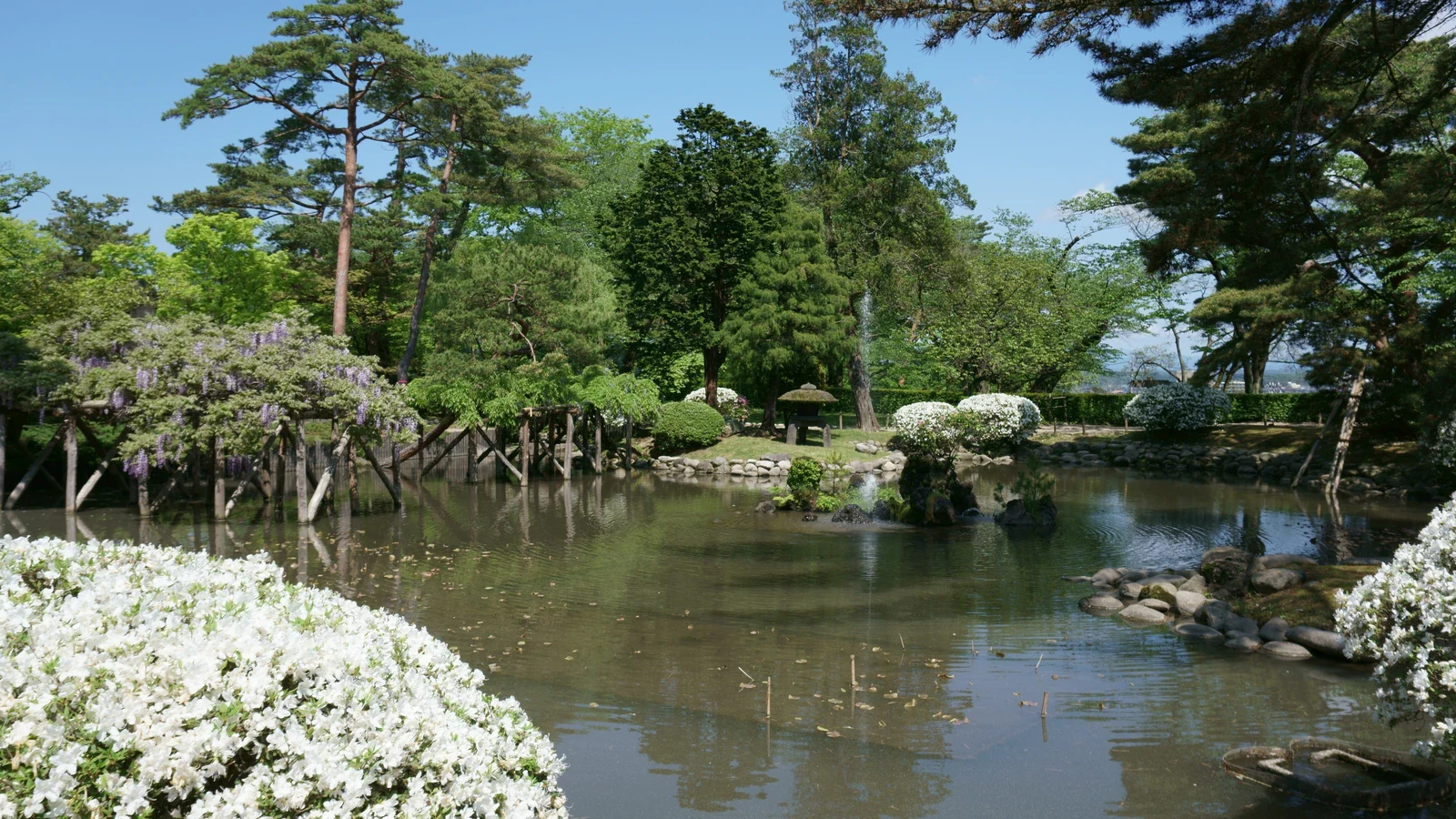
White flowering shrubs edge a pond with rocks and a fountain, surrounded by trees and a purple-flowering trellis.

Kogetsu Pond in Senshu Park, photographed in May 2018.

Kogetsu-pond in Senshu Park 20180520.jpg — 掬茶, CC BY-SA 4.0 (https://creativecommons.org/licenses/by-sa/4.0/). Source: https://commons.wikimedia.org/wiki/File:Kogetsu-pond_in_Senshu_Park_20180520.jpg. Proportionally reduced to a 1600-pixel long edge without upscaling; recompressed as WebP quality 92, method 6. No crop, retouching, added text or colour changes. EXIF omitted. · Creative Commons

Walks and routes

A short visit beside the moat

Start at the eastern pocket park on the station side of the Ōtemon moat. When open, follow the floating walkway toward Nakadobashi, pausing without blocking other walkers. The city gives the walkway itself as 254.2 metres long; the approach and your return add more walking. Turn back or continue along the public streets according to your energy.

Ask the park office about the current step-free approach and gangway conditions before relying on the floating walkway. The eastern pocket park also has a stair deck, so follow the appropriate entrance rather than assuming every connection is step-free.

A short visit beside the moat

Pond, gate and castle grounds

From the moat, follow Nakadobashi street and the uphill Ōsaka approach to Ninomaru. Visit Kogetsu Pond, then decide whether to take the Nagasaka steps through the main gate into Honmaru. From there, continue past the Satake Yoshitaka statue toward the turret if everyone still wants more walking. Return on open signed paths; the pond and Ninomaru make a satisfying stopping point without the upper section.

This suggestion includes an uphill approach and a stair climb. Wheelchair users and families with strollers should ask for a suitable alternative before setting off; do not lift a loaded chair or stroller up the gate steps.

Pond, gate and castle grounds

A relaxed family visit

Give the moat 20–30 minutes, including pauses, then decide whether the group wants the hill. Use the remaining time for Ninomaru, the pond and, if comfortable, the gate. Keep the turret optional. If a child is more interested in drawing leaves than moving on, that is a perfectly good use of the visit.

A history-focused half day

Walk first, then allow 45–60 minutes for Satake Historical Museum and around 30 minutes for the turret if it is open. Add a meal near the station or city centre rather than filling every gap with another attraction. Check exhibition and last-entry arrangements before deciding which indoor stop comes first.

Things to try

Build a three-shape sketchbook

Find three different shapes during the walk: a round lotus leaf when in season, the pointed outline of a maple leaf, and the roofline of the main gate. Sketch them or take one photograph of each. Let children choose their own shapes if those examples are out of season; the aim is to notice details, not finish a checklist.

Read the castle through the landscape

At a change of level, stop and ask why a castle builder might want a visitor to climb or turn. Compare the open Ninomaru space with the narrower approach to the gate. You can explore that question without knowing all the historical names, and the museum becomes more interesting if you carry one question inside.

Let the museum carry the visit

If rain makes the park’s slopes unappealing, make Satake Historical Museum the main stop when its exhibitions are open. Pair it with only a brief outdoor look at the moat if conditions allow. Its permanent collection and special exhibitions have different admission arrangements.

A separate indoor stop near the moat

Akita City Cultural Creation Center occupies the former prefectural art-museum building beside the park approach. Check its current programme for exhibitions or activities; it is normally closed on Tuesdays, or the following day when Tuesday is a public holiday. It can make a useful alternative to a long outdoor walk, with its own operating arrangements.

Wildlife and habitats

Lotus: look for leaves, flowers and seed heads

The moat’s cultivated lotus belongs to Nelumbo nucifera. Look for round leaves lifted above the water and, later, the distinctive seed-bearing centre after the petals fall. Compare what you can see from the walkway with Kogetsu Pond’s separate Ōga lotus planting. Keep hands and feet behind the edge; there is no need to lean out for a closer view.

Japanese maple: a small leaf with many points

The city lists iroha-momiji, Acer palmatum, on the southern Ōsaka approach. Choose a leaf you can see from the path and count its lobes without picking it. In autumn, compare a sunlit leaf with one in shade. These maples are associated with the park’s planting history, rather than evidence of an untouched native forest.

Dawn redwood: a conifer that changes colour

The park’s tree guide records planted dawn redwoods north of Honmaru and the former riding ground. Their narrow leaves sit in paired rows, and the foliage turns reddish brown before falling. If you reach the upper grounds, compare their outline with a nearby evergreen. Look from an open path instead of leaving it to find a particular tree.

Stories and discoveries

One park, two lotus stories

The city identifies the outer moat’s lotus as Gyozan-kōren. Kogetsu Pond received six Ōga lotus rhizomes in April 2002. The famous ancient-seed story belongs to the Ōga lineage; it should not be used to label every lotus in the outer moat.

A name looking toward the future

The name Senshū combines Akita’s character for “autumn” with “a thousand”, expressing a wish for lasting prosperity. The park began with the name Senshūen; it is a hopeful name for a place that has changed from a domain’s seat of power to a shared public landscape.

When to visit

Spring: follow the blossoms, not a fixed festival date

About four-fifths of the park’s cherries are Somei-yoshino. The city recorded full bloom in both Ninomaru and Honmaru on 11 April 2026, compared with 19 and 20 April in 2025. Treat those as examples of how much a season can move, not dates for your next trip. May then brings azaleas.

Summer: give the water its own visit

The city’s usual outer-moat lotus season runs from early July to mid-September. Choose a comfortable daylight morning and bring water. Summer illumination is a separately scheduled event; its dates and evening access rules do not replace the ordinary walkway notice.

Autumn and winter: shorten the plan as conditions change

The municipal map gives mid-October to early November for autumn colour. In winter, concentrate on a short outing only when footing is suitable, and check which toilets remain open before leaving the station. Do not plan to use the floating walkway or enter the turret simply because the surrounding grounds are normally open.

Getting there and practical advice

Toilets and borrowing a wheelchair

Accessible outdoor toilets are listed north of the turret, east of Honmaru, north of Kogetsu Pond and east of Ninomaru. The park map says outdoor toilets other than Ninomaru close in winter. The museum shop lends one wheelchair, without reservations, during its 09:00–16:30 hours on museum-open days. Ask about availability and any temporary changes on 018-824-1211.

Optional turret admission

Osumiyagura normally opens 09:00–16:30 and closes from 1 December to 31 March. Published admission is ¥150 for adults; high-school students and younger enter free. Hours extend during the city schools’ summer holiday, so check the current schedule if planning a late visit. Ask about interior access before buying a ticket if you need step-free movement.

Optional museum admission

Satake Historical Museum normally opens 09:00–16:30. Permanent-exhibition admission is ¥500 for adults and free for high-school students and younger; special exhibitions may charge differently. It closes 29 December–3 January, with additional exhibition-change or maintenance closures. The museum reopened in October 2025 after rebuilding. Check its date-specific calendar before visiting, especially around exhibition changes.

From Akita Station

Leave JR Akita Station on the west side. The city gives about five minutes on foot to the station-side pocket park and about fifteen minutes to Ninomaru. Allow longer for crossings, photographs and the uphill section. The moat is the easiest place to decide whether you want a short stop or a longer park outing.

Using the city buses

The Gururu city-centre loop serves Miruhasu-mae, about five minutes on foot from Ninomaru. Akita Chūō Kōtsū buses also stop at Senshū-kōen-iriguchi; allow roughly five to seven minutes onward, depending on the approach. Check the current service information rather than assuming a bus will save time over the walk from the station.

Choose the right small car park

The Ōtemon Street paid car park opened on 1 April 2026 with 31 spaces and year-round, 24-hour use. The older Ōsaka car park near Matsushita Gate has 14 spaces, operates 1 April–30 November and is unavailable during the cherry-blossom festival. Both publish ¥100 per 30 minutes. Construction can temporarily suspend use. Do not drive or park elsewhere inside the park; use nearby paid parking when these small lots are full.

Plan the whole journey, including the return

Call the park office on 018-888-5753 to discuss your chair, walking range or stroller and ask about the entrance, gradients and toilets on the day. If you need to avoid steps, agree a suitable return route as well as an outward one. The museum has four designated disability/considerate-use parking spaces; general visitors must use other parking.

Visitor information

Before choosing your route

Bears have been recorded in and around Senshu Park. Check the prefecture’s Kumadas information and the city’s park notices on the day, and obey any local restrictions. As checked on 16 October 2026, a prefecture-wide bear advisory runs from 1 to 31 October; its end date is not a promise that the risk has ended.

Sources and useful links

Wildlife you might spot

3

Each card links to a full Explore page with photos, traits, and fun facts.

Snap map for this place

Start with the big picture, then zoom in to explore individual wildlife observations around this place.

Loading map…

Good to know before you go

Check Akita’s current bear information and park notices before visiting, even though this is a city-centre park. Follow barriers and staff instructions; change your plan if an alert affects the grounds.

Visit in daylight, keep children close and avoid wandering alone into quiet, overgrown corners. If you see a bear, do not approach for a photograph or run; back away slowly and seek safety in a building or vehicle.

On the moat walkway, walk rather than run. Bicycles and kick scooters are prohibited even when pushed; skateboards are prohibited too. Preschool children must be accompanied by an adult.

Do not feed birds or fish, pick plants or remove lotus seed heads. Bring a snack if useful, keep food packed away between stops and take every wrapper home.

Wear shoes with grip. On rainy or icy days, shorten the visit rather than forcing the main-gate steps or the full castle-ground circuit.

Use the latest parking page

a new Ōtemon Street car park opened in April 2026, and older maps may omit it. The small uphill car park closes in winter and during the cherry-blossom festival.

Keep the museum and turret opening calendars separate. A closed exhibition or winter turret closure does not mean the public park itself is closed.

For professional photography or filming, arrange the city’s park-use permission in advance. Follow any separate photography rules inside museum exhibitions.

Frequently asked questions

Yes, the public grounds are free and normally open throughout the day. Museum and turret admissions are separate, and the floating moat walkway has its own seasonal and nighttime restrictions.
No. Kogetsu Pond lies inside the park near Ninomaru. The Ōtemon moat runs beside Hirokōji street at the foot of the park. Both have lotus plantings, but the large outer-moat display and floating walkway are at Ōtemon.
Kubota Castle did not have a grand keep. The familiar building you can enter is a reconstructed corner turret with an added viewing space. The park’s earthworks, moats and changes of level are central to understanding the site.
Yes, but choose your route with advice from the park office. The suggested upper-ground walk includes steps and slopes. Borrowing a wheelchair does not make every path suitable; check the approach, return route and toilet you plan to use.
The city recommends the morning, particularly 07:00–09:00 during the flowering season. Check local safety and access notices first, and visit only once it is light. A later safe visit is better than following a flower timetable into an affected area.
The photograph shows Kogetsu Pond in May 2018. It introduces the garden setting; flowering, maintenance and weather change the scene from year to year.

Recent snaps at this place

Recent snaps will appear here as new observations are added.

View all ›

Take the discovery with you

Exploring Senshu Park?

Identify the wildlife you spot, learn as you go, and keep a collection of the adventure.

  1. 1Spot it
  2. 2Snap it
  3. 3Keep the discovery