
Snappit logo
Snappit
Get App
Generic illustration, not a photograph of this venueIllustration
ParkKR

Seongsan Ilchulbong

Choose the kind of visit you want before buying a ticket.

About

Choose the kind of visit you want before buying a ticket. The summit gives you the crater from above; the lower visitor zone lets you appreciate the cone rising beside the sea without committing to the full climb. Both belong to the same destination. Clear daylight is excellent for understanding the landform, so there’s no need to build the whole visit around sunrise. Bring shoes you trust on steps, leave room in the schedule for the descent, and let the weather decide how far you go. Enhance your adventure: download the Snappit app to identify the local species you encounter.

The cone records an eruption in shallow seawater roughly 5,000 years ago. Water and rising magma interacted violently, throwing out ash that built up in layers. Later coastal erosion exposed those layers, while accumulated sediment joined the former island to Jeju. Seongsan became a component of the UNESCO-listed Jeju Volcanic Island and Lava Tubes property in 2007. Its importance is geological as well as scenic: the visible structure helps explain how this kind of water-driven volcanic eruption works.

What to do here

Take the managed summit path if repeated stairs suit your group, then pause at the designated viewing area to look across the crater and out toward Udo. For a shorter outing, use the open lower visitor paths overlooking the coast near Umutgae. The lower visit is a worthwhile choice in its own right, especially when you want the outline of the cone rather than the crater interior.

Seasonal info

Spring and autumn are useful starting points for a walking plan, but choose by the day’s wind and visibility. Summer calls for sun protection and a slower pace; in winter, keep hands free for the railings and check for slippery steps. No season guarantees a clear sunrise or an open summit.

Accessibility

The summit involves sustained stairs and uphill walking, so it is not a step-free outing. The lower zone is comparatively gentler, but that does not certify every viewpoint or beach approach as wheelchair-accessible. Ask staff which open section suits your mobility needs before setting off.

Don't miss

1

The contrast between the crater view above and the cone’s profile below

2

Layered volcanic cliffs shaped by eruptions and coastal erosion

3

Views toward Udo when visibility allows

4

A flexible visit with separate summit and lower-zone choices

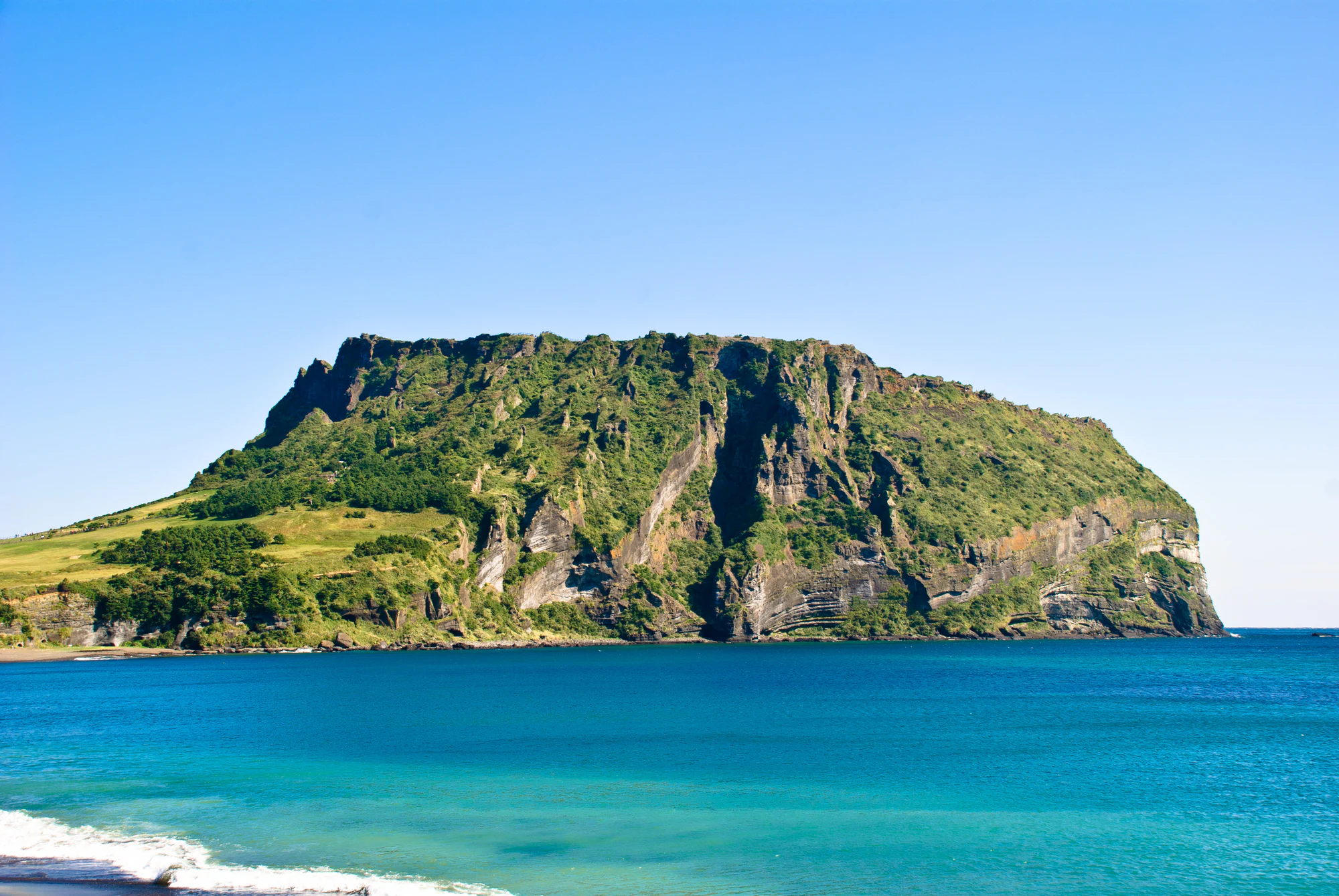
A steep, green-covered volcanic cone with exposed layered cliffs beside blue sea under a clear sky.

Seongsan Ilchulbong’s layered coastal face, photographed on 28 October 2010. This historical view illustrates the landform, not today’s access or conditions.

“Seongsan Ilchulbong tuff cone” — Jérôme Decq (-Jérôme-), Flickr, CC BY 2.0. Original file unchanged. · Creative Commons

Walks and routes

Ticketed summit visit

From the visitor entrance, follow the currently signed summit ascent, take breaks out of the main flow, and use the designated viewpoint rather than looking for a path into the crater. Follow the posted descent directions when you return; do not assume you should retrace an ascent-only section. The reward for the effort is the bowl-like interior, which is difficult to understand from the base. Leave enough energy for the steps down, especially if stairs trouble your knees.

Repeated steps make this a substantial climb despite the compact destination. A stroller or wheelchair cannot make the summit route step-free; choose the lower visit instead if carrying or repeated stair transfers would be necessary.

Ticketed summit visit

Lower coastal-view visit

Stay on the open visitor paths below the summit and take in the cone’s steep sides and the sea toward Umutgae. This is an out-and-back style visit that you can shorten to suit your group, not a mapped circuit. A coastal viewpoint does not require you to descend to the shore. If you want to watch a haenyeo program, ask where it is taking place and whether its approach is suitable before continuing.

Comparatively gentle does not mean level throughout. Inspect the next section before committing to a slope or steps, and keep the return journey in mind. Beach access and the easiest lower viewpoints should be treated as separate choices.

Lower coastal-view visit

If you have two hours

Check the entrance information, use the toilets, and choose the summit only if the group is ready for the steps. Spend your main walking time on the ascent and descent, with an unhurried stop at the crater viewpoint. Add a short look from below only if time and energy remain. A tour, queue or slow stair pace may mean leaving that extra stop for another visit.

If you want a gentler stop

Begin with the lower paths and choose a comfortable place to look toward the cone and sea. Turn around before a section that would make the return difficult. For a mixed-mobility group, sharing this part first can be more enjoyable than having everyone wait while one person races to the summit.

Things to try

See the volcano’s structure

Make room for the cliff profile as well as the summit. Tuff is rock made from volcanic material such as ash; here, exposed layers show how the cone accumulated. The steep sides are part of its scientific interest, so you can enjoy the geology from an authorized viewpoint without approaching the cliff base or collecting fragments.

Ask about a guided explanation

The operator lists interpretation at the summit. Ask staff about availability and language before relying on it; the listed session is about 40 minutes, so joining one would extend a standard visit. A guide can help connect the crater shape with the layers you saw from below.

Treat haenyeo work with respect

Umutgae is associated with demonstrations by Jeju’s women divers. A demonstration is a separate activity with its own conditions, rather than a guaranteed part of the climb. Follow the organizers’ directions, ask before photographing people closely, and keep clear of working space and equipment.

When the summit is a poor choice

A lower visit is an option only if that area is open and conditions there are safe. It is still outdoors, so strong wind, heavy rain or rough seas can make postponing the better decision. Ask at the entrance whether the on-site interpretation space is open if you want a brief indoor stop; do not count on it as a full replacement for the walk.

Wildlife and habitats

Look across the crater vegetation

Silver grass is documented inside the crater, but view the vegetation from the visitor area rather than seeking close-up access. Its appearance changes with season and conditions. Do not expect a particular flowering display, and do not use a distant photograph to identify a precise species.

Stories and discoveries

Why “Seongsan Ilchulbong”?

The name joins an image of a castle-like mountain with the spectacle of sunrise. Looking at the uneven crown from below makes the castle comparison easy to understand. The name describes the landscape and its reputation; it is not an opening-hours promise.

The coast is part of the heritage

The natural reserve’s significance extends beyond the summit to its coastal setting and marine vegetation. The sea is therefore more than a backdrop to a photograph. Stay within visitor areas and leave shore life and rock layers undisturbed.

When to visit

Plan for exposure, not just the forecast icon

Carry a layer you can put on while standing still and footwear with dependable grip. In warm weather, take the climb at a pace that leaves you comfortable for the descent. In cold or wet conditions, pay particular attention to the steps. Check Korea Meteorological Administration warnings as well as the local forecast; then ask the site about any access controls.

Getting there and practical advice

Hours, closure and tickets

The regular schedule checked on 18 October 2026 is 06:00–18:00 in November–February, 05:00–19:00 in March–April and September–October, and 04:30–20:00 in May–August. Ticket sales stop one hour before closing. The scheduled closure is the first Monday of each month; when that Monday is a public holiday, closure moves to the following day. Recheck special notices before traveling.

Budget and basic facilities

The published individual summit fee is ₩5,000 for adults aged 25–64 and ₩2,500 for ages 7–24. Ask about any exemption and the evidence needed rather than assuming it applies. Parking is listed as free, and toilets are available. Use facilities before climbing and check their location at the entrance; this is not a promise of summit services.

Find the visitor entrance

Use the destination name 성산일출봉 and the visitor address 284-12 Ilchul-ro, Seongsan-eup, Seogwipo-si. A pin for the peak or for a photographer’s viewpoint may lead somewhere quite different. If taking a taxi, make the entrance your destination and arrange your return around the actual visit rather than the ascent time alone.

Coming by bus

The official bus listings include route 111 between the airport and the Seongsan area, and route 201 along the east coast between Jeju and Seogwipo terminals. Look up 성산일출봉입구, the entrance stop, in the Jeju bus information system. Confirm the direction, branch and return departure on the day. Neither a route number nor a published seasonal gate time guarantees a bus connection for sunrise.

Ask the practical questions

If a step-free visit is essential, ask which lower viewpoints can currently be reached from parking or drop-off without stairs, whether gradients are manageable, and where the usable toilet is. Do not interpret a general accessible-tourism label as certification of the summit or the whole coast. Allow your group to change plans once you can see the route.

Sources and useful links

Wildlife you might spot

1

Each card links to a full Explore page with photos, traits, and fun facts.

We are still adding species preview cards for this place.

Snap map for this place

Start with the big picture, then zoom in to explore individual wildlife observations around this place.

Loading map…

Good to know before you go

Decide on the summit only after checking the steps, weather and everyone’s energy.

Finish eating before entry

Visit Jeju lists a no-food rule.

Keep your hands available for the railings and stop for photos only where others can pass.

Agree on a meeting place and time if some of your group stay below.

Do not enter the crater, climb barriers or approach cliff edges for a photograph.

Save the return-bus plan before you begin walking.

Frequently asked questions

No. The free lower visitor zone gives you coastal scenery and the cone’s exterior. It does not give you the same view into the crater. Choose it because it suits your time and mobility, rather than treating it as an incomplete summit visit.
Check your date with the site. Seasonal opening hours are published, but special arrangements, closures and the time needed for the stairs all matter. Do not enter a closed gate or assume that an old sunrise itinerary still applies.
Plan to use the signed visitor route and designated viewpoints. This guide does not describe a full crater-rim circuit or a descent into the crater, and a visible track in a photograph is not permission to use it.
It may not. The official tourism listing says the Umutgae coast demonstration depends on season and weather. Ask locally about that day’s program, and do not make the rest of your trip depend on seeing a performance.

Recent snaps at this place

Recent snaps will appear here as new observations are added.

View all ›

Take the discovery with you

Exploring Seongsan Ilchulbong?

Identify the wildlife you spot, learn as you go, and keep a collection of the adventure.

  1. 1Spot it
  2. 2Snap it
  3. 3Keep the discovery
