Snappit logo
Snappit
Get App
Generic illustration, not a photograph of this venueIllustration
ParkChubu, Japan

Tokugawaen

Start beside Ryusenko Pond and let the garden reveal itself a little at a time.

About

Start beside Ryusenko Pond and let the garden reveal itself a little at a time. Across the water, islands, pine trees and carefully placed rocks give each viewpoint a different balance. Follow the sound of running water toward the wooded side, and the open pond scene gives way to a small valley. This is a garden for slowing down, looking back and noticing how much a few steps can change the view.

Tokugawaen has deep ties to the Owari Tokugawa family, but today’s Japanese garden is a modern renewal of a much older place. Its story begins with Tokugawa Mitsutomo’s retirement residence in 1695. After donation to Nagoya and public opening in the 1930s, wartime destruction and later use as an ordinary park changed the site. The Japanese garden reopened in 2004, using existing woodland, the varied ground and substantial rock arrangements.

There are two useful scales to keep in mind. Nagoya describes the wider urban park as about 4.5 hectares; the landscaped Japanese garden itself occupies about 2.3 hectares. This guide focuses on that garden while explaining the surrounding heritage setting. Ryusenko, the waterfalls and the flower beds belong to one visit. The neighbouring Tokugawa Art Museum and the Hosa Library are cultural stops to plan separately.

You can enjoy the main contrasts without knowing the names of every plant. Compare a broad water reflection with a shaded stream, a simple wooden bridge with a dramatic rock face, or a single flower with its surrounding leaves. Leave room for a pause rather than treating the garden as a checklist. Turn your visit into a safari! Use the Snappit app to scan and log wildlife sightings here.

The surviving Kuromon gate and adjoining buildings help connect the present park to the former Tokugawa residence. Much of the garden was lost in the 1945 air raids; the current design should not be mistaken for an untouched Edo-period garden.

What to do here

Make the pond your starting point, then choose the stream and waterfalls or the seasonal flower beds. Add a cafe or museum visit if it suits your day.

Seasonal info

Check the latest flower report and event page. Evening access is date-specific, and a winter snow photograph is not a promise of snowy conditions.

Accessibility

Use the separate wheelchair map and ask at the entrance. It identifies uneven paths, stairs, a detour and a waterfall viewpoint where visitors must turn back; the whole garden is not a certified step-free circuit.

Don't miss

1

Ryusenko Pond and the Seikotei causeway

2

The wooded Toranoo stream and Kosenkyo Bridge

3

Ozone and Ryumon waterfalls

4

Peonies, Japanese irises and seasonal planting

Walks and routes

A first visit around the pond

From either garden entrance, use the official map to reach Ryusenko, then choose a comfortable sequence of pond views, the causeway area and seasonal planting. Return by an open path that suits your mobility. Allow 45–60 minutes as an editorial suggestion, with extra time for flowers or photographs. This is a flexible outing, not a signed or measured official route.

Add the wooded stream

If steps and uneven ground suit your party, add Toranoo, Kosenkyo and the Ozone Falls area to the pond visit. Allow 75–100 minutes in total as an editorial estimate. Wheelchair users should follow the dedicated map, use the marked viewing approach and turn back before the stairs; ask staff for today’s best option.

Things to try

A small garden challenge for children

Ask children to find a reflection, three different leaf shapes and a place where the water changes its sound. Compare what each person notices, then choose a favourite view. This is a suggested family activity, not a staffed programme. Keep young children beside you near pond edges and steps, and leave flowers, stones and wildlife where they are.

Learn with a garden guide

Free volunteer guides are normally listed for Fridays, weekends and public holidays, with a meeting point just inside the Kuromon garden entrance. Availability depends on time and weather; languages are not guaranteed. Ask on arrival rather than building a tight schedule around a guide being present.

Make time for tea or a meal

The surrounding facilities include Sozanso, a cafe in a relocated 1937 exposition building, the Garden Restaurant and Shop Aoi. These give you options for extending a garden outing. Check each business’s hours, reservations and menu separately, especially if you need a particular diet or are arriving late.

Wildlife and habitats

Japanese iris: a cultivated display

Look in the iris beds beside the pond in the usual late-May to early-June season. Compare colours and flower forms from the path. These are cultivated garden irises, not evidence of a wild wetland population. A flowering date and exact display size can vary.

Japanese black pine: part of the pond scene

The pond description specifically identifies black pine behind the islands. Look at the shape of the canopy against water and sky rather than trying to reach the planted islands. Its evergreen presence helps give the view structure outside the flower season.

Nandina: look near the entrance and peonies

The garden’s autumn plant guide places nandina near the Kuromon entrance and in the peony garden. It is a cultivated ornamental here. Use labels and the planting guide to help identify it, and leave berries and leaves untouched.

Stories and discoveries

Ryusenko and a borrowed Chinese landscape

The central pond is supplied by groundwater and represents the sea. Walk between viewpoints to see islands, rocks and pine silhouettes overlap in different ways. Seikotei, the straight causeway, draws on the celebrated West Lake in Hangzhou. It adds a Chinese landscape reference to the Japanese garden; you do not need to cross every water-edge feature to appreciate it.

A valley in miniature

Toranoo, the “tiger’s tail”, is the stream winding through the wooded garden toward the pond. Above it, Kosenkyo’s hinoki-wood bridge gives a different perspective, looking down about five metres to the water. The name invites an easy family story, but the stream is for looking at: stay on the paths and never step into it.

Two waterfalls with different stories

Ozone Falls drops six metres over three tiers, each shaped by a different arrangement of rocks. Ryumon Falls has a historical connection: stones from the Owari family’s former Toyama residence in Tokyo were reused in its reconstruction. Its name recalls the legend of a carp becoming a dragon after climbing a waterfall. Pause to listen as well as look.

Shelters and views worth lingering over

Shisuian sits among plum and peach trees, offering a quieter rest point. Across the pond, Zuiryutei is a small tea room with a view toward Seikotei. Enjoy their setting without assuming that interiors, tea service or special activities are available every day. On your approach, look at Kuromon and the buildings that retain the old residence’s character.

A garden rebuilt after several lives

The site moved from a Tokugawa residence to a public park, suffered wartime destruction and later returned to Japanese-garden form. The 2004 renewal explains why old buildings, mature woodland and contemporary landscape design sit together.

The waterfall rocks travelled from Tokyo

Ryumon’s stones were found during work at Waseda University in 1998 and identified with the Owari Tokugawa family’s former Edo residence. Reusing them links the Nagoya garden with another chapter of the family’s landscape history.

When to visit

Early spring and spring

Look around Shisuian and Zuiryutei for the garden’s listed plum plantings, and around Shisuian for camellias. Later, the peonies become a main attraction, usually in mid-to-late April. Different flowers peak at different moments, so choose a few things to look for rather than expecting the whole spring calendar at once.

Late spring and summer

Japanese irises usually provide their main display from late May to early June. The garden describes roughly 1,800 plants, especially Edo-style cultivars, in its iris beds. Fresh maple leaves along the stream offer a different pleasure. In hot weather, shorten the walk, carry water and take seated breaks.

Autumn

Combine changing leaves with smaller details: the autumn planting guide places sweet osmanthus near the Ozone entrance and tsuwabuki around the pond. Follow the current colour report instead of assuming one fixed peak week. Stop clear of narrow paths when taking photographs so everyone can enjoy the view.

Winter

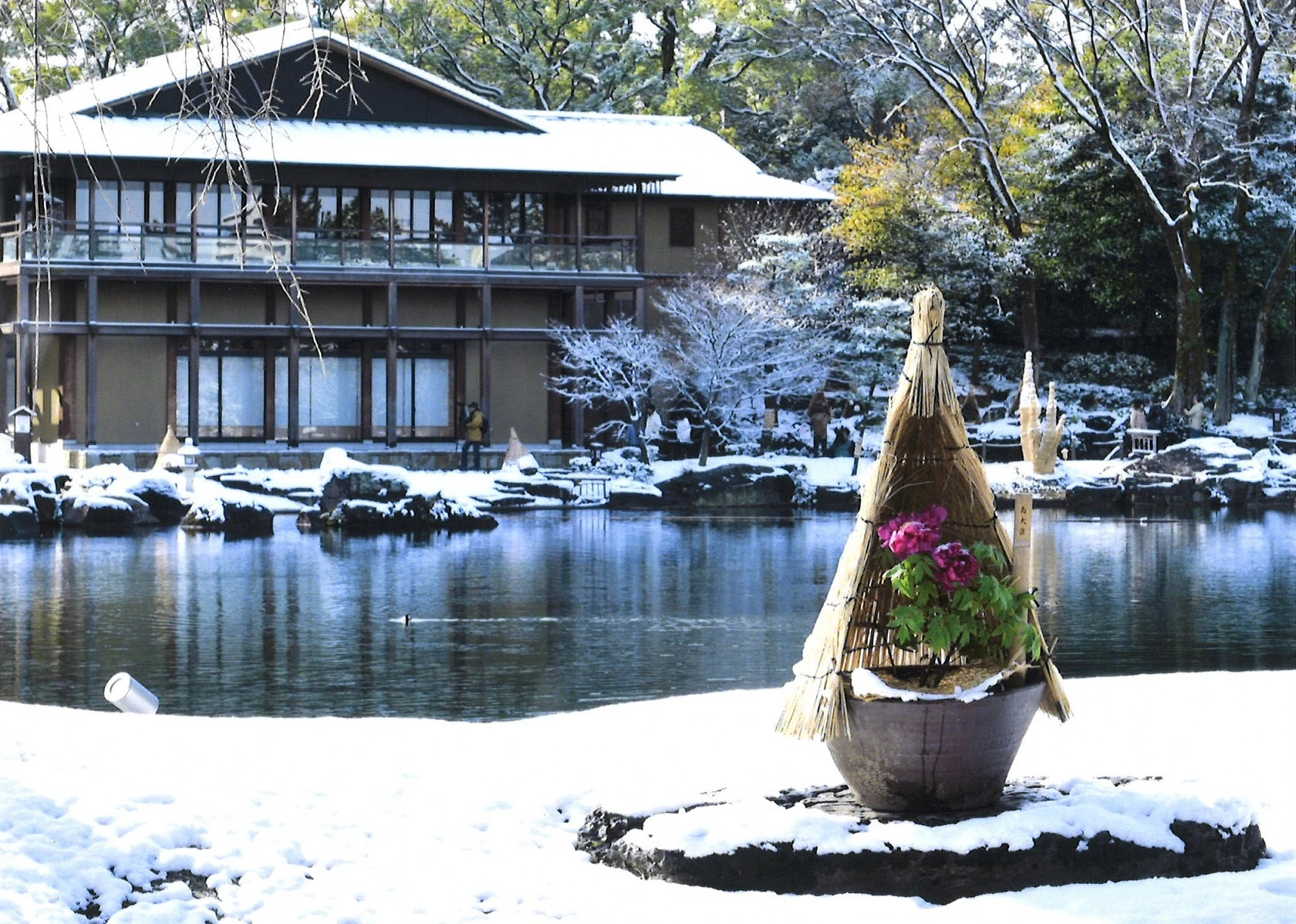
A quieter visit can focus on evergreen structure, bare branches and the garden’s winter-peony displays when scheduled. The accompanying city photograph records an unusually snowy scene, with a peony under straw protection. Snow is occasional and cannot be booked into an itinerary; check weather and footing before you travel.

Pink peony flowers stand in a pot beneath a conical straw cover, with snow around the pond and a two-storey garden building reflected in the water.

A winter peony under straw protection beside snowy Ryusenko Pond, with Kansenro across the water. This photograph has no verified capture date and does not show current conditions.

Photo: 佐々基成 / Nagoya City, “徳川園” (4th Nagoya Townscape Design Selection, 20 Selected Landscapes), CC BY 4.0. Original unchanged. · Creative Commons

Getting there and practical advice

Address: 1001 Tokugawa-cho, Higashi-ku, Nagoya, Aichi 461-0023. From JR Ozone Station’s south exit, the official estimate is about ten minutes on foot; from subway Ozone exit 3, about fifteen minutes. Morishita on the Meitetsu Seto Line is approximately eight to ten minutes, reflecting different official estimates. Kikan bus services stop at Tokugawaen Shindeki, about three minutes away; the Me~guru sightseeing bus also serves the cultural complex. Check current timetables and the most suitable station exit.

For drivers, regular-car parking is listed at ¥100 per 25 minutes, with a ¥1,000 same-day maximum through 23:00. The north underground car park has height and width limits; accessible spaces are listed in both parking areas. Ask about eligibility for parking concessions. Parking hours are not garden opening hours.


Hours, tickets and practical stops

Regular garden hours are 09:30–17:30, with last entry at 17:00. It normally closes on Mondays, or the next non-holiday when Monday is a public holiday, and from 29 December to 1 January. Events can change hours.

Standard admission is ¥300 for adults, including high-school and university students; junior-high-school age and younger enter free. Nagoya residents aged 65 or over pay ¥100 with proof. Specified Japanese disability and related documents can qualify the holder and up to two carers for free entry; overseas documents are not automatically covered. Check eligibility before relying on a concession.

The city lists wheelchair-accessible and ostomate toilets, baby facilities in toilets, an accessible elevator and an AED. The map shows toilets near the entrances. Ask staff for the facility best suited to your needs.

The official wheelchair map is essential because it is more specific than the general park plan. It marks uneven stretches, stair barriers and a viewing point for Ozone Falls beyond which visitors should turn back. It also shows a detour beside steps and an elevator near the Kuromon side. Confirm current surfaces, elevator operation and a suitable route with staff. One wheelchair is available free at each information desk, subject to availability, without reservations and for use inside the garden only.

www.tokugawaen.aichi.jp

Stay on open paths and supervise children beside water and steep edges. Wet stone, fallen leaves and winter ice can make footing difficult. Do not climb garden rocks or cross barriers for a photograph. Take shade and water breaks in heat, and follow temporary closure instructions during severe weather. The garden is non-smoking; collecting plants or animals is prohibited. These are observation spaces, so leave the next visitor the same quiet scene you enjoyed.

Visitor information

Dates checked on 20 October 2026

The event page lists free garden admission on 3 November 2026, the autumn-colour festival for 14 November–6 December 2026, and winter peonies for 2 January–14 February 2027. The 18 October free-admission day has passed. Confirm details before travelling; these listings do not establish evening hours or guarantee every path is open.

Autumn colour is a changing picture

The 1 October 2026 update describes colour beginning around Ryusenko and spreading toward the eastern garden. Treat it as an early-season report, not a peak-colour forecast for your visit. Typhoons or other conditions can trigger temporary closures.

Sources and useful links

Wildlife you might spot

3

Each card links to a full Explore page with photos, traits, and fun facts.

We are still adding species preview cards for this place.

Snap map for this place

Start with the big picture, then zoom in to explore individual wildlife observations around this place.

Loading map…

Good to know before you go

Keep the [official garden map](https

//www.tokugawaen.aichi.jp/walking/index.html) handy. It is useful for locating features, but does not provide a measured walking circuit.

Check [current events](https

//www.tokugawaen.aichi.jp/event/index.html) before planning a special opening. An old festival date or photograph does not establish today’s access.

Wear shoes with good grip. A short pond visit with a comfortable break can be more rewarding than rushing to every viewpoint.

Frequently asked questions

The garden and neighbouring museum are different attractions. Check the museum and Hosa Library’s own tickets, exhibitions and hours before combining them. Shirotori Garden is another garden elsewhere in Nagoya.
Packed food can be eaten on permitted benches, but not at Zuiryutei, Shisuian or the benches near Ozone Falls. Picnic sheets, alcohol and eating while walking are not allowed. Take your rubbish home.
Ordinary pets are not admitted. If you use an assistance dog, contact the garden about arrangements rather than relying on the general pet rule.
Do not assume so. Zuiryutei is a tea-room feature of the garden; any tea event or special opening needs its own current listing.
Ordinary personal snapshots and landscape photos need no application. Avoid tripods when crowded. Planned portrait, commemorative and commercial shoots require advance permission, even when some are non-commercial.
Use an entrance information desk or call the garden office on 052-935-8988. Agree a meeting point with companions: the garden does not provide visitor call-out announcements.

Recent snaps at this place

Recent snaps will appear here as new observations are added.

View all ›

Take the discovery with you

Exploring Tokugawaen?

Identify the wildlife you spot, learn as you go, and keep a collection of the adventure.

  1. 1Spot it
  2. 2Snap it
  3. 3Keep the discovery