
Snappit logo
Snappit
Get App
Generic illustration, not a photograph of this venueIllustration
ParkShikoku, Japan

Tokushima Central Park

Tokushima Central Park is a good place to let a city day loosen up.

About

Tokushima Central Park is a good place to let a city day loosen up. Start with the old castle walls and water, then give the family a choice: flowers and a pond at the foot of the hill, or a climb through the trees to the castle ruins. The lower grounds make a satisfying visit on their own. There is no need to turn a short outing into a summit mission.

The park brings together quite different kinds of greenery. The rose beds are deliberately tended for colour and scent; Benten Pond invites a pause beneath overhanging trees; and Shiroyama rises behind them as a wooded hill. In the separately ticketed Former Tokushima Castle Omotegoten Garden, stones, gravel and water become a carefully composed miniature landscape. Ask children to compare the shapes people have arranged with the shapes trees make for themselves.

For a first visit, allow about two hours for the lower park and the historic garden, including stops. Add the hill only if everyone is comfortable with steps, and save the museum for curious historians or a change in the weather. The stone walls are the main castle remains: do not expect a standing keep at the top. The museum helps put the missing buildings back into the story. Planning to visit? Download the Snappit app to identify the wildlife you spot in real-time.

The park occupies the former Hachisuka family castle grounds and opened in 1906. Washi-no-mon Gate was rebuilt in 1989 after its destruction in the 1945 air raid. The castle ruins received national historic-site designation in 2006. The Omotegoten Garden, protected as a national Place of Scenic Beauty since 1941, preserves a Momoyama-style arrangement traditionally attributed to the warrior and tea master Ueda Sōko. Its dry garden and pond garden let you read the landscape as part of the former lord’s residence.

What to do here

Begin at Washi-no-mon Gate, look along the moat and stone walls, then wander toward Benten Pond and the rose garden. Add the historic Omotegoten Garden for its dry landscape and pond. Families with energy left can follow the signed climb to Shiroyama’s Honmaru ruins; those wanting a gentler outing can stay below and enjoy the trees.

Seasonal info

Summer calls for water, a hat and a shorter walk with shade breaks. After rain, leave the hill and garden stepping stones for another day if footing feels uncertain. In winter, check the separate garden, museum and parking holiday closures before setting out.

Accessibility

Keep the hill climb separate from any wheelchair or stroller plan: its approaches include steps. The lower grounds offer a less demanding outing, but ask the park office which paths suit your needs. The historic garden has stone crossings and uneven sections. Accessible parking spaces and multipurpose toilets are available; ask staff to help you choose a suitable route between them.

Don't miss

1

The moat and surviving stone walls around the former castle

2

Benten Pond and a pause beneath the park’s trees

3

Seasonal roses in the eastern flower beds

4

The Omotegoten Garden’s contrasting dry and water-filled landscapes

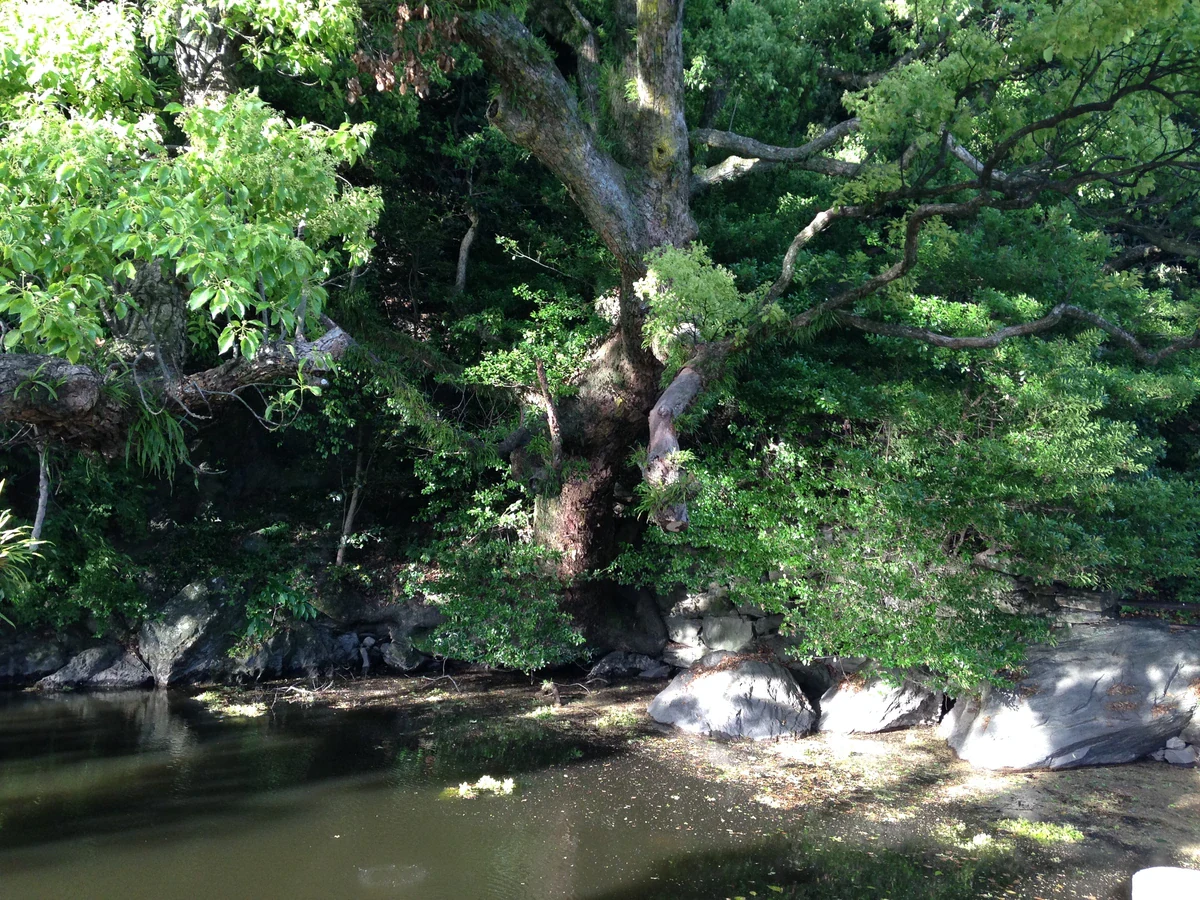
A broad, branching tree and dense green foliage shade a small pond edged by pale rocks.

Trees lean over Benten Pond in Tokushima Central Park, photographed in May 2016.

© そらみみ (Soramimi) / Wikimedia Commons / CC BY-SA 4.0. Benten'ike_Pond_in_Tokushima_Central_Park_1.JPG. Source: https://commons.wikimedia.org/wiki/File:Benten'ike_Pond_in_Tokushima_Central_Park_1.JPG. License: https://creativecommons.org/licenses/by-sa/4.0/. Proportional downsampling to fit 1200 × 1200 pixels without enlargement; WebP quality 92, method 6. No crop, retouch, recoloring or added text. EXIF omitted. Source EXIF lists software 9.3.1. Original camera rendering retained; no restoration or recovered-detail claim. · Creative Commons

Walks and routes

Pond, roses and castle walls

Allow 60–90 minutes. Start at Washi-no-mon, enjoy the moat and walls, and use the park map for the lower paths toward Benten Pond and the eastern rose beds. Take a break before returning. On an open day, add 20–30 minutes inside the Omotegoten Garden beside the museum.

Stay on the lower paths if steps are a problem. Ask the park office for the most suitable approach and any current diversions; do not assume every bridge or garden section is step-free.


Pond, roses and castle walls

Optional Shiroyama climb

Allow another 35–50 minutes for an up-and-down visit to the Honmaru ruins, including a pause at the top. Follow the signed approach shown on the city’s castle map and return before anyone is tired. The official map gives roughly 10 minutes from an ascent start to Honmaru, but children and careful walkers may need longer. The hill reaches 61.7 m above sea level.

This is a stepped climb, unsuitable as a wheelchair or stroller route. Keep away from wall edges and do not climb the historic stonework.

Optional Shiroyama climb

A relaxed two-hour visit

Spend the first hour around the gate, moat, pond and roses. If the garden is open, give it another 20–30 minutes, then leave the remaining time for a rest and the return walk. If it is closed, slow down in the free grounds rather than adding a climb by default.

When everyone wants more

Choose one extra: the hill for a little exertion, or 45–60 minutes in the museum for the Hachisuka family and castle-town story. Doing both can turn the outing into a three- to four-hour visit, especially with lunch and the station walks.

Things to try

Choose a rose by shape

At the flower beds, let each person pick a favourite bloom without touching it. Compare loose and tightly packed petals, then see whether your favourites share a colour. In a quieter season, compare the leaves and the way the plants have been trained.

Find the crane and turtle

In the historic garden, look for the stone arrangements representing a crane and a turtle. The long blue-green stone bridge is 10.5 m long. Try sketching the same view twice: once as stones, then as the shapes they suggest. Enjoy the bridge from the visitor path and follow signs about where you may walk.

A quiet minute by Benten Pond

Stop well back from the water and notice reflections, leaf movement and sounds. What changes when a breeze arrives? This is a simple way to slow the visit without needing to identify every plant or bird.

A small change of subject

If flowers have lost their audience, find the steam-locomotive display marked on the park map. It makes a useful lower-ground detour before returning to the nature walk; follow the display barriers.

Change the balance of the day

If the museum is open, swap the climb for its indoor exhibits. A brief lower-park walk can wait for a break in light rain; in a storm, postpone the outdoor portion. The museum has regular and special closures, so check before relying on it as your backup.

Wildlife and habitats

The eastern rose garden is a cultivated collection. Treat the name “roses” as a broad group here, then use individual labels to learn cultivar names. The city lists roughly 50 kinds and 400 plants, although the planting can change.

The park map marks a camphor tree called Ryūō-san no Kusu. Look for its branching shape, glossy leaves and grooved bark from the path, and take a moment to enjoy this living park landmark.

Think of this as a small plant-comparison walk: tended flowers, a historic park tree and a wooded hill all tell different stories. Look from paths, leave plants untouched and enjoy any wildlife without feeding or approaching it.

Stories and discoveries

A garden that once followed the tide

The historic garden’s pond used to connect to the moat through an underground channel, so its level changed with the tide. The city brochure says that connection is now blocked. The garden’s water story is historical, rather than a promise of a tidal display today.

Two ways to make a landscape

The southern dry garden suggests scenery without a full pond; the northern section uses real water and island-like stone groups. Looking for the differences is more rewarding than trying to rush through every named feature.

When to visit

Spring

Cherry blossom brings visitors to the park. Keep the schedule loose during busy periods and check current bloom notices if blossoms are the main reason for your trip.

The two rose seasons

Mid-May to early June and October are the city’s usual rose-viewing windows. Weather and gardening work can shift the display. Go slowly enough to compare flowers rather than expecting every bed to peak together.

Summer and winter

In hot weather, shorten the route and pause in shade; take water even for a city walk. In winter, the garden’s stonework and the castle walls still provide plenty to notice, but check holiday closures if you want indoor time too.

Getting there and practical advice

Toilets and rest stops

The city lists five toilet locations, including multipurpose facilities. Check the official map when you arrive and use a lower-park toilet before tackling the hill. Bring your own water and snacks rather than depending on a stall being open.

An indoor history stop

The museum introduces the domain’s history, the lives of its rulers, castle design, town life and the Awa navy. Pick one theme that interests the family, rather than trying to read every label. It is a separate paid visit with its own opening calendar.

From Tokushima Station

The city gives about 10 minutes on foot from JR Tokushima Station. Use the official map to find the park approach: the railway lies between the station and much of the park, so allow extra time with small children.

Suketo Bridge works

Suketo Bridge is closed to vehicles until the end of January 2028, as currently planned. Follow the signed road diversion. Pedestrians and cyclists may use the temporary walkway; cyclists must dismount. Kōen Kitaguchi bus stop is suspended during the works, and 10 east-car-park spaces are unavailable. Check the city’s works notice before travelling.

Parking

Ordinary cars cost ¥310 per entry per day. East parking opens 08:30–21:00 in April–September and 08:30–18:00 in October–March. West/south parking opens 08:00–22:00 on weekdays and 07:30–22:00 on weekends and public holidays. The usual parking closure is 29 December–3 January. Use these car parks only while visiting the park or its facilities, and check for special-date changes.

Planning with a wheelchair or stroller

Ask the park office at 088-621-5295 about your entrance, intended stops and suitable lower paths. The city lists two accessible bays in east parking and three in west/south parking; confirm availability during the bridge works. Ask the museum at 088-656-2525 about access to the museum and historic garden.

Inside the historic garden

Its ornamental rocks, stepping stones and uneven surfaces call for care. Ask which portions can be enjoyed without awkward crossings. You can still make a worthwhile park visit without entering every part of the garden.

The park and the paid attractions

The ordinary grounds have free admission. Plan an outdoor visit in daylight; garden, museum and car-park opening times are separate. The following practical details were checked on 16 October 2026.

Historic garden admission

Garden-only admission is ¥50 from age 12 and ¥30 for ages 6–11. Under-6s and visitors aged 65 or over enter free. The garden also lists free entry for holders of specified Japanese disability certificates and one carer. Museum visitors can enter the garden without a separate garden ticket; ask at reception about eligibility or proof.

Historic garden hours

Open 09:00–17:00, last entry 16:30. Closed Mondays unless a public holiday; also the day after a public holiday unless that day is Sunday or another public holiday. The annual closure is 28 December–4 January. Check the calendar for your date.

Museum admission and the current exhibition

Standard museum admission is ¥300 for adults and ¥200 for high-school and university students; junior-high-school pupils and younger enter free. During the autumn special exhibition, 10 October–23 November 2026, the rates are ¥500 and ¥300 respectively, with the same free child category. The special exhibition is about Hachisuka Masakatsu.

Museum hours and closures

The museum opens 09:30–17:00, last entry 16:30. It closes on Mondays unless a public holiday, and the day after a public holiday unless that day is Saturday, Sunday or a public holiday. Its annual closure is 28 December–2 January. An additional exhibition-change closure is listed for 25 November 2026; check the live calendar for other exceptions.

Sources and useful links

Wildlife you might spot

2

Each card links to a full Explore page with photos, traits, and fun facts.

Snap map for this place

Start with the big picture, then zoom in to explore individual wildlife observations around this place.

Loading map…

Good to know before you go

Start with the lower park, then decide together whether to add the hill.

Wear grippy shoes and keep small children close beside water, steps and wall edges.

Bring drinking water and leave time for a seated break.

Enjoy flowers and bark with your eyes; leave plants and fallen natural material in place.

Do not feed birds or park cats, and take your rubbish home.

Check both the garden and museum calendars; their holiday rules are not identical.

If driving, check the Suketo Bridge diversion and reduced east-car-park capacity.

Arrange park-use permission in advance for a commercial photo session.

Frequently asked questions

The ordinary park grounds are free. The historic garden and castle museum have separate admission arrangements; museum admission includes the garden.
No. The pond, roses, moat and historic garden can form the whole visit. Choose the stepped hill climb only if it suits everyone.
You will see castle ruins and stonework rather than a standing keep. Visit the museum if you would like help imagining the former buildings and castle-town life.
No. It is a separate feature in the park. The Omotegoten Garden has its own entrance and a different landscaped pond.
Keep a simple picnic considerate of other visitors and follow signs about where to sit. Take rubbish home; barbecues, camping stoves and other fires are prohibited.
A short lower-park stroll can work, but include the walk back to the station and a comfortable boarding buffer. Save the garden, hill or museum for a longer gap.

Recent snaps at this place

Recent snaps will appear here as new observations are added.

View all ›

Take the discovery with you

Exploring Tokushima Central Park?

Identify the wildlife you spot, learn as you go, and keep a collection of the adventure.

  1. 1Spot it
  2. 2Snap it
  3. 3Keep the discovery




