Snappit logo
Snappit
Get App
Generic illustration, not a photograph of this venueIllustration
ParkKR

Ulsan Grand Park

The best way to enjoy Ulsan Grand Park is to give one part of it your attention.

About

The best way to enjoy Ulsan Grand Park is to give one part of it your attention. A pond-side pause, a shaded walk beneath planted trees and a picnic can make a satisfying visit without trying every attraction. The main gate suits the large pond and woodland-side paths; the south gate is the practical choice for roses and the zoo; the east gate brings you to the bell and eastern ponds. Decide on your starting gate before setting off, especially with children or anyone who needs a shorter walk. [Choose an entrance](https://www.uic.or.kr/ulsanpark/introduction/intro05.do). Enhance your adventure: download the Snappit app to identify the local species you encounter.

The park grew out of Ulsan’s effort to improve everyday life alongside its heavy-industrial economy. The city and SK agreed on the project in 1995: Ulsan provided land, and SK developed facilities over the following decade before donating them to the city. That background helps explain the combination of large green spaces and practical recreation. This is a place built for residents to return to, as well as for visitors making a single stop. [How the park was created](https://uic.or.kr/ulsanpark/introduction/intro01.do).

What to do here

Choose a walk below, leave time to sit down, and add just one attraction if you want a fuller outing. The Zelkova Walk is a particularly simple choice for walking itself. Garden enthusiasts can compare the formal rose beds with the smaller themed planting areas. Families can put a picnic and play stop ahead of a long cross-park walk.

Seasonal info

Flowering, fountains and outdoor play facilities follow different seasons. Do not use a spring blossom photograph or a past festival schedule to predict what will be open or in bloom on your visit. Winter also brings shorter admission hours at the rose garden, zoo and Ecology Travel Hall.

Accessibility

Free wheelchair loans are listed at the security offices of the main, east and south gates; bring identification and ask about availability. This is a useful service, but it does not establish a step-free route through every garden. Start with a modest out-and-back and confirm the surfaces, gradients and nearest suitable toilet for your chosen destination.

Don't miss

1

The Pond of Abundance and its windmill setting

2

The planted Zelkova Walk and Dawn Redwood Path

3

Optional rose-garden and zoo visits from the south gate

4

Picnics, play spaces and small educational gardens

Walks and routes

Main gate: pond first, woodland if you feel like it

Begin at the main gate and make the Pond of Abundance your first stop. Its windmill and bridge give this part of the park a clear focal point. If everyone wants more walking, use the park signs and map toward Tiger’s Paw Terrace and the Dawn Redwood Path, then return the way you came. Allow about 45–90 minutes with stops; the route is an adjustable suggestion, not a measured loop. Park map.
Main gate: pond first, woodland if you feel like it

Zelkova Walk: make the trees the destination

For a straightforward walk, follow the signed Zelkova Walk and turn back whenever you have had enough. The operator publishes a total path length of about 1.8 km, with three rows of planted zelkova trees, benches and small resting spaces. Allow about 45–75 minutes for a leisurely visit, depending on how much you cover. The published length is for the named walk; it does not include getting there from your gate or returning to your car. Zelkova Walk details.

Zelkova Walk: make the trees the destination

South gate: roses, with the zoo as an extra

Enter at the south gate for the rose garden. Walk the formal beds at your own pace, then continue uphill to the zoo if it is part of your plan and admission is available. Return toward the south gate rather than adding a long crossing at the end. Allow roughly 1½–2½ hours for both, longer if flowers or animals hold your attention. The zoo is beyond the rose-garden entrance, so include the climb when deciding whether this route suits your group. Rose garden · Zoo.

South gate: roses, with the zoo as an extra

East gate: a short pond-and-bell outing

Use the east gate for the lotus-shaped fountain and Ulsan Grand Bell, then head toward the Carp Pond if you want a longer stroll. Return to the east gate for an easy-to-organize outing of about 45–75 minutes. Ornamental carp occupy the lower pond; treat them as managed park animals and leave feeding to staff. Fountains may be off, so choose this route for the waterside setting rather than a guaranteed display. Ponds and fountains.

East gate: a short pond-and-bell outing

An unhurried free morning

Choose the main-gate pond route, then add either a section of the Zelkova Walk or a short redwood-path visit. Finish with a drink or a packed snack rather than another long detour. Give yourself about two hours, and shorten the walk if weather or tired legs make sitting down more appealing.

A garden-led half-day

Start at the south gate, visit the rose garden while you have plenty of time before last admission, and decide afterward whether to add the zoo or the nearby indoor ecology exhibits. Leave room for lunch and a rest. About three to four hours is a sensible allowance; paying for every nearby attraction is unnecessary.

Things to try

Pause among the dawn redwoods

The Dawn Redwood Path has its own small-scale appeal: the operator describes a 270 m tree-lined path and a separate 60 m red-clay barefoot section, with a foot-washing area, benches and swings. These are facility lengths, not a complete gate-to-gate itinerary. Keeping shoes on and enjoying the trees is an equally good option; skip barefoot walking if the surface or your feet are uncomfortable. Dawn Redwood Path.

Look more closely at the gardens

The Nature Learning Garden near the carp water-play area is planted for education, with herbaceous and subtropical plants and several surface materials along its observation paths. The separate Themed Flower Gardens include useful plants, a rock garden and a wetland garden with viewing decks. These are good places to slow the pace after a larger lawn or pond, especially if you enjoy reading plant labels. Stay on the paths and leave flowers where everyone can see them. Nature Learning Garden · Themed gardens.

Give a picnic its own time

The designated Picnic Area combines lawn sections, a small stream, a playground and a small performance space. Bring a simple ready-to-eat lunch and let a meal break be part of the visit rather than something rushed between attractions. Keep children close beside water and clear your spot when you leave. A picnic can be the main activity for a younger family; there is no need to add the zoo simply because it is in the same park. Picnic Area.

Check Sopungmaru for play and rest

Sopungmaru occupies the former Children’s Traffic Safety Park site. It combines resting decks and shelters with net play, slides and other play equipment. Some spaces are freely used, while the rest shelters require a paid reservation; individual facilities have their own sessions and conditions. The operator lists Monday and Lunar New Year/Chuseok-day closures. Use the current facility page before promising a particular activity to children. Sopungmaru information and reservations.

Use the Ecology Travel Hall as a separate option

Near the south gate, the Ecology Travel Hall combines plant displays, insect specimens and live exhibits; its butterfly garden is described as operating from spring to autumn. It can be a useful indoor-focused alternative when open, though reaching it still involves an outdoor approach. Standard admission is separately charged at ₩2,000 for adults, ₩1,000 for teenagers and ₩500 for children, with card payment. It normally closes Mondays; last admission is 17:30 in April–October and 16:30 in November–March. Confirm the day’s arrangements before traveling. Ecology Travel Hall.

Wildlife and habitats

Japanese zelkova

The zelkova trees are deliberately planted along the named walk. Their three-row arrangement creates a leafy avenue, with places to sit along the way.

Dawn redwood

Look for these planted trees along the Dawn Redwood Path. Benches make the avenue a place to rest as well as pass through.

Roses

The rose garden brings together cultivated roses from the genus Rosa. Individual bed labels help distinguish the garden varieties.

Meerkat

Meerkats are listed among the zoo’s captive mammals. Check the exhibits on arrival; the collection list does not guarantee that every animal is on view.

Black swan

Black swans are listed in the zoo’s bird collection. This is a captive association, not a claim that wild black swans live in the park’s public ponds.

Stories and discoveries

A formal rose garden with three named themes

The rose garden is arranged around a central circular fountain, with Cupid, Venus and Minerva gardens adding distinct patterns to the flower beds. It is cultivated horticulture: the many named roses are garden selections, so a single wild-species label would give a misleading picture of the display.

When to visit

Spring

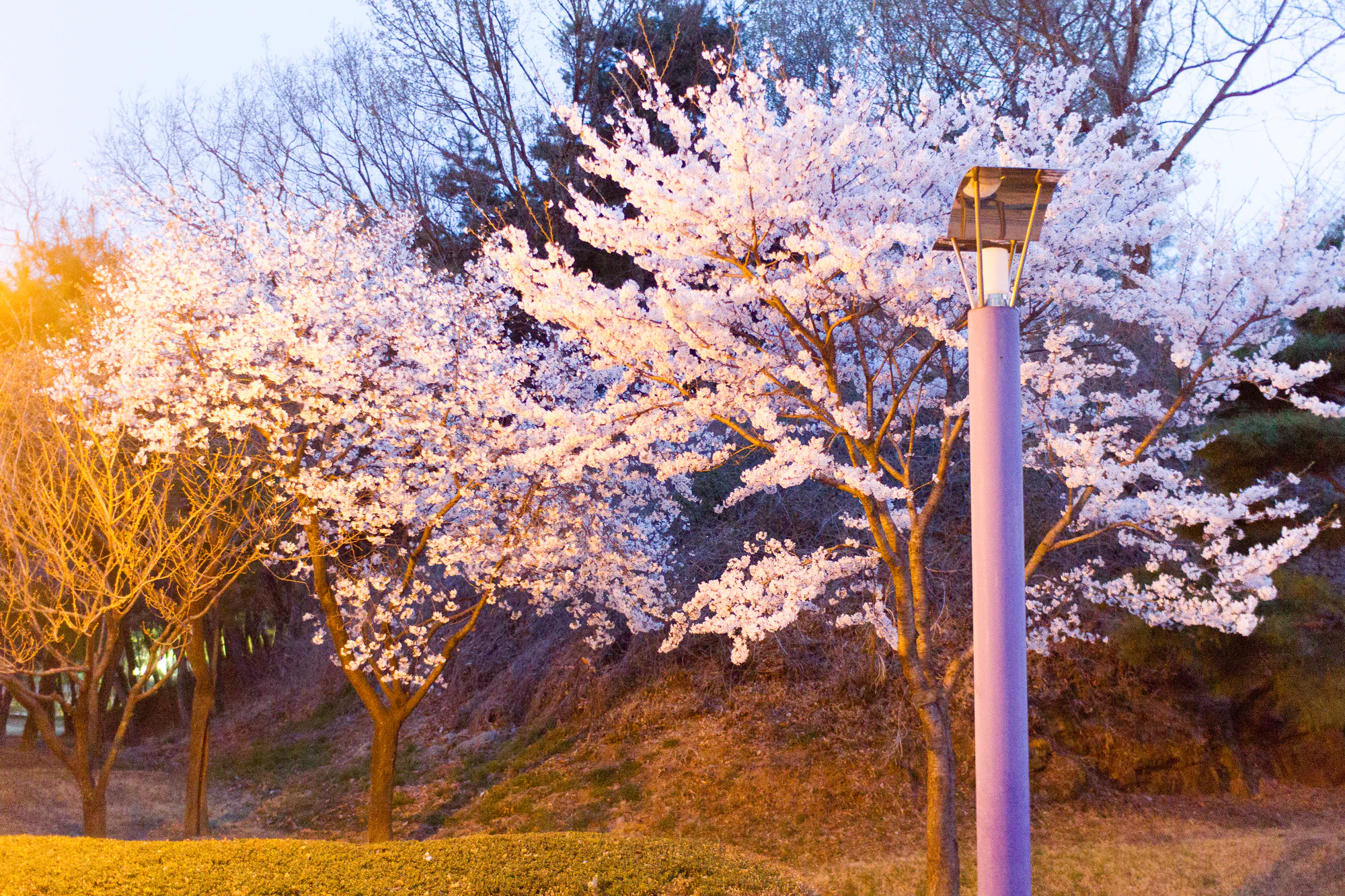
The Four Seasons Flower Garden at the south-gate plaza is described as an April tulip display. Planting and flowering vary, so leave room for a general park walk if the flowers are early or late. The historical blossom photograph below offers atmosphere, not a bloom forecast.

Summer

Choose shorter shaded walks and make water breaks part of the plan. The operator lists a seasonal outdoor water-play period, but its exact dates and operating conditions need checking each summer. Fountains also follow a separate schedule; ordinary ponds are not swimming areas.

Autumn and winter

Autumn is a good time to focus on the tree walks rather than a particular flower bed. In winter, aim for daylight and keep the outing flexible if paths are icy. The paid garden and indoor-exhibit day is shorter from November, so visit those before settling into a longer outdoor stroll.

Pale flowering branches beside a tall lamp post, lit with warm light against a wooded slope at dusk.

Spring blossoms at Ulsan Grand Park in a photograph dated 10 April 2011 by the photographer. The exact park section is unverified; this historical view does not show current bloom or lighting conditions.

[“IMG_4791”](https://www.flickr.com/photos/mylovechoe/18770099795/) by [Studio Kei](https://www.flickr.com/photos/mylovechoe/), [CC BY-SA 2.0](https://creativecommons.org/licenses/by-sa/2.0/deed.en). Unmodified original photograph. · Creative Commons 1 · Creative Commons 2

Getting there and practical advice

Admission and facility hours

Standard rose-garden/zoo admission, checked on 18 October 2026, is ₩2,000 for adults, ₩1,000 for teenagers and ₩500 for children, paid by card. Their standard hours are 09:30–18:00 in April–October, last entry 17:00; November–March closes at 17:00, last entry 16:00. Monday is the regular closure day. Ask about age categories, concessions and any event arrangements before buying. The general grounds remain a separate, free visit.

Everyday essentials

The operator lists convenience stores at all three principal gates and information points at the main-gate Aquasis building and beside the south-gate entrance. The official map marks toilets and drinking fountains. Check their locations before setting out with children or limited walking stamina, and bring your own water rather than depending on every fountain being available.

Plan to a gate

The park’s published address is 94 Daegongwon-ro, Nam-gu, Ulsan. For a taxi or a public-transport journey, choose the precise gate on the official directions page, which provides separate map links. Check a current journey planner for the bus route and final walk from your starting point; a route to the administrative address may be inconvenient for the south-gate attractions.

Arriving by car

There are main-, east- and south-gate car parks. The dedicated parking page lists 09:00–21:00 operation, subject to events and other changes. Parking is charged separately from park admission. Follow the posted tariff and exit arrangements on arrival, particularly if you intend to stay later than the car park’s listed hours. Parking information.

Choose the surface as well as the distance

The Nature Learning Garden includes red-clay, permeable-concrete and Jeju-stone paving, so the shortest-looking line on a map is not automatically the easiest route for small wheels. The zoo approach rises from the rose-garden area, while the barefoot path is an optional activity rather than a necessary connection. Ask staff for a route that matches your mobility and for current toilet access. For wheelchair loans, use the gate security offices and bring identification. Visitor services.

Sources and useful links

Wildlife you might spot

5

Each card links to a full Explore page with photos, traits, and fun facts.

Snap map for this place

Start with the big picture, then zoom in to explore individual wildlife observations around this place.

Loading map…

Good to know before you go

Save the Korean gate name you need

main gate 정문, south gate 남문 or east gate 동문. A generic park destination can leave you on the wrong side for your planned activity.

Bring a payment card if you plan to visit the paid gardens or exhibits; the operator lists card-only admission for the rose garden, zoo and Ecology Travel Hall.

Keep a little energy for the return to your starting gate. The named tree walks are only part of the distance from a car park or bus stop.

Carry water and sun protection, even if your main aim is a shaded walk. Stop before a child or companion becomes too tired to enjoy the return.

Watch for cyclists on shared approaches, and check the posted rules before riding into a garden or play area. Cycling in the park is prohibited after sunset.

Before leaving, check [park notices](https://uic.or.kr/ulsanpark/community/community01.do) and the page for any facility that is essential to your visit.

Frequently asked questions

The general grounds are free. Parking and some facilities cost extra. The rose-garden/zoo area has its own admission arrangements, and the Ecology Travel Hall is another paid visit. Choose the outdoor walks if you want to keep the outing simple and inexpensive.
The operator lists gate access from 05:00 to 23:00. That is not the timetable for every attraction: the rose garden, zoo and Ecology Travel Hall close earlier and normally close on Mondays. Check their individual pages and current notices, particularly around holidays or special events.
Yes, if you choose one area. Start at the main gate for the pond, or use a short section of a tree-lined walk. An hour is too tight for a relaxed circuit of several gates plus paid attractions. Make the farthest point of your walk a deliberate turning point.
No. The animals described in the zoo section are captive exhibits. The rose beds and tree avenues are planted landscapes. Enjoy any free-living wildlife you happen to encounter from a distance, but this guide does not promise particular wild species or sightings.

Recent snaps at this place

Recent snaps will appear here as new observations are added.

View all ›

Take the discovery with you

Exploring Ulsan Grand Park?

Identify the wildlife you spot, learn as you go, and keep a collection of the adventure.

  1. 1Spot it
  2. 2Snap it
  3. 3Keep the discovery