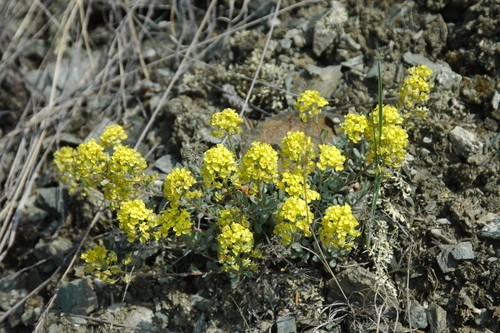


American Alyssum
odontarrhena obovata
The American Alyssum (Odontarrhena obovata) is a resilient, low-growing perennial herb belonging to the mustard family. This hardy species is adapted to thrive in some of the most challenging environments on Earth, such as subalpine and alpine tundra, rocky mountain slopes, and metal-rich serpentine barrens. Its ability to colonize barren soils and survive freezing temperatures makes it an important pioneer species in northern latitudes, helping to stabilize gravelly substrates and initiate soil development.
Habitat: Found on rocky slopes, gravelly scree, alpine tundra, and serpentine soils in cold temperate and arctic regions.
American Alyssum forms low, spreading cushions or mats of woody-based stems reaching 5 to 20 centimeters in height. Its small, paddle-shaped (obovate) leaves are covered in a dense layer of tiny, silvery, star-shaped hairs, giving the foliage a distinct grayish-green or dusty appearance. In mid-summer, it produces dense, rounded clusters of tiny, bright yellow flowers, each featuring the characteristic four petals of the mustard family.
Category
PlantsRarity
Common
Danger
1/5 · Very low
Snaps
2
The genus name Odontarrhena translates to 'toothed male' in Greek, referring to the characteristic shape of the filaments in the stamens of some species.
The silvery hairs that cover its leaves are so dense that they can make the entire plant look frosted even on warm summer days.
This plant is used by scientists in phytoremediation studies to explore how plants can clean up heavy-metal-polluted industrial soils.
It can safely absorb and store high concentrations of toxic heavy metals, particularly nickel, from serpentine soils in its tissues.
Its leaves are densely covered in star-shaped hairs that reflect excess solar radiation and reduce water loss from dry winds.
It produces specialized proteins and sugars that act as natural antifreeze, protecting its cellular structure during sudden freezes.
As a photoautotroph, this plant produces its own food using sunlight, carbon dioxide, water, and minerals absorbed through its roots.

Pieris rapae
Caterpillars feed on the foliage of this plant as a primary food source.
Bombus polaris
Provides vital nectar and pollen during the short arctic summer.

Silene acaulis
Competes for space and sparse nutrients in dry alpine gravel soils.
No trait badges are assigned for this object yet.
No aliases listed yet.
Collections for this object will appear here as more themes are added.
Danger
1/5 · Very low
No special safety notes yet.
The easiest way to identify American Alyssum is to use the Snappit nature identifier app.
5-20 cm
0.01-0.1 kg
3-10 years
As a photoautotroph, this plant produces its own food using sunlight, carbon dioxide, water, and minerals absorbed through its roots.
Found on rocky slopes, gravelly scree, alpine tundra, and serpentine soils in cold temperate and arctic regions.
14-30 days
Zoom in to split clusters and explore where this object has been snapped.
Take the discovery with you
Snap it with Snappit to identify it, learn what makes it special, and add the discovery to your collection.












.jpg&width=800)



_001.jpg&width=800)




