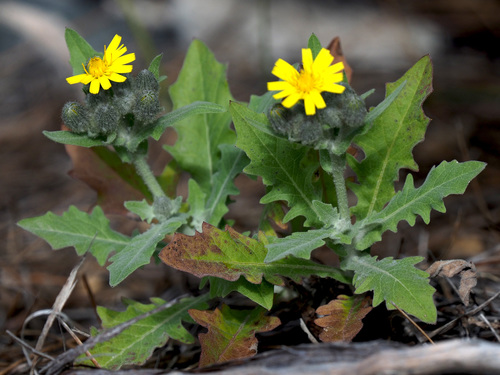


Andryala Pinnatifida
andryala pinnatifida
Andryala pinnatifida is an eye-catching perennial subshrub endemic to the Canary Islands. Belonging to the sunflower family (Asteraceae), this resilient plant has adapted beautifully to the volcanic terrains and varying microclimates of the archipelago. Known locally for its soft, velvety texture, it thrives on rocky slopes, open pine forests, and scrublands, adding a touch of silver-grey to the rugged landscapes. Its vibrant yellow composite flowers stand in stark contrast to its pale foliage, making it a favorite amongst native pollinators like wild bees and butterflies. This species plays an important role in the local ecology, colonizing volcanic soils and helping to prevent erosion in delicate island ecosystems.
Habitat: Found primarily on rocky volcanic slopes, roadsides, and open pine forests of the Canary Islands.
This plant is easily identified by its deeply lobed, pinnately divided leaves that are covered in a dense blanket of star-shaped, whitish-to-yellowish glandular hairs, giving the entire plant a distinct velvety, grey-green or silver appearance. It typically grows as an erect herb or small subshrub, reaching heights of 30 to 80 cm. During its blooming season, it produces terminal clusters of bright yellow flower heads (capitula) resembling dandelions, each measuring about 2 to 3 cm in diameter, sitting atop hairy, branched stems.
Category
PlantsRarity
Common
Danger
1/5 · Very low
Snaps
Be the first to snap!
It is a highly resilient pioneer plant, often being one of the first species to sprout on fresh volcanic ash after eruptions.
Its thick, fuzzy coating gives it a remarkably soft, felt-like texture that locals sometimes refer to as plant wool.
The species name 'pinnatifida' refers to its deeply lobed, feather-like leaves.
The dense layer of stellate hairs covering its leaves acts as a natural sunblock and reduces water loss by trapping moisture near the leaf surface.
Its robust root system allows it to grip loose volcanic soil and ash, stabilizing steep slopes and colonizing harsh terrains.
The bright yellow inflorescences emit subtle chemical cues that highly attract a wide range of native Macaronesian bees and butterflies.
As a photoautotrophic plant, it produces its own energy by converting sunlight, carbon dioxide, water, and soil minerals into sugars through photosynthesis.
Bombus canariensis
Provides nectar and pollen to this endemic Canarian bumblebee.
Gallotia galloti
Occasionally grazed upon by endemic lizards seeking hydration and nutrients in arid zones.
No trait badges are assigned for this object yet.
No aliases listed yet.
Collections for this object will appear here as more themes are added.
Danger
1/5 · Very low
No special safety notes yet.
The easiest way to identify Andryala Pinnatifida is to use the Snappit nature identifier app.
30-80 cm
2-5 years
As a photoautotrophic plant, it produces its own energy by converting sunlight, carbon dioxide, water, and soil minerals into sugars through photosynthesis.
Found primarily on rocky volcanic slopes, roadsides, and open pine forests of the Canary Islands.
Zoom in to split clusters and explore where this object has been snapped.
Recent snaps will appear here as new observations are added.
Take the discovery with you
Snap it with Snappit to identify it, learn what makes it special, and add the discovery to your collection.








.jpg&width=800)



_001.jpg&width=800)




