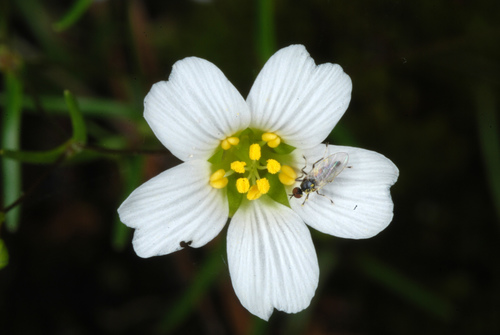


Appalachian Sandwort
mononeuria glabra
The Appalachian Sandwort is a resilient, delicate-looking wildflower that thrives in some of the most challenging environments of eastern North America. Often found clinging to the cracks of sun-baked granite domes and sandstone ledges, this small herb puts on a spectacular display of white blossoms during the spring. It is a true specialist of rock outcrop ecosystems, where it plays an important ecological role in anchoring thin pockets of soil and supporting local pollinator communities. Despite its fragile appearance, the Appalachian Sandwort is exceptionally tough. It has evolved to withstand intense solar radiation, extreme temperature fluctuations, and prolonged dry spells on exposed stone. For hikers and plant enthusiasts exploring the Piedmont and Appalachian regions, encountering a patch of these bright white flowers carpeted over bare gray rock is a memorable and beautiful sight.
Habitat: Found on exposed granite outcrops, sandstone ledges, and rocky barrens with extremely thin, acidic soils.
This low-growing plant typically reaches heights of 10 to 30 centimeters, forming loose, airy tufts. It features extremely slender, bright green stems that are entirely smooth and hairless. The leaves are small, narrow, and needle-like, growing in opposite pairs along the stem. During its blooming period from April to June, the plant produces numerous small, five-petaled white flowers. Each flower is about 1 to 1.5 centimeters wide, with tiny yellow or brown anthers in the center, contrasting beautifully against the pristine white petals.
Category
PlantsRarity
Common
Danger
1/5 · Very low
Snaps
1
Because it grows in incredibly harsh, soil-less conditions, it is considered a pioneer species that helps pave the way for other plants by slowly building organic matter.
It is highly sensitive to foot traffic, and a single step can easily dislodge its delicate roots from the shallow soil pockets where it clings.
The species name 'glabra' is Latin for smooth, highlighting the plant's lack of sticky hairs which are common in other sandwort species.
Its highly specialized, fibrous root system can penetrate microscopic fissures in solid rock, securing the plant against strong winds and heavy rains.
The plant features narrow, reduced leaves and a smooth waxy cuticle that drastically limits water loss, allowing it to survive on bare stone under the blazing sun.
It quickly completes its flowering and seed production in early spring before the intense heat of summer completely dries out its shallow soil pockets.
As a photosynthetic plant, it produces its own energy using sunlight, carbon dioxide, and water while absorbing essential mineral nutrients through its roots.
Toxomerus marginatus
Adult flies visit the flowers to feed on nectar, transferring pollen from plant to plant in the process.
Bombus pensylvanicus
Bumblebees visit the blossoms for pollen and nectar, acting as important pollinators in rocky glade habitats.
No trait badges are assigned for this object yet.
No aliases listed yet.
Collections for this object will appear here as more themes are added.
Danger
1/5 · Very low
No special safety notes yet.
The easiest way to identify Appalachian Sandwort is to use the Snappit nature identifier app.
10+ cm
As a photosynthetic plant, it produces its own energy using sunlight, carbon dioxide, and water while absorbing essential mineral nutrients through its roots.
Found on exposed granite outcrops, sandstone ledges, and rocky barrens with extremely thin, acidic soils.
Photosynthesis
Zoom in to split clusters and explore where this object has been snapped.
Take the discovery with you
Snap it with Snappit to identify it, learn what makes it special, and add the discovery to your collection.












.jpg&width=800)



_001.jpg&width=800)




