

Australian Magpie
gymnorhina tibicen
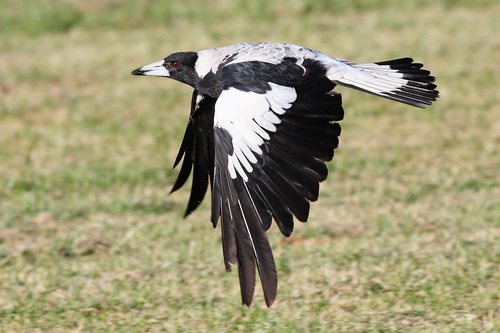
The Australian Magpie is one of Australia's most iconic and highly intelligent avian species. Renowned for its complex, flute-like carolling, this medium-sized black and white bird is a common sight in parks, gardens, and woodlands. Despite their friendly interactions during most of the year, they are famous for their protective 'swooping' behavior during the spring nesting season, fiercely defending their territory from perceived threats, including humans. Highly social and cognitively advanced, they live in stable, territorial groups and can recognize individual human faces.
Habitat: Typically found in open woodlands, agricultural lands, suburban parks, and grassy playing fields where they can forage on the ground.
The Australian Magpie is a robust bird, measuring between 37 and 43 cm in length, with a wingspan of 65 to 85 cm. It features a striking piebald plumage of solid black and pure white, though the exact patterns vary across its nine subspecies. Generally, it has a white nape, upper tail, and shoulder patches that contrast sharply with its black body. Its eyes are a distinctive reddish-brown, and its powerful, wedge-shaped bill is a pale bluish-white tipped with black.
Category
BirdsRarity
Common
Danger
1/5 · Very low
Snaps
Be the first to snap!
Their nesting defense, or 'swooping', is famously known to Australians as 'swooping season' and typically only lasts about six weeks.
They are so cognitively advanced that they have been documented working together to remove tracking devices placed on them by scientists.
Unlike many other songbirds that hop, Australian Magpies walk or run gracefully along the ground.
Capable of mimicking over 15 species of birds, as well as human speech, sirens, and domestic animals.
Can distinguish between individual humans and remember specific faces, categorizing them as friends or threats for years.
Utilizes complex social structures where group members take turns watching for predators while others forage.
Mainly insectivorous, foraging on the ground for invertebrates, but will also consume small reptiles, frogs, seeds, and fruit.
Scythrops novaehollandiae
The Channel-billed Cuckoo acts as a brood parasite, laying its eggs in the nests of Australian Magpies, which then raise the cuckoo chicks.
Anoplognathus pallidicollis
Australian Magpies actively hunt and consume Christmas Beetles during the summer months.

Vulpes vulpes
The introduced Red Fox preys upon young, fledgling, or injured Australian Magpies foraging on the ground.
No trait badges are assigned for this object yet.
No aliases listed yet.
Collections for this object will appear here as more themes are added.
Danger
1/5 · Very low
No special safety notes yet.
Compare the silhouette, bill shape, tail length, wing bars and markings around the eyes. The same small brown bird at your feeder can look quite different in breeding plumage, winter plumage or its first year. Bird Identifier: upload a photo and compare the visible details.
37+ cm
65+ cm
0.22+ kg
15+ years
45 km/h
Mainly insectivorous, foraging on the ground for invertebrates, but will also consume small reptiles, frogs, seeds, and fruit.
Typically found in open woodlands, agricultural lands, suburban parks, and grassy playing fields where they can forage on the ground.
Zoom in to split clusters and explore where this object has been snapped.
Recent snaps will appear here as new observations are added.
Take the discovery with you
Snap it with Snappit to identify it, learn what makes it special, and add the discovery to your collection.