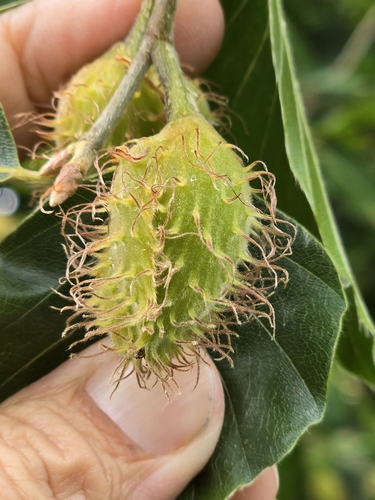





Beech
Fagus
Beech trees are tall and strong with smooth gray bark. Their leaves are shiny and turn golden in the fall. Beech trees provide homes for birds and squirrels.
Habitat: Forests
The Beech is known for its strikingly smooth, pale grey bark that often remains uncracked even on old trees. It has distinctive cigar-shaped, pointed reddish-brown winter buds and oval, slightly wavy-edged leaves that turn a brilliant golden-bronze in autumn.
Category
TreesRarity
Common
Danger
1/5 · Very low
Snaps
Be the first to snap!
Ancient people sometimes ground beechnuts into flour to make bread, especially during lean times.
Beech trees communicate through their roots using a 'wood wide web' of fungi, sharing nutrients!
Look closely at the buds! Beech buds are famously long, narrow, and pointed, like tiny cigars.
The word 'book' comes from an old word for beech, as early writing tablets were made from its wood!
Beech has uniquely smooth bark that makes it difficult for climbing plants to establish, helping it stay healthy and strong.
Beech trees produce abundant, nutritious 'beechnuts' in mast years, providing a vital food source for many forest animals.
Some Beeches keep their dry, brown leaves through winter (marcescence), possibly protecting new spring buds from frost.
Sciurus carolinensis
eats beechnuts

Sus scrofa
forages for fallen beechnuts
Lactarius blennius
forms mycorrhizal associations with roots

Cervus elaphus
browses on young leaves and shoots
This trait describes a symbiotic relationship between a fungus and the roots of a plant, benefiting both organisms.
Deciduous plants periodically shed all their leaves, typically during autumn or dry seasons.
Broadleaf trees are angiosperms characterized by flat, wide leaves that are typically shed annually in temperate climates.
Nut bearing plants produce hard-shelled fruits, commonly known as nuts, which contain a single seed and are a valuable food source.
Timber refers to wood that has been prepared for use in building and carpentry.
Forest habitats are terrestrial environments dominated by dense tree cover, supporting a high diversity of plant and animal life.
This trait characterizes organisms with an exceptionally long lifespan compared to others of their kind.
Danger
1/5 · Very low
Enjoy looking at beech trees from a safe distance and avoid climbing them.
Compare leaves or needles, how they attach to the twig, buds, bark and the shape of the crown. Lobed leaves are useful clues, but several unrelated trees share a similar outline. Tree Identifier: upload a photo and compare the visible details.
20-40 m
10-20 m
Yes
50-150 cm
150-300 years
Forests
Nut
Zoom in to split clusters and explore where this object has been snapped.
Recent snaps will appear here as new observations are added.

Bremen, DE
You might spot Duck, Oak, and Beech.
View guide →
Chugoku, JP
You might spot Beech, Oak, and Grey Wagtail.
View guide →
Hessen, DE
You might spot Beech, Oak, and Pine.
View guide →
Shikoku, JP
You might spot Beech, Maple, and Eurasian Wren.
View guide →
IT
You might spot Peregrine Falcon, Rosalia Longhorn Beetle, and Beech.
View guide →
Hamburg, DE
You might spot Beech, Maple, and Willow.
View guide →
Take the discovery with you
Snap it with Snappit to identify it, learn what makes it special, and add the discovery to your collection.