

Beech Leaf Disease
litylenchus crenatae
Beech Leaf Disease is an emerging forest threat caused by the microscopic foliar nematode Litylenchus crenatae. First recognized in Ohio in 2012, this invasive nematode attacks the leaf tissues of beech trees, rapidly spreading through forests in eastern North America. It invades the buds and leaves, disrupting the tree's photosynthetic capacity, leading to canopy dieback and, eventually, the death of both young and mature trees. This minuscule roundworm represents a major ecological challenge, threatening vital hardwood forest ecosystems and the diverse wildlife that depends on beech mast.
Habitat: Typically found in temperate deciduous and mixed forests where beech trees are present, living within the leaf buds and foliage of its host plants.
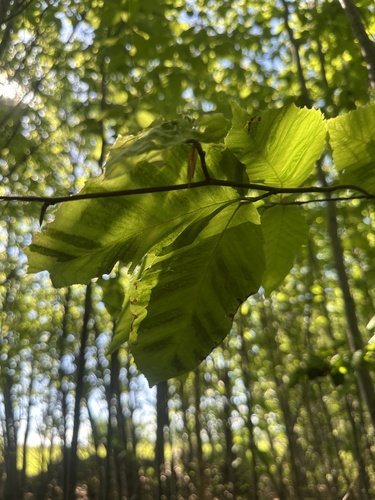
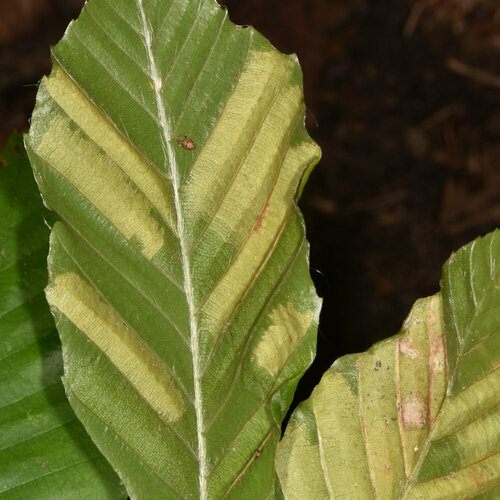
As microscopic nematodes, individual Litylenchus crenatae are invisible to the naked eye, measuring less than a millimeter in length with transparent, worm-like bodies. Instead, they are identified by the distinctive symptoms they produce on their host trees. Infected beech leaves display striking, dark green to blackish bands between the lateral veins, which are most visible when looking up through the canopy against the light. As the infection progresses, affected leaves become crinkled, leathery, and curled, eventually turning yellow or brown before dropping prematurely.
Category
AnimalRarity
Common
Danger
1/5 · Very low
Snaps
2
Despite their destructive impact, individual nematodes are so tiny that thousands can inhabit a single beech leaf without being individually visible.
The disease was first discovered in Ohio in 2012, and scientists rapidly traced the cause to this newly identified nematode species.
These nematodes are highly dependent on water films on leaves and stems to migrate upward from the soil or leaf litter into the tree canopy.
Employs a specialized stylet to pierce plant cell walls, allowing it to feed on and damage the internal mesophyll of beech leaves.
Can survive periods of severe desiccation inside dry fallen leaves or dormant buds, reviving when moisture returns.
Migrates into beech buds during late summer and autumn, sheltering inside the protective scales to survive freezing winter temperatures.
Feeds on the cellular contents of beech leaf tissues, specifically targeting the mesophyll cells within developing buds and mature leaves.

Fagus grandifolia
Serves as the primary host plant, sustaining the nematode population while suffering severe leaf damage and eventual mortality.

Fagus sylvatica
Acts as an alternative host plant susceptible to the nematode, particularly in ornamental and European forest settings.
No trait badges are assigned for this object yet.
No aliases listed yet.
Collections for this object will appear here as more themes are added.
Danger
1/5 · Very low
No special safety notes yet.
Start with body shape, legs or fins, fur, feathers or scales, and standout markings. Then weigh size, habitat and where you saw it. Young animals and seasonal coats can look very different from familiar adults. Animal Identifier: upload a photo and compare the visible details.
0+ cm
Feeds on the cellular contents of beech leaf tissues, specifically targeting the mesophyll cells within developing buds and mature leaves.
Typically found in temperate deciduous and mixed forests where beech trees are present, living within the leaf buds and foliage of its host plants.
Grazing
Zoom in to split clusters and explore where this object has been snapped.
May 26, 2026
CheshamPhoto attribution
(c) Jaime McGuigan, some rights reserved (CC BY)
License: CC BY 4.0 ↗
Image may be shown cropped inside the card frame.

New Hampshire, US
You might spot Eastern Red-Backed Salamander and Eastern Newt.
View guide →

Connecticut, US
You might spot Hobblebush, Pink Lady's Slipper, and Red Trillium.
View guide →

New Jersey, US
You might spot Striped Wintergreen and Partridgeberry.
View guide →

New Hampshire, US
You might spot White-Tailed Deer, Beech Leaf Disease, and Eastern Newt.
View guide →
Take the discovery with you
Snap it with Snappit to identify it, learn what makes it special, and add the discovery to your collection.