





Bellflower Resin Bee
Megachile campanulae
The Bellflower Resin Bee is a small, fuzzy bee that loves to collect resin from plants. They are great pollinators and help flowers grow by spreading pollen as they visit them.
Habitat: Grasslands
The Bellflower Resin Bee is a dark-bodied bee with distinct pale yellow to whitish hair bands on its abdomen. It has a bright reddish-orange "pollen brush" (scopa) on the underside of its belly and robust mandibles for manipulating sticky resin.
Category
InsectsRarity
Common
Danger
1/5 · Very low
Snaps
Be the first to snap!
Bellflower Resin Bees often sleep inside bellflowers, using them as tiny sleeping bags!
Each female bee builds her own cozy nest, all by herself!
They carry pollen on their belly hairs, not on their legs like honeybees!
They seal their nests with sticky tree sap, like nature's super glue!
Bellflower Resin Bees can collect and sculpt sticky tree resin because it helps them build strong, waterproof nest cells.
Bellflower Resin Bees have stiff hairs on their belly that helps them carry huge loads of pollen back to their nests.
Bellflower Resin Bees can efficiently gather nectar and pollen from bellflowers because they are perfectly adapted to them.
Nectar fuels their flight, while pollen feeds their growing young!
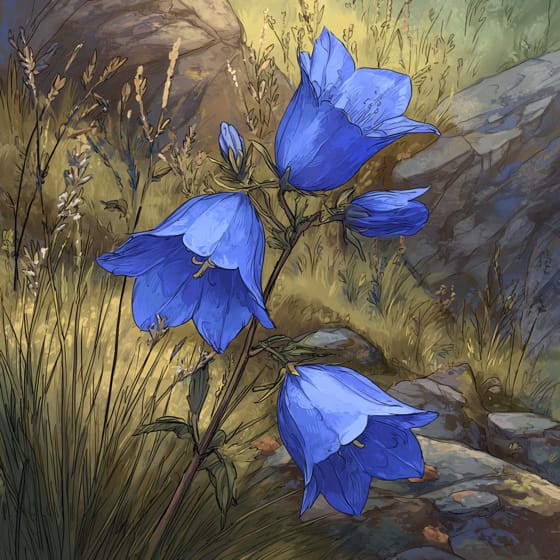
Campanula rotundifolia
Primary pollinator for its specialized host flower.
Araneus diadematus
Spiders often ambush foraging bees near flowers.
Coelioxys coturnix
Lays eggs in its nests, stealing food for its own young.
Furry describes animals possessing a dense covering of soft hair or fur.
Solitary animals live alone for most of their lives, only interacting with others for mating or parental care.
Grassland habitats are terrestrial biomes dominated by grasses and herbaceous plants, supporting a variety of grazing animals.
This trait characterizes organisms whose diet consists entirely or primarily of plant material.

Describes plants that are particularly attractive and beneficial to a wide range of pollinating organisms.

Diurnal animals are primarily active during daylight hours, typically resting or sleeping at night.

Describes a species whose presence and role have a disproportionately large effect on its environment.

Describes organisms that transfer pollen, enabling the fertilization and reproduction of plants.
No aliases listed yet.
Danger
1/5 · Very low
If you see a bee, watch it from a distance and don't touch it. They are usually busy working!
The easiest way to identify Bellflower Resin Bee is to use the Snappit nature identifier app.
15-25 mm
9-13 mm
20-40 days
15 km/h
Nectar fuels their flight, while pollen feeds their growing young!
Grasslands
Foraging
Zoom in to split clusters and explore where this object has been snapped.
Recent snaps will appear here as new observations are added.
Take the discovery with you
Snap it with Snappit to identify it, learn what makes it special, and add the discovery to your collection.





.jpg&width=800)



