
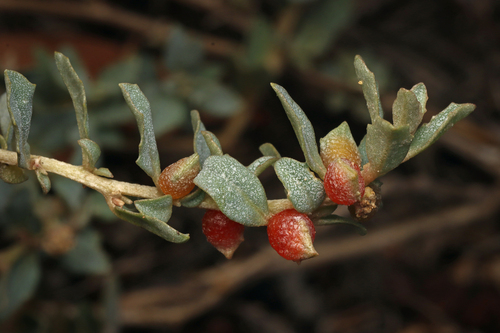


Berry Saltbush
atriplex semibaccata
Berry Saltbush, also known as creeping saltbush, is a resilient and adaptable perennial groundcover belonging to the Amaranthaceae family. Native to Australia, it has gained global recognition for its remarkable ability to thrive in challenging environments, particularly those with saline or disturbed soils where other plants struggle. This low-growing, spreading shrub is often utilized for erosion control and as a drought-tolerant ornamental. Its most distinctive feature is the small, bright red, berry-like fruits that cling to its stems, providing a splash of color and a food source for local wildlife. Its hardiness and ecological flexibility make it a fascinating study in plant survival, showcasing remarkable adaptations to harsh conditions.
Habitat: This hardy plant is typically found in coastal areas, salt marshes, disturbed sites, arid and semi-arid regions, and along roadsides and cultivated fields, thriving in a wide range of soil types, including sandy, loamy, and clay soils, often with high salinity.
The Berry Saltbush forms a sprawling, low-lying mat, typically growing 10-50 cm high and spreading up to 2 meters wide. Its stems are often reddish, bearing small, oblong to triangular leaves, 1-3 cm long, that are initially green but may develop a silvery sheen due to a coating of specialized salt glands. The most striking visual identifier is its abundance of small (3-6 mm), fleshy, berry-like fruits, which ripen from green to a glossy bright red, often appearing in clusters along the stems and persisting for much of the year, contrasting vibrantly with the foliage.
Category
PlantsRarity
Common
Danger
1/5 · Very low
Snaps
Be the first to snap!
Despite its common name and berry-like appearance, the fruits are not typically consumed by humans due to their salty and somewhat bitter taste, though they are safe for many animals.
It is known for its ability to quickly establish itself in disturbed areas, acting as a pioneer species that helps to stabilize soil and prepare it for other plants to grow.
The 'berries' of the Berry Saltbush are technically fleshy bracteoles (modified leaves) that enclose the true seed, making them attractive to seed-dispersing animals.
This plant's exceptional salt tolerance makes it a valuable species for phytoremediation, a process used to clean up salt-affected soils by absorbing excess salts.
Berry Saltbush possesses specialized salt glands on its leaves that excrete excess salt, allowing it to thrive in saline soils where most other plants would perish. This adaptation is crucial for its survival in coastal and arid environments.
Its ability to develop deep root systems and efficiently manage water loss enables it to withstand prolonged periods of drought, making it an excellent candidate for xeriscaping and revegetation in dry climates.
This plant is a prolific seeder and can spread effectively, establishing dense groundcover quickly in disturbed areas. This characteristic is highly beneficial for erosion control but can also lead to it becoming an invasive species in some non-native regions.
As an autotrophic plant, Berry Saltbush produces its own food through photosynthesis, converting light energy into chemical energy using carbon dioxide and water. It absorbs essential nutrients from the soil.

Passer domesticus
Seeds are consumed by various bird species, aiding in dispersal across new areas.

Ovis aries
Provides groundcover and some forage for livestock, particularly in arid regions where other plants are scarce.
Various native grasses and shrubs
Its extensive root system stabilizes soil, preventing erosion in fragile ecosystems like coastal dunes and disturbed sites.

Eschscholzia californica
In non-native habitats, it can outcompete and displace local flora due to its aggressive growth and resilience.
No trait badges are assigned for this object yet.
No aliases listed yet.
Collections for this object will appear here as more themes are added.
Danger
1/5 · Very low
No special safety notes yet.
Compare how the fruit is clustered, the leaves and their arrangement, the stems and any thorns. Red, blue and black fruits grow on lots of unrelated plants, and the same color can show up on both edible and poisonous species. Berry Identifier: upload a photo and compare the visible details.
10-50 cm
0.2-1.5 kg
3-10 years
As an autotrophic plant, Berry Saltbush produces its own food through photosynthesis, converting light energy into chemical energy using carbon dioxide and water. It absorbs essential nutrients from the soil.
This hardy plant is typically found in coastal areas, salt marshes, disturbed sites, arid and semi-arid regions, and along roadsides and cultivated fields, thriving in a wide range of soil types, including sandy, loamy, and clay soils, often with high salinity.
Photosynthesis
Zoom in to split clusters and explore where this object has been snapped.
Recent snaps will appear here as new observations are added.
Take the discovery with you
Snap it with Snappit to identify it, learn what makes it special, and add the discovery to your collection.


















