
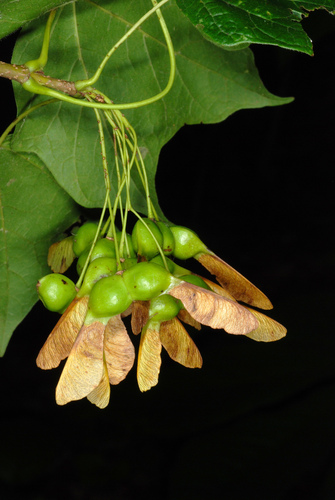


Black Maple
acer nigrum
The Black Maple (Acer nigrum) is a majestic, deciduous hardwood tree deeply cherished for its brilliant autumn colors and incredibly sweet sap. Often found thriving in the rich, moist soils of river bottoms and floodplains across the Midwestern and Northeastern United States, this species is a close relative of the iconic Sugar Maple. In fact, they are so closely related that many botanists classify the Black Maple as a subspecies, and they frequently hybridize where their ranges overlap. Beyond its striking presence in Eastern forests, the Black Maple plays a pivotal role in the maple syrup industry. Many syrup producers actively seek out these trees because their sap often boasts a slightly higher sugar content than that of their famous cousins. With its deeply furrowed dark bark and distinctive drooping leaves, the Black Maple stands as a resilient and beautiful cornerstone of North America's woodland ecosystems.
Habitat: Found primarily in rich, moist soils of floodplains, river bottoms, and mixed hardwood forests across the midwestern and northeastern United States.
The Black Maple is a large tree reaching up to 35 meters in height, characterized by its heavily furrowed, dark gray to nearly black bark on mature trunks. Its leaves are distinctly three-lobed (rarely five) with a drooping or wilted appearance at the edges, and unlike the smooth undersides of sugar maple leaves, black maple leaves feature fine, velvety hairs beneath. At the base of the leaf stalk (petiole), prominent leafy appendages called stipules are often present. In autumn, the foliage transforms into a breathtaking display of vibrant golden-yellow to brownish-yellow hues.
Category
PlantsRarity
Common
Danger
1/5 · Very low
Snaps
Be the first to snap!
Because of their drooping leaves, healthy Black Maples often look wilted or thirsty even when they have plenty of water.
Botanists still debate its classification; many consider it a distinct species, while others classify it as a subspecies of the Sugar Maple due to frequent natural hybridization.
The Black Maple's sap is highly prized by syrup producers, as it can occasionally contain even more sugar than that of the famous Sugar Maple.
The prominent leafy appendages, or stipules, at the base of its leaf stems are one of the most reliable ways to distinguish it from the Sugar Maple.
Produces a sap with an exceptionally high sugar concentration, allowing it to store energy efficiently for harsh winters and early spring growth.
Exhibits remarkable shade tolerance as a sapling, capable of surviving in the dark understory for decades until a canopy gap provides sunlight.
The drooping structure and fine hairs on the underside of its leaves help reduce transpiration, allowing it to conserve water during dry spells.
As a photosynthetic plant, the Black Maple produces its own energy by converting sunlight, water, and carbon dioxide into sugars.

Dryocampa rubicunda
Caterpillars of the Rosy Maple Moth feed extensively on the foliage.

Sciurus carolinensis
Small mammals like squirrels rely on its winged seeds (samaras) for winter food.

Odocoileus virginianus
Deer frequently browse on its young twigs and saplings during the winter months.
No trait badges are assigned for this object yet.
No aliases listed yet.
Collections for this object will appear here as more themes are added.
Danger
1/5 · Very low
No special safety notes yet.
Start with the whole plant, then compare leaf arrangement, leaf edges, stems and any flowers or fruit. Opposite leaves grow in pairs; alternate leaves come one at a time along the stem. These details tell you far more together than a single green leaf does. Plant Identifier: upload a photo and compare the visible details.
2000-3500 cm
100-300 years
As a photosynthetic plant, the Black Maple produces its own energy by converting sunlight, water, and carbon dioxide into sugars.
Found primarily in rich, moist soils of floodplains, river bottoms, and mixed hardwood forests across the midwestern and northeastern United States.
Zoom in to split clusters and explore where this object has been snapped.
Recent snaps will appear here as new observations are added.
Take the discovery with you
Snap it with Snappit to identify it, learn what makes it special, and add the discovery to your collection.


















