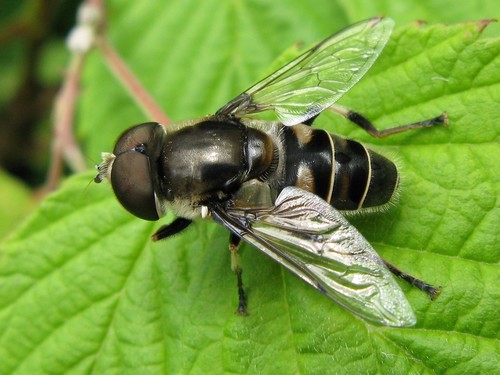


Black-Shouldered Drone Fly
eristalis dimidiata
The Black-Shouldered Drone Fly (Eristalis dimidiata) is a fascinating species of hoverfly that expertly disguises itself as a stinging bee to deter predators. Found widely across North America, these diligent pollinators are frequently spotted darting among blossoms in gardens, meadows, and wetlands. Despite their somewhat intimidating, bee-like appearance, they are entirely harmless and lack a stinger. What makes this species particularly remarkable is its extreme life cycle transformation. While the adults are elegant, agile flyers that sip nectar and pollinate flowers, their larvae—known as 'rat-tailed maggots'—thrive in stagnant, nutrient-rich pools of water. These larvae utilize a unique, telescoping breathing tube to survive in environments where few other aquatic insects can, eventually transforming into the beautiful, hovering adults that grace our summer gardens.
Habitat: Commonly found in moist meadows, gardens, and woodland edges near stagnant water sources where their aquatic larvae can develop.
Adults measure roughly 10 to 15 millimeters in length and are striking mimics of honeybees. As their common name suggests, they feature a distinctive dark, velvety band or 'shoulders' across the front half of their thorax. The abdomen is robust and dark brown to black, often accented with faint lighter banding or translucent patches near the base. Their wings are predominantly clear but display a noticeable brownish smudge or cloud near the middle of the leading edge. Large, prominent compound eyes cover much of the head, and unlike true bees, they have only a single pair of wings and short, stubby antennae.
Category
InsectsRarity
Common
Danger
1/5 · Very low
Snaps
Be the first to snap!
Despite looking exactly like a stinging bee, it only has two wings (like all true flies), whereas bees have four.
The larvae of the Black-Shouldered Drone Fly are commonly called 'rat-tailed maggots' due to a breathing tube that can stretch up to several times their body length.
They are often seen rubbing their front legs together while resting, a grooming behavior that helps keep their sensory organs clean.
This fly's hovering ability is so advanced it can fly backward or sideways in the blink of an eye to avoid an incoming predator.
Closely resembles stinging honeybees in both appearance and behavior to trick predators into leaving it alone, despite being completely defenseless.
Equipped with highly advanced flight mechanics, allowing it to hover perfectly still in mid-air and dart away rapidly in any direction.
Larvae possess a long, telescopic breathing tube on their posterior, enabling them to breathe atmospheric air while completely submerged in oxygen-depleted water.
Adults feed exclusively on the nectar and pollen of flowering plants, while the aquatic larvae filter-feed on decaying organic matter and microbes.
Age differences: Larvae are aquatic filter-feeders consuming organic detritus, whereas mature adults emerge to feed purely on floral nectar and pollen.
Solidago canadensis
Adults are important pollinators for late-summer blooms like goldenrod.

Misumena vatia
Often hunted by ambush predators hiding amongst flower petals.
Apis mellifera
Mimics the appearance of the honey bee to avoid predation from birds.
No trait badges are assigned for this object yet.
No aliases listed yet.
Collections for this object will appear here as more themes are added.
Danger
1/5 · Very low
No special safety notes yet.
Look for six legs, antennae, three body sections and the shape of the wings. Beetles have hardened front wings; flies have just one working pair. Tiny insects may need a close view before their group is clear. Insect Identifier: upload a photo and compare the visible details.
1-2 cm
1-2 cm
0.0001-0.0003 kg
0 years
15 km/h
Adults feed exclusively on the nectar and pollen of flowering plants, while the aquatic larvae filter-feed on decaying organic matter and microbes.
Commonly found in moist meadows, gardens, and woodland edges near stagnant water sources where their aquatic larvae can develop.
Zoom in to split clusters and explore where this object has been snapped.
Recent snaps will appear here as new observations are added.
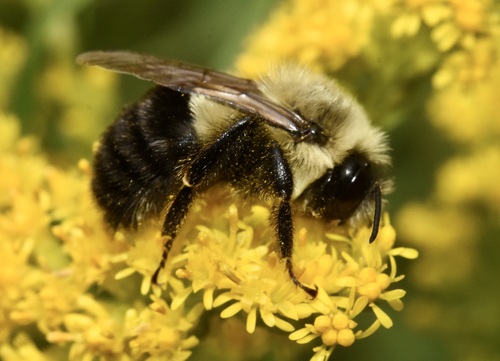
Georgia, US
You might spot Common Eastern Bumble Bee and Bee.
View guide →

Maine, US
You might spot Black-Shouldered Drone Fly and Dimorphic Sickleleg.
View guide →
Take the discovery with you
Snap it with Snappit to identify it, learn what makes it special, and add the discovery to your collection.