





Black-tailed Bumble Bee
Bombus melanopygus
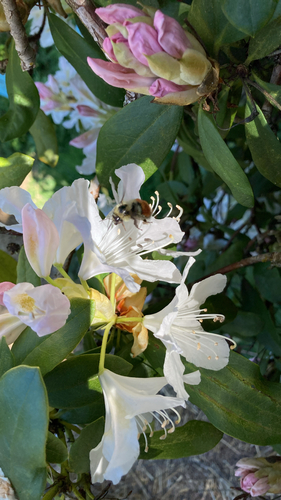
The Black-tailed Bumble Bee is a fuzzy, friendly insect that helps flowers grow by spreading pollen. They are often seen buzzing around gardens and parks, making them a delightful sight!
Habitat: Urban areas
The Black-tailed Bumble Bee is a medium-sized bee with a fuzzy, rounded body. It typically has two yellow bands on its thorax and a yellow band on its first abdominal segment. The rest of its abdomen is primarily black, often with reddish-orange hairs at the very tip, giving it its 'black-tailed' appearance.
Category
InsectsRarity
Common
Danger
2/5 · Low
Snaps
10
A queen bee lays all the eggs, starting a new colony each year!
Bumble bees can fly in temperatures too cold for most other insects!
They have a super-sense for electric fields, helping them find flowers!
They use their sticky feet to climb and hold onto flowers!
Black-tailed Bumble Bee can vibrate its powerful flight muscles to shake pollen loose from flowers, helping them spread seeds.
Black-tailed Bumble Bee can shiver its muscles to warm up its body, letting it fly in colder temperatures than many other insects.
Black-tailed Bumble Bee can remember the best flower patches and quickly find its way back to its nest using landmarks.
These busy bees sip sweet nectar for energy and gather pollen for their babies.

Lupinus arcticus
Collects nectar and pollen, aiding plant reproduction.
Misumena vatia
Ambush predator camouflaged in flowers, preying on bees.
Physocephala rufipes
Lays eggs on bees; larvae develop inside the bumble bee.
Furry describes animals possessing a dense covering of soft hair or fur.
Social animals live in organized groups, cooperating for survival benefits such as foraging, defense, and raising offspring.
This trait characterizes organisms whose diet consists entirely or primarily of plant material.
Describes plants that are particularly attractive and beneficial to a wide range of pollinating organisms.

Diurnal animals are primarily active during daylight hours, typically resting or sleeping at night.

Describes a species whose presence and role have a disproportionately large effect on its environment.

This habitat trait indicates species that can coexist with humans in urban and suburban environments, utilizing man-made structures and green spaces.

Describes organisms that transfer pollen, enabling the fertilization and reproduction of plants.
No aliases listed yet.
Danger
2/5 · Low
Don't touch bees; just watch them from a distance. They are usually friendly!
The easiest way to identify Black-tailed Bumble Bee is to use the Snappit nature identifier app.
20-38 mm
10-19 mm
14-365 days
18 km/h
These busy bees sip sweet nectar for energy and gather pollen for their babies.
Urban areas
Foraging
Zoom in to split clusters and explore where this object has been snapped.
May 2, 2025
FairhavenPhoto attribution
(c) larndesolen, some rights reserved (CC BY)
License: CC BY 4.0 ↗
Image may be shown cropped inside the card frame.

Washington, US
You might spot Pacific Tree Frog and Long-Toed Salamander.
View guide →

Washington, US
You might spot Pacific Banana Slug and Oregon Forestsnail.
View guide →

Washington, US
You might spot Bigleaf Maple, Mule Deer, and Oregon Grape.
View guide →

Washington, US
You might spot Rock Pigeon, Great Blue Heron, and Duck.
View guide →

Montana, US
You might spot Sticky Geranium, White-Tailed Deer, and Common Toadflax.
View guide →

Washington, US
You might spot Tiger, Walrus, and Polar Bear.
View guide →
Take the discovery with you
Snap it with Snappit to identify it, learn what makes it special, and add the discovery to your collection.






.jpg&width=800)



