
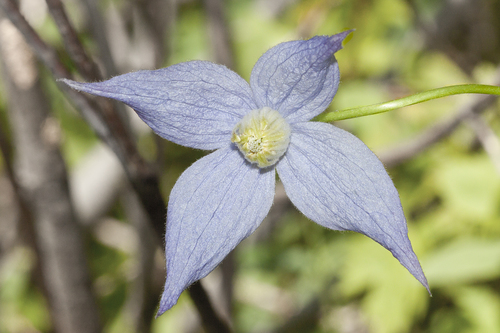


Blue Clematis
clematis columbiana
Blue Clematis (Clematis columbiana), also known as the rock clematis, is a lovely, delicate perennial vine native to the mountainous regions of western North America. Unlike many robust, woody garden cultivars, this wild relative is a slender climber that gracefully drapes itself over rocky slopes, forest floors, and low-growing shrubs. It brings a touch of elegance to the rugged understory with its nodding, bell-shaped violet-blue flowers that bloom in late spring and early summer. This species plays an important role in its native ecosystem, providing early-season nectar for native pollinators while its dense, tangled vines offer shelter for small birds and insects. Gardeners and native plant enthusiasts admire it for its subtle beauty and resilience in cold, rocky soils, representing the quiet wildness of montane woodlands.
Habitat: Found in open, rocky coniferous forests, mountain slopes, and thickets, often climbing over fallen logs or low shrubs in well-drained, shaded soils.
The Blue Clematis is characterized by its slender, climbing or trailing stems that can reach up to 3 meters in length. Its leaves are divided into three distinct, pointed leaflets with slightly toothed margins. The most striking feature is its solitary, nodding flowers, which sport four delicate, petal-like sepals ranging in color from pale blue to deep violet-purple, surrounding a cluster of yellowish-white stamens. Following the blooming period, the plant produces attractive, feathery, tassel-like seed heads that shimmer in the sunlight.
Category
PlantsRarity
Common
Danger
1/5 · Very low
Snaps
Be the first to snap!
Despite looking like petals, the showy blue structures on the flowers are actually sepals, which protect the flower bud before it opens.
Its fluffy, feathery seed heads remain on the plant long after the flowers fade, earning it the whimsical nickname of old man's beard in some regions.
The genus name Clematis comes from the ancient Greek word for a climbing plant or vine branch.
Modified leaf stalks function like sensitive tendrils, wrapping quickly around nearby branches and rocks to support upward growth toward sunlight.
Seeds are equipped with long, plume-like tails that catch the wind easily, allowing them to travel significant distances to find new rocky crevices.
Adapted to montane environments, this plant can survive sub-zero winter temperatures by entering a dormant state and storing energy in its deep roots.
As a photosynthetic plant, Blue Clematis produces its own energy using sunlight, water, and carbon dioxide, while absorbing essential minerals from rocky soils.
Bombus bifarius
Provides early-spring nectar to bumblebees while they act as primary pollinators.

Odocoileus hemionus
Mule deer occasionally browse on the leaves and stems in early spring when other vegetation is scarce.
Pseudotsuga menziesii
Uses the sturdy trunks and branches of Douglas-fir trees for physical climbing support to reach sunlight.
No trait badges are assigned for this object yet.
No aliases listed yet.
Collections for this object will appear here as more themes are added.
Danger
1/5 · Very low
No special safety notes yet.
Start with the whole plant, then compare leaf arrangement, leaf edges, stems and any flowers or fruit. Opposite leaves grow in pairs; alternate leaves come one at a time along the stem. These details tell you far more together than a single green leaf does. Plant Identifier: upload a photo and compare the visible details.
100-300 cm
1-2 kg
5-15 years
As a photosynthetic plant, Blue Clematis produces its own energy using sunlight, water, and carbon dioxide, while absorbing essential minerals from rocky soils.
Found in open, rocky coniferous forests, mountain slopes, and thickets, often climbing over fallen logs or low shrubs in well-drained, shaded soils.
Zoom in to split clusters and explore where this object has been snapped.
Recent snaps will appear here as new observations are added.
Take the discovery with you
Snap it with Snappit to identify it, learn what makes it special, and add the discovery to your collection.


















