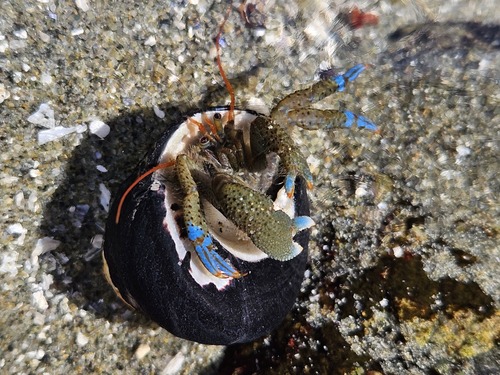


Blueband Hermit Crab
pagurus samuelis
The Blueband Hermit Crab (Pagurus samuelis) is a charismatic and highly active intertidal crustacean native to the rocky tide pools of the Pacific coast of North America. Renowned for its lively behavior, this small hermit crab is a favorite among tidepoolers due to its constant movement, scurrying over rocks and wrestling with peers for optimal discarded snail shells. Unlike true crabs, hermit crabs possess a soft, vulnerable abdomen, which forces them to inhabit abandoned gastropod shells to protect themselves from predators and harsh atmospheric exposure during low tide.
Habitat: Found in the high to middle rocky intertidal zones, particularly in shallow tide pools and among cobblestones along wave-swept ocean shores.
The Blueband Hermit Crab is easily identified by the bright blue bands wrapping around the tips of its walking legs, which contrast with its olive-green to reddish-brown body color. It has bright blue or white stripes near its joints and possesses dark antennae with distinct red bands. This species is relatively small, with a carapace length rarely exceeding 2 centimeters. It is almost always seen residing inside a protective spiral shell, most frequently that of the black turban snail, with its unequal, bumpy claws (chelae) visible at the entrance.
Category
AnimalRarity
Common
Danger
1/5 · Very low
Snaps
Be the first to snap!
They are highly social and are frequently found clustering together in damp rock crevices during low tide to conserve water and protect themselves from land predators.
They use chemical cues in the water to detect when a snail has died, rushing to the scene to compete for the newly vacant home.
When outgrowing their shells, these hermit crabs will often line up by size to execute a chain-reaction shell exchange, where each crab moves into the next larger vacant shell.
Uses precise tactile and visual senses to evaluate, clean, and select empty gastropod shells, upgrading to larger homes as it grows to protect its soft abdomen.
Seals its shell opening tightly using its modified claws to trap moisture inside, allowing it to survive hours of exposure to dry air during low tide.
Utilizes sharp-pointed tips on its walking legs to grip slippery, wave-battered rocky surfaces without being washed out to sea.
An opportunistic scavenger that feeds on macroalgae, microscopic organic detritus, and small dead animal matter found in tide pools.
Tegula funebralis
Provides essential shell shelters for the hermit crab after the snail dies.

Pachygrapsus crassipes
Actively hunts and cracks open smaller hermit crabs in rocky tide pools.
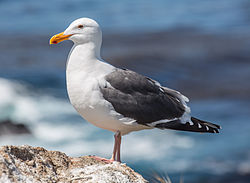
Larus occidentalis
Opportunistically predates on hermit crabs exposed during low tide.
No trait badges are assigned for this object yet.
No aliases listed yet.
Collections for this object will appear here as more themes are added.
Danger
1/5 · Very low
No special safety notes yet.
Look for fins, arms, tentacles, shells and body symmetry. Underwater light shifts colors, so structure and markings usually matter more than shade. Sea Creature Identifier: upload a photo and compare the visible details.
1+ cm
0.002+ kg
1+ years
An opportunistic scavenger that feeds on macroalgae, microscopic organic detritus, and small dead animal matter found in tide pools.
Found in the high to middle rocky intertidal zones, particularly in shallow tide pools and among cobblestones along wave-swept ocean shores.
Foraging
100+
Zoom in to split clusters and explore where this object has been snapped.
Recent snaps will appear here as new observations are added.
Take the discovery with you
Snap it with Snappit to identify it, learn what makes it special, and add the discovery to your collection.