

Bluestriped Grunt
haemulon sciurus
The Bluestriped Grunt is a vibrant and highly social marine fish that brings a splash of color to the coral reefs and seagrass beds of the western Atlantic and Caribbean. Famous for its schooling behavior, this species is often seen drifting in large, tightly packed groups beneath coral ledges, artificial reefs, and mangrove roots during the day. As night falls, these schools disperse into nearby seagrass meadows and sand flats, where the fish act as independent hunters searching for benthic invertebrates. They earn their common name from the distinct "grunting" noise they produce when distressed, which is created by grinding their pharyngeal teeth and amplifying the sound using their swim bladder. This acoustic trick, paired with their striking coloration, makes the Bluestriped Grunt a favorite among snorkelers and divers exploring shallow tropical waters.
Habitat: Typically found in shallow, clear tropical waters among coral reefs, rocky drop-offs, mangroves, and adjacent seagrass beds in the western Atlantic Ocean.
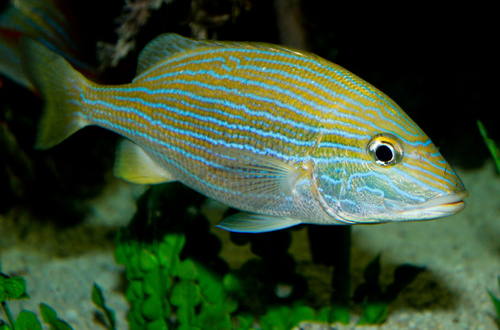
The Bluestriped Grunt is easily identified by its almond-shaped body covered in a bright yellow to yellowish-green base color, marked by striking, bold, electric blue horizontal stripes running from its snout to the base of its tail. Its dorsal and caudal (tail) fins are notably dark, often appearing black or dark brown, which helps distinguish it from similar species like the French Grunt, which has a yellow tail. The inside of its mouth is a vibrant red. They typically range from 20 to 30 centimeters in length, though exceptional individuals can grow larger.
Category
FishRarity
Common
Danger
1/5 · Very low
Snaps
Be the first to snap!
Despite being fiercely independent hunters at night, they depend heavily on the safety of tight-knit schools during daylight hours.
Snorkelers often confuse them with the French Grunt, but you can always spot a Bluestriped Grunt by its distinctive black or dark brown tail fin.
They create their namesake 'grunt' sound by grinding teeth located deep in their throat and using their air-filled swim bladder as a biological amplifier.
When Bluestriped Grunts feel territorial, they will engage in a behavior that looks exactly like kissing, forcefully pushing their open jaws against an opponent.
Produces a distinct grunting sound by grinding its pharyngeal teeth together and amplifying the noise through its gas-filled swim bladder.
Rests in dense, protective schools around coral reefs during the day, then purposefully disperses at night to hunt invertebrates hidden in sandy plains.
Engages in a unique territorial behavior where two individuals swim toward each other and forcefully push their wide-open mouths together.
A nocturnal carnivore that feeds primarily on benthic invertebrates and small crustaceans found in sand flats and seagrass beds.
Age differences: Juveniles primarily consume zooplankton before graduating to larger benthic crustaceans and mollusks as adults.
Epinephelus striatus
Preyed upon by large reef predators such as groupers and snappers.
Haemulon flavolineatum
Competes for reef space and similar food resources with closely related grunt species.
Farfantepenaeus duorarum
Hunts small benthic crustaceans during its nocturnal foraging in seagrass beds.
No trait badges are assigned for this object yet.
No aliases listed yet.
Collections for this object will appear here as more themes are added.
Danger
1/5 · Very low
No special safety notes yet.
Look at body shape, where the fins sit and their outline, mouth position, stripes and spots. Young fish and breeding adults can wear different patterns, and aquarium color varieties can look nothing like wild fish. Fish Identifier: upload a photo and compare the visible details.
20-46 cm
0.5-1.5 kg
10-15 years
25 km/h
A nocturnal carnivore that feeds primarily on benthic invertebrates and small crustaceans found in sand flats and seagrass beds.
Typically found in shallow, clear tropical waters among coral reefs, rocky drop-offs, mangroves, and adjacent seagrass beds in the western Atlantic Ocean.
Foraging
Zoom in to split clusters and explore where this object has been snapped.
Recent snaps will appear here as new observations are added.

US
You might spot Great Barracuda, Gray Snapper, and Red Mangrove.
View guide →

US
You might spot Great Barracuda, Gray Snapper, and Atlantic Sergeant Major.
View guide →
Take the discovery with you
Snap it with Snappit to identify it, learn what makes it special, and add the discovery to your collection.