

Brown-Black Carpenter Ant
camponotus ligniperda
The Brown-Black Carpenter Ant (Camponotus ligniperda) is one of Europe's largest and most ecologically significant ant species. Often found nesting in dead or decaying wood, these impressive insects play a critical role in forest ecosystems by accelerating the decomposition of timber and cycling nutrients back into the soil. Unlike termites, they do not eat wood; instead, they meticulously excavate complex galleries to house their rapidly growing colonies, which can persist for decades under the leadership of a single, long-lived queen. These social insects exhibit a fascinating division of labor, with workers divided into distinct size classes, or castes, including formidable soldiers equipped with powerful mandibles. Their active foraging behavior, complex chemical communication system, and mutualistic relationships with aphids make them a captivating subject for entomologists and nature lovers alike.
Habitat: Typically found in sun-exposed temperate coniferous and mixed forests, nesting primarily inside dry or decaying softwood stumps, fallen logs, and living tree trunks.
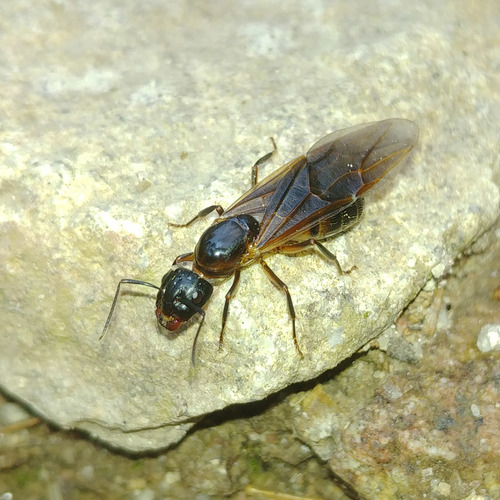
This species is characterized by its large size and distinct bicolored appearance. Workers range from 0.6 to 1.4 centimeters in length, while the massive queens can reach up to 1.8 centimeters. They have a shiny, black head and abdomen, contrasted beautifully by a reddish-brown thorax and legs. Their bodies are robust with a single petiole node connecting the thorax and abdomen. Winged queens and males may be observed during late spring nuptial flights, displaying darkened, semi-transparent wings.
Category
InsectsRarity
Common
Danger
1/5 · Very low
Snaps
Be the first to snap!
A queen of this species can live for up to 15 years, during which she maintains a colony of several thousand workers.
During spring, winged males and queens leave the nest in synchronized nuptial flights to mate in mid-air and start new colonies.
They are highly organized and can partition their wood nests into dry chambers for pupae and humid chambers for eggs and larvae.
Unlike termites, Brown-Black Carpenter Ants do not consume wood as food; they only excavate it to build elaborate, clean nests.
Using powerful, chitin-reinforced jaws, workers can chew through tough wood to construct intricate nesting galleries.
Foraging workers lay down precise pheromone trails to coordinate mass-recruitment of nestmates to rich food sources.
When threatened, these ants can curl their abdomens forward to spray formic acid over short distances to deter predators.
They primarily feed on honeydew secreted by aphids, supplemented heavily by scavenging dead insects, plant sap, and occasionally small live invertebrates.
Age differences: Larval stages are fed a protein-rich diet of insect prey, while adult workers consume energy-dense sugary liquids like honeydew.
Cinara piceae
The ants tend these aphids on spruce or pine trees, defending them from predators in exchange for sweet honeydew.
Picus viridis
This woodpecker frequently drills into decaying wood or ground nests to feed heavily on carpenter ants.
Formica rufa
Competes fiercely for nesting territories and foraging pathways in mixed European forests.
No trait badges are assigned for this object yet.
No aliases listed yet.
Collections for this object will appear here as more themes are added.
Danger
1/5 · Very low
No special safety notes yet.
Compare the antennae, waist segments, body proportions and size. Workers, queens and males of the same species can look surprisingly different. Ant Identifier: upload a photo and compare the visible details.
6-18 cm
2-3 cm
0.00001-0.00005 kg
1-15 years
They primarily feed on honeydew secreted by aphids, supplemented heavily by scavenging dead insects, plant sap, and occasionally small live invertebrates.
Typically found in sun-exposed temperate coniferous and mixed forests, nesting primarily inside dry or decaying softwood stumps, fallen logs, and living tree trunks.
Foraging
Zoom in to split clusters and explore where this object has been snapped.
Recent snaps will appear here as new observations are added.
Take the discovery with you
Snap it with Snappit to identify it, learn what makes it special, and add the discovery to your collection.