
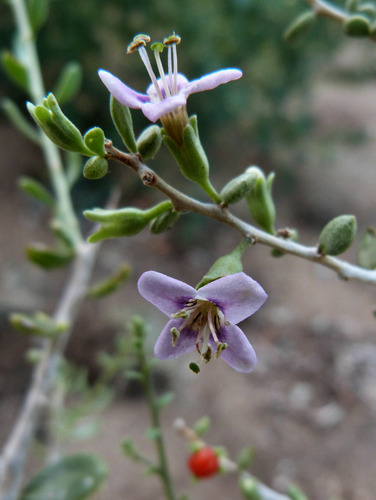


California Boxthorn
lycium californicum
The California Boxthorn is a resilient, heavily branched shrub native to the coastal bluffs and desert transition zones of Southern California and Baja California. As a tough member of the nightshade family, it is exceptionally adapted to harsh, salty coastal winds and prolonged droughts. Its dense, tangled branches form protective thickets that provide critical nesting sites and cover for local wildlife, while its bright red berries serve as a vital food source for native birds and mammals. During dry spells, this remarkable plant enters a dormant state to conserve water, bursting back to life with lush green leaves and delicate blossoms following the winter rains.
Habitat: Found on coastal bluffs, maritime succulent scrub, and salt marshes of Southern California and northern Baja California.
This species forms low, spreading mounds typically standing 0.5 to 2 meters tall. Its intricate, light-gray branches are highly stiff and end in sharp, defensive spine-tips. The leaves are small, succulent, cylindrical to club-shaped, and bright green, measuring about 3 to 15 millimeters long. It produces small, tubular flowers that are white to pale lavender with four (or occasionally five) lobes. These flowers give way to shiny, egg-shaped berries that turn from green to a striking, bright orange-red when ripe.
Category
PlantsRarity
Common
Danger
1/5 · Very low
Snaps
Be the first to snap!
Despite its common name containing 'thorn' and its resemblance to desert scrub, it is a true member of the nightshade family, making it a distant cousin of potatoes, tomatoes, and eggplants.
During deep summer droughts, the plant can appear completely dead, dry, and skeletal, only to sprout bright green succulent leaves within days of the first autumn or winter rain.
The small red berries are entirely edible and were traditionally harvested and eaten fresh or cooked by the indigenous Kumeyaay people of Southern California and Baja.
The plant can drop its succulent leaves entirely during severe dry periods to minimize water loss, entering a dormant state until moisture returns.
It thrives in saline soils and coastal spray, using specialized cellular adaptations to cope with high salt concentrations.
Its branches taper into sharp, woody spines that act as physical deterrents against hungry herbivores.
As an autotrophic plant, the California Boxthorn synthesizes its own organic compounds using sunlight, water, carbon dioxide, and mineral nutrients absorbed from the soil.

Zonotrichia leucophrys
The ripe, juicy berries are an important food source during late spring and summer.
Apis mellifera
Bees visit the tubular blossoms to collect nectar and pollen, acting as key pollinators.
Polioptila californica
The dense, spiny branches offer secure nesting sites and protection from predators.
No trait badges are assigned for this object yet.
No aliases listed yet.
Collections for this object will appear here as more themes are added.
Danger
1/5 · Very low
No special safety notes yet.
Start with the whole plant, then compare leaf arrangement, leaf edges, stems and any flowers or fruit. Opposite leaves grow in pairs; alternate leaves come one at a time along the stem. These details tell you far more together than a single green leaf does. Plant Identifier: upload a photo and compare the visible details.
50-200 cm
15-50 years
As an autotrophic plant, the California Boxthorn synthesizes its own organic compounds using sunlight, water, carbon dioxide, and mineral nutrients absorbed from the soil.
Found on coastal bluffs, maritime succulent scrub, and salt marshes of Southern California and northern Baja California.
Zoom in to split clusters and explore where this object has been snapped.
Recent snaps will appear here as new observations are added.
Take the discovery with you
Snap it with Snappit to identify it, learn what makes it special, and add the discovery to your collection.


















