

Canary Lauristine
viburnum rugosum
The Canary Lauristine (Viburnum rugosum) is a striking evergreen shrub endemic to the ancient laurel forests of the Canary Islands. Renowned for its lush foliage and resilient nature, this woody plant thrives in the humid, misty trade-wind zones of the mid-altitude mountains. As a key understory component, it contributes significantly to the unique, cloud-nourished ecosystems where it resides. During the spring, it bursts into dense, flat-topped clusters of creamy white flowers that later mature into glossy, metallic blue-black berries. This spectacular seasonal transition makes it not only a botanical jewel of the Macaronesian region but also an invaluable food source for endemic bird species.
Habitat: Found in humid, mid-altitude laurel forests and fayal-brezal shrublands of the Canary Islands, thriving in moist, shade-dappled environments.
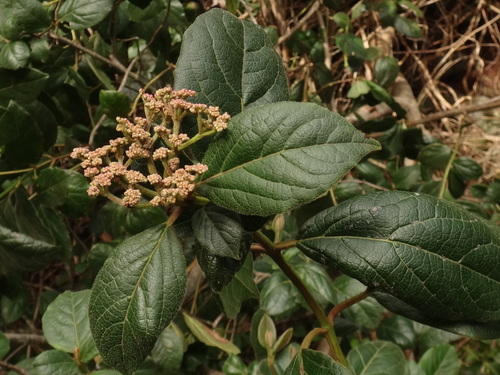
This evergreen shrub typically grows between 100 to 500 centimeters in height, featuring stout, hairy branches and large, ovate leaves. The leaves are notably rugose (wrinkled), dark green above, paler beneath, and covered with fine, rough hairs that give them a leathery texture. Its inflorescences are dense, flat-topped corymbs containing dozens of small, five-petaled white or light-pink flowers, which are succeeded by small, ovoid drupes that turn from red to a brilliant metallic dark blue or black as they ripen.
Category
PlantsRarity
Common
Danger
1/5 · Very low
Snaps
Be the first to snap!
Its metallic blue-black berries get their striking coloration not just from pigment, but from a unique microscopic structure in the fruit's skin that reflects light.
The species name 'rugosum' refers to the prominently wrinkled and rough texture of its evergreen leaves.
This plant is a classic relict of the Tertiary period, representing the ancient flora that once covered the Mediterranean basin before the ice ages.
The heavily wrinkled, hairy leaves trap moisture from mountain mists, reducing water loss and helping the plant thrive in variable island climates.
Deeply adapted to cloud forests, it efficiently utilizes low-light conditions beneath dense tree canopies through broad leaf surface areas.
Produces highly reflective, metallic blue-black berries that are exceptionally attractive to local bird species, ensuring efficient seed dispersal across fragmented island habitats.
As an autotrophic plant, the Canary Lauristine produces its own food through photosynthesis, utilizing sunlight, water, carbon dioxide, and soil nutrients.
Columba bollii
Feeds on the ripe metallic-blue berries, helping disperse the seeds throughout the island's cloud forest habitat.
Bombus canariensis
Feeds on the nectar of the white flowers while acting as a primary pollinator for the shrub.
Vanessa vulcania
Feeds on the foliage of Viburnum species during its larval stage.
No trait badges are assigned for this object yet.
No aliases listed yet.
Collections for this object will appear here as more themes are added.
Danger
1/5 · Very low
No special safety notes yet.
Start with the whole plant, then compare leaf arrangement, leaf edges, stems and any flowers or fruit. Opposite leaves grow in pairs; alternate leaves come one at a time along the stem. These details tell you far more together than a single green leaf does. Plant Identifier: upload a photo and compare the visible details.
100-500 cm
15-40 years
As an autotrophic plant, the Canary Lauristine produces its own food through photosynthesis, utilizing sunlight, water, carbon dioxide, and soil nutrients.
Found in humid, mid-altitude laurel forests and fayal-brezal shrublands of the Canary Islands, thriving in moist, shade-dappled environments.
Zoom in to split clusters and explore where this object has been snapped.
Recent snaps will appear here as new observations are added.
Take the discovery with you
Snap it with Snappit to identify it, learn what makes it special, and add the discovery to your collection.