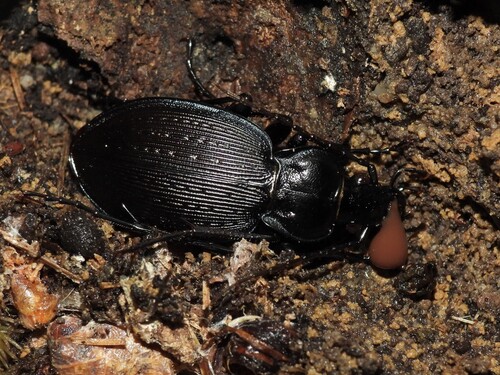


Carabus Goryi
carabus goryi
Carabus Goryi is an impressive and elegant species of ground beetle native to the forests and scrublands of the Middle East, particularly within regions like Turkey and Iran. As a member of the diverse Carabidae family, this beetle is a highly efficient, nocturnal predator that patrols the forest floor in search of small invertebrates. With its striking metallic margins and robust, athletic build, it is a fascinating find for any insect enthusiast exploring nature at dusk. Unlike many other insect species, these ground beetles are primarily flightless, having adapted their bodies for rapid running and power. Their presence in an ecosystem is a strong indicator of a healthy, biodiverse environment, as they help control populations of pests like snails and destructive caterpillars.
Habitat: Found in temperate deciduous forests, dense woodland floors, and Mediterranean scrublands, typically hiding under leaf litter, stones, or rotting logs.
Carabus Goryi typically measures between 2.5 and 3.8 centimeters in length, presenting an elongated, robust body with a matte black base. The margins of its pronotum and fused elytra often exhibit a striking, metallic violet, blue, or coppery-green sheen under direct light. Its elytra are distinctively textured with faint ridges or punctures, and it possesses long, powerful legs adapted for rapid running, along with prominent, sharp mandibles designed for capturing prey.
Category
InsectsRarity
Common
Danger
1/5 · Very low
Snaps
Be the first to snap!
Most members of the genus Carabus, including Carabus Goryi, have fused wing cases (elytra) and are entirely flightless, relying solely on their impressive running speed.
The metallic coloration on their bodies is not caused by pigments, but rather by structural coloration that refracts light, creating a shimmering effect.
Their mandibles are so powerful that they can easily pierce the shells of small snails to reach the soft prey inside.
When threatened, it can exude or spray a noxious, foul-smelling chemical cocktail from its abdomen to deter predators.
Equipped with elongated, powerful legs, it can sprint rapidly across uneven forest floors to chase down prey or escape danger.
It regurgitates digestive enzymes onto its prey to soften tissues before consumption, allowing it to eat tough invertebrates like snails.
A voracious predator that feeds primarily on soft-bodied invertebrates found on or just below the forest floor.

Cornu aspersum
Preys heavily upon this terrestrial mollusk, using its strong mandibles to break shells or pull the body out.
Erinaceus concolor
Frequently consumed by this nocturnal mammal while foraging on the forest floor.
Carabus violaceus
Competes with other large carabid beetles for food resources and hunting territories on the forest floor.
No trait badges are assigned for this object yet.
No aliases listed yet.
Collections for this object will appear here as more themes are added.
Danger
1/5 · Very low
No special safety notes yet.
Look for hard wing covers meeting in a line down the back, then compare the antennae, body shape, legs and markings. Metallic colors shift a lot with lighting. Beetle Identifier: upload a photo and compare the visible details.
4 km/h
A voracious predator that feeds primarily on soft-bodied invertebrates found on or just below the forest floor.
Found in temperate deciduous forests, dense woodland floors, and Mediterranean scrublands, typically hiding under leaf litter, stones, or rotting logs.
Pursuit
Zoom in to split clusters and explore where this object has been snapped.
Recent snaps will appear here as new observations are added.
Take the discovery with you
Snap it with Snappit to identify it, learn what makes it special, and add the discovery to your collection.