





Great Golden Digger Wasp
Sphex ichneumoneus
The Great Golden Digger Wasp is a shiny yellow and black insect that digs in the ground to make homes for its babies. They are busy workers and help keep our gardens healthy by controlling pests.
Habitat: Urban areas
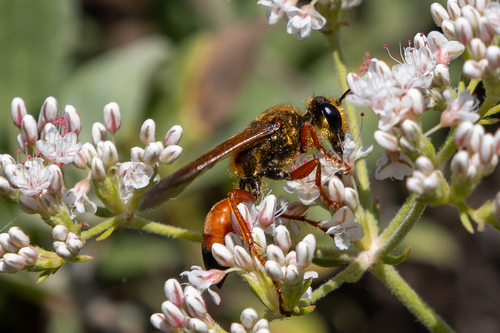
The Great Golden Digger Wasp has a slender body with a distinctive, bright golden-orange abdomen. Its head and thorax are black, contrasting with golden-orange legs and smoky, iridescent wings. It's often mistaken for a hornet but is more graceful.
Category
InsectsRarity
Common
Danger
2/5 · Low
Snaps
19
A mother wasp digs her own nursery tunnels, sometimes over a foot long!
Adult wasps are peaceful nectar drinkers, not aggressive stingers.
They can carry prey much heavier and larger than themselves!
They mostly feed their babies paralyzed crickets or katydids.
Great Golden Digger Wasp can paralyze large prey with its venom, keeping it fresh for its developing young.
Great Golden Digger Wasp can dig intricate underground burrows because of its strong legs and digging claws.
Great Golden Digger Wasp can remember its burrow's location, even after a long hunt carrying heavy prey.
Adults sip sweet flower nectar, but their young feast on paralyzed insects stored in underground nurseries!
Age differences: Adults feed on nectar, while larvae consume paralyzed insects provided by the mother.

Gryllus pennsylvanicus
primary food source for larvae
Scudderia furcata
common prey species for larvae
Sarcophaga lherminieri
larvae can feed on wasp's stored prey
Solidago canadensis
adults visit flowers for nectar
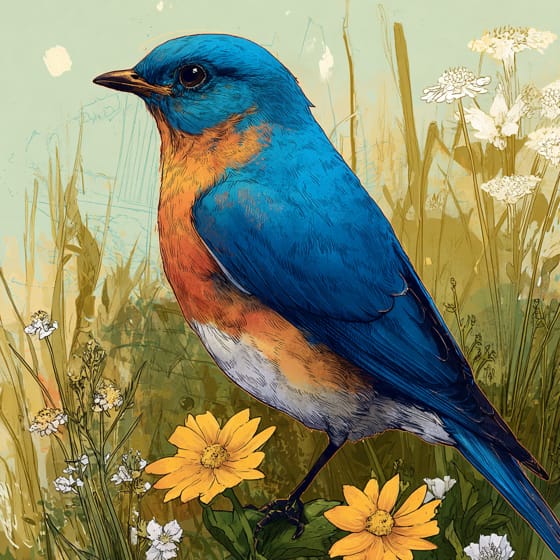
Sialia sialis
adult wasps can be bird food
Marked with parallel bands or lines of color.
Solitary animals live alone for most of their lives, only interacting with others for mating or parental care.
Burrowing animals dig tunnels and chambers in the ground, using these subterranean structures for shelter, hunting, or breeding.
Colorful describes organisms or objects displaying a wide range of bright and distinct colors.

This trait identifies organisms whose diet primarily consists of insects and other small invertebrates.

Diurnal animals are primarily active during daylight hours, typically resting or sleeping at night.

Describes a species whose presence and role have a disproportionately large effect on its environment.

This trait identifies organisms that exhibit exceptional swiftness in movement for hunting, escape, or travel.

This habitat trait indicates species that can coexist with humans in urban and suburban environments, utilizing man-made structures and green spaces.

Describes organisms that transfer pollen, enabling the fertilization and reproduction of plants.
No aliases listed yet.
Danger
2/5 · Low
Stay calm if you see a wasp and don't bother it; they are usually not harmful.
The easiest way to identify Great Golden Digger Wasp is to use the Snappit nature identifier app.
25-40 mm
12-24 mm
14-30 days
25 km/h
Adults sip sweet flower nectar, but their young feast on paralyzed insects stored in underground nurseries!
Urban areas
Pursuit
Zoom in to split clusters and explore where this object has been snapped.
Jun 6, 2026
Venice Canal Historic DistrictPhoto attribution
(c) Roberto Daniel Avila, some rights reserved (CC BY)
License: CC BY 4.0 ↗
Image may be shown cropped inside the card frame.

Connecticut, US
You might spot Striped Wintergreen and Common Eastern Bumble Bee.
View guide →

Connecticut, US
You might spot Striped Wintergreen and Common Eastern Bumble Bee.
View guide →

Virginia, US
You might spot Asian Lady Beetle, Spotted Lanternfly, and Christmas Fern.
View guide →

Florida, US
You might spot Brown Anole, Monarch, and Eastern Lubber Grasshopper.
View guide →

Oklahoma, US
You might spot Monarch, American Bumble Bee, and Gulf Fritillary.
View guide →

California, US
You might spot Eastern Fox Squirrel, Bee, and House Sparrow.
View guide →
Take the discovery with you
Snap it with Snappit to identify it, learn what makes it special, and add the discovery to your collection.








.jpg&width=800)


