


Carpenter Ants, Typical Sugar Ants And Allies
camponotus
Camponotus is a massive, ecologically vital, and globally widespread genus of ants, famous for its carpenter ants and sugar ants. Unlike termites, carpenter ants do not eat wood; instead, they hollow out dead, damp timber to create elaborate, smooth-walled galleries for their colonies. This behavior makes them significant decomposers in forest ecosystems, accelerating the breakdown of fallen logs and returning nutrients to the soil. Beyond their woodworking skills, these fascinating insects are highly adaptable, displaying complex social structures with distinct worker castes, including robust soldiers with oversized heads. From dense tropical rainforests to suburban backyards, Camponotus species play pivotal roles as fierce predators of pest insects and dedicated tenders of sap-sucking bugs, farming them for sugary honeydew.
Habitat: Found globally in forested environments, they typically nest inside decaying wood, hollow trees, fallen logs, and occasionally the damp structural timbers of human dwellings.
Camponotus ants are among the largest ants, typically ranging from 5 to 20 millimeters in length depending on the species and caste. When viewed from the side, they feature a smooth, evenly rounded thorax, which clearly distinguishes them from many other common ants that possess a notched or uneven thorax. Their coloration varies widely but is mostly solid black, brown, red, or a striking bicolored combination of red and black. Workers are highly polymorphic, meaning a single colony contains ants of various sizes, with large 'major' workers possessing disproportionately massive heads and powerful mandibles. Reproductive alates (males and queens) possess long, translucent, veined wings before shedding them after their mating flights.
Category
InsectsRarity
Common
Danger
1/5 · Very low
Snaps
Be the first to snap!
A mature carpenter ant colony can contain multiple satellite nests, meaning a single massive colony might span several different trees, logs, or structures.
A queen carpenter ant can live for up to 15 years, continuously laying eggs to sustain a colony that can eventually grow to contain up to 100,000 workers.
Carpenter ants do not actually eat wood; they simply excavate it to build their nests, spitting out the wood shavings as debris called 'frass'.
Some species of Camponotus in Southeast Asia are known as 'exploding ants' because workers can voluntarily rupture their own bodies to release a sticky, toxic glue to trap enemies.
They possess powerful mandibles capable of chewing through solid, damp wood to construct intricate, smooth-walled nesting galleries.
Many Camponotus species host endosymbiotic bacteria in their gut that synthesize essential amino acids, allowing them to thrive on nitrogen-poor diets like honeydew.
Lacking a functional stinger, they defend themselves by biting attackers with strong jaws and spraying highly concentrated formic acid into the wound.
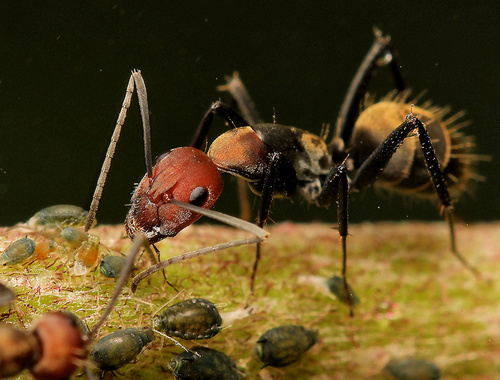
They feed extensively on honeydew secreted by aphids, as well as floral nectar, plant juices, and dead or living insects for vital proteins.
Age differences: Larvae require high-protein diets comprising insect meat for proper growth, while adult ants primarily consume carbohydrate-rich liquids like honeydew and nectar for energy.
Macrosiphum rosae
Carpenter ants protect aphids from predators in exchange for harvesting their sugar-rich honeydew.

Dryocopus pileatus
Woodpeckers tear into infested dead trees to extract and feed on carpenter ant colonies deep within the wood.
Ophiocordyceps unilateralis
A highly specialized fungus infects and mind-controls specific Camponotus workers, forcing them to climb vegetation before killing them to release fungal spores.
Furry describes animals possessing a dense covering of soft hair or fur.
Social animals live in organized groups, cooperating for survival benefits such as foraging, defense, and raising offspring.
This trait identifies organisms whose diet includes both plant and animal matter.
Describes organisms that break down dead organic material, recycling nutrients back into the ecosystem.
Forest habitats are terrestrial environments dominated by dense tree cover, supporting a high diversity of plant and animal life.
Diurnal animals are primarily active during daylight hours, typically resting or sleeping at night.
Describes a species whose presence and role have a disproportionately large effect on its environment.
No aliases listed yet.
Collections for this object will appear here as more themes are added.
Danger
1/5 · Very low
No special safety notes yet.
Compare the antennae, waist segments, body proportions and size. Workers, queens and males of the same species can look surprisingly different. Ant Identifier: upload a photo and compare the visible details.
1-3 cm
1-3 cm
0.000001-0.00005 kg
1-15 years
They feed extensively on honeydew secreted by aphids, as well as floral nectar, plant juices, and dead or living insects for vital proteins.
Found globally in forested environments, they typically nest inside decaying wood, hollow trees, fallen logs, and occasionally the damp structural timbers of human dwellings.
Foraging
Zoom in to split clusters and explore where this object has been snapped.
Recent snaps will appear here as new observations are added.

US
You might spot Carpenter Ants, Typical Sugar Ants and Allies and Axolotl.
View guide →
Colorado, US
You might spot Common Dandelion, Apples and Crabapples, and Dwarf Mallow.
View guide →
Take the discovery with you
Snap it with Snappit to identify it, learn what makes it special, and add the discovery to your collection.