

Christmas Lichen
herpothallon rubrocinctum
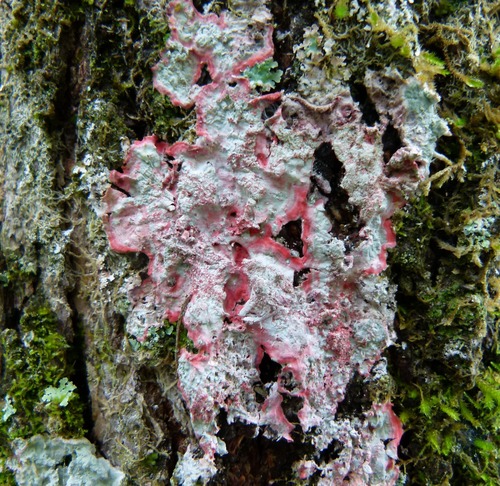
The Christmas Lichen (Herpothallon rubrocinctum) is a stunning and eye-catching species that brings festive colors to humid forests year-round. Named for its striking combination of bright red borders and cool, pale-green centers, this unique organism is not a single plant but a symbiotic partnership between a fungus and a photosynthetic alga. It forms delicate, felt-like patches on the trunks of hardwood trees in subtropical regions, brightening up shaded forest understories. Beyond its beautiful holiday-like appearance, the Christmas Lichen serves as an important ecological indicator. Because lichens absorb nutrients directly from the air and rain rather than from roots, they are highly sensitive to atmospheric quality. Spotting a vibrant patch of Christmas Lichen is a wonderful sign that the local air is clean and the forest ecosystem is thriving and undisturbed. It remains a favorite find for nature enthusiasts exploring wet woodlands and cypress swamps.
Habitat: Found on the shaded bark of hardwood trees in highly humid, subtropical environments such as cypress swamps and hammocks.
This species is easily recognized by its distinctive circular or irregular flat patches with a powdery, felt-like texture. The central region of the lichen is a pale greenish-gray to white, which is sharply contrasted by a bright, vibrant crimson-red or pink border. It can grow from a few centimeters to over 15 centimeters in diameter on tree bark, with the bright red coloration originating from a specialized chemical compound known as chiodonic acid.
Category
FungiRarity
Common
Danger
1/5 · Very low
Snaps
1
Because it has no root system, this lichen relies entirely on clean air and rain for survival, making it a natural air quality monitor.
Its festive red-and-green coloration makes it look like a holiday decoration growing naturally on tree bark.
The bright red chemical, chiodonic acid, also acts as a natural deterrent against hungry herbivores like snails and mites.
Combines a fungal structure with photosynthetic algae to survive on bare bark without soil.
Produces chiodonic acid, a bright red pigment that protects the organism from harmful ultraviolet radiation.
Possesses a poikilohydric nature, enabling it to absorb moisture and dissolved nutrients directly from humid air.
Produces its own food through photosynthesis carried out by its algal partner, while the fungal partner absorbs water and essential minerals from the air.
Trentepohlia sp.
Algal photobiont partner providing sugar via photosynthesis.

Quercus virginiana
Acts as a harmless epiphyte growing on the protective bark of the tree.
Armadillidium vulgare
Invertebrate grazers that sometimes feed on the lichen thallus.
No trait badges are assigned for this object yet.
No aliases listed yet.
Collections for this object will appear here as more themes are added.
Danger
1/5 · Very low
No special safety notes yet.
Compare the cap shape, the underside, the stem and base, and whether the fungus grows on wood or soil. Some fungi have gills, others pores or teeth. A cap seen only from above often hides the most useful features. Mushroom Identifier: upload a photo and compare the visible details.
2-15 cm
5-50 years
Produces its own food through photosynthesis carried out by its algal partner, while the fungal partner absorbs water and essential minerals from the air.
Found on the shaded bark of hardwood trees in highly humid, subtropical environments such as cypress swamps and hammocks.
Zoom in to split clusters and explore where this object has been snapped.

Georgia, US
You might spot Anole, Pond Slider, and Spanish Moss.
View guide →

Alabama, US
You might spot Eastern Lubber Grasshopper, Christmas Lichen, and Anole.
View guide →

Florida, US
You might spot Resurrection Fern, Spanish Moss, and Brown Anole.
View guide →
Take the discovery with you
Snap it with Snappit to identify it, learn what makes it special, and add the discovery to your collection.