

Cladycnis Insignis
cladycnis insignis
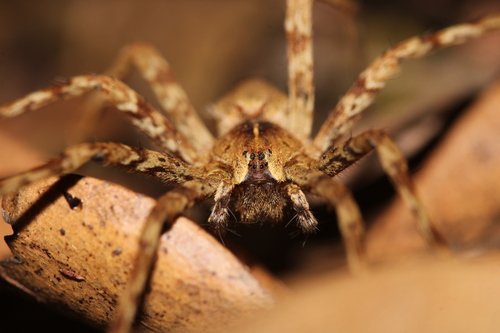
Cladycnis insignis is a striking nursery web spider native to the Mediterranean basin. Belonging to the family Pisauridae, this agile hunter does not rely on a traditional web to capture its prey, instead choosing to actively stalk and pounce on insects among low vegetation, grasses, and shrubs in warm, sunny habitats. Like other nursery web spiders, females exhibit remarkable maternal care, carrying their large egg sacs beneath their bodies and constructing a protective silk nursery dome for their newly hatched spiderlings. Their elegant form and distinct coloration make them a captivating find for arachnid enthusiasts exploring southern European landscapes.
Habitat: Typically found in Mediterranean scrublands, dry grasslands, and sunny low vegetation near woodland edges.
This medium-sized spider displays a slender, elongated body, with females measuring between 10 to 15 millimeters and males slightly smaller. The carapace is typically yellowish-brown to reddish-orange, adorned with conspicuous pale yellow or white longitudinal bands along the sides. Its abdomen features a matching central pattern with elegant light-colored lateral stripes. The long, robust legs are covered in fine sensory hairs and prominent spines, ideal for gripping foliage and sprinting rapidly over leaves.
Category
InvertebrateRarity
Common
Danger
1/5 · Very low
Snaps
Be the first to snap!
Their scientific name insignis translates to distinguished or remarkable, referring to their striking color patterns and elegant hunting posture.
To protect her young just before they hatch, the mother spins a complex silken nursery web over leaves and guards it aggressively against any intruders.
Unlike many spiders that carry egg sacs attached to their spinnerets, the female Cladycnis insignis carries her egg sac using her jaws and pedipalps.
Uses its keen eyesight and vibrations to sense prey on leaves, launching a lightning-fast forward pounce without the aid of a capture web.
Constructs a dense, protective silk dome in low shrubs to house and guard its offspring after carrying the egg sac in its chelicerae.
Utilizes its light weight and hydrophobic leg hairs to walk easily across the surface of calm water if pushed or hunting near margins.
An active predator feeding primarily on small invertebrates, including flies, grasshoppers, and other spiders, caught through active hunting on vegetation.
Age differences: Spiderlings feed on tiny insects like fruit flies and aphids, while adults target larger orthopterans and dipterans.

Chorthippus paralellus
Hunts and feeds on this common grassland grasshopper.
Cyanistes caeruleus
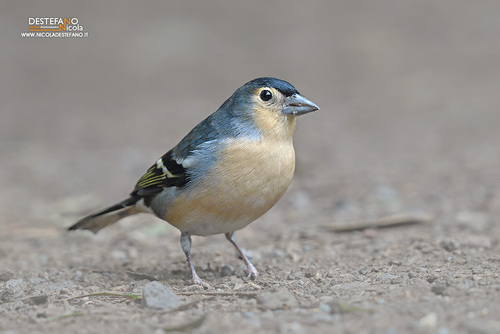
Preys upon this spider when hunting in shrub canopies.
Anoplius viaticus
Parasitizes and provisions its nest with this spider.
No trait badges are assigned for this object yet.
No aliases listed yet.
Collections for this object will appear here as more themes are added.
Danger
1/5 · Very low
No special safety notes yet.
Compare body proportions, leg shape, abdomen markings and the web, if there is one. Eye arrangement can be decisive but rarely shows up in a casual phone photo. A web is a supporting clue, not proof of who built it. Spider Identifier: upload a photo and compare the visible details.
1+ cm
0.0001+ kg
1+ years
2 km/h
An active predator feeding primarily on small invertebrates, including flies, grasshoppers, and other spiders, caught through active hunting on vegetation.
Typically found in Mediterranean scrublands, dry grasslands, and sunny low vegetation near woodland edges.
Ambush
Zoom in to split clusters and explore where this object has been snapped.
Recent snaps will appear here as new observations are added.
Take the discovery with you
Snap it with Snappit to identify it, learn what makes it special, and add the discovery to your collection.