
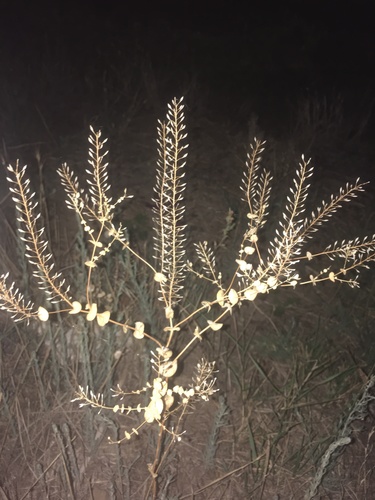


Clasping Pepperweed
lepidium perfoliatum
Clasping Pepperweed (Lepidium perfoliatum) is an intriguing annual or biennial herbaceous plant in the mustard family, Brassicaceae. Native to Europe and Asia, this highly adaptable species has successfully naturalized across much of North America, particularly in arid and semi-arid regions. It is famous for its striking leaf dimorphism, where the lower and upper leaves look so completely different they appear to belong to two distinct plants.
Habitat: Found in dry, disturbed soils, roadsides, fields, and waste areas, often in arid or semi-arid regions.
Growing between 10 to 60 centimeters tall, this plant features heavily dissected, lace-like lower leaves that contrast sharply with its upper leaves, which are round, heart-shaped, and completely clasp the stem (perfoliate). This gives the illusion that the stem is skewering the center of the upper leaves. In late spring, the plant produces dense, elongated clusters of tiny, four-petaled yellow flowers that eventually mature into small, heart-shaped or oval flat seed pods called silicles.
Category
PlantsRarity
Common
Danger
1/5 · Very low
Snaps
Be the first to snap!
Because it thrives in disturbed, salty soils, it is often one of the first pioneer species to green up degraded pastures and dry roadsides in early spring.
Its lower foliage is so lacy and finely dissected that a young seedling looks like an entirely different species compared to the mature, shield-leafed plant.
The scientific name 'perfoliatum' translates to 'through the leaf,' describing how the plant's stem appears to skewer its own upper leaves.
Produces deeply divided lower leaves to maximize early-season moisture capture, transitioning to solid, disk-like clasping upper leaves that shade the stem and conserve water in hot weather.
Generates thousands of tiny, hardy seeds per plant that are easily distributed by wind, water, and passing animals, allowing rapid colonization of barren soils.
Utilizes a deep taproot and highly efficient water-use systems to survive in highly compacted, nutrient-poor, and arid ground where other plants fail.
As a photosynthetic plant, it manufactures its own sugars and energy using sunlight, carbon dioxide, water, and essential mineral nutrients absorbed through its root system.
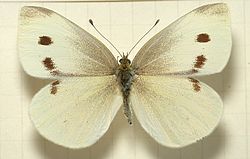
Pieris rapae
The caterpillars of this butterfly species actively feed on the foliage of clasping pepperweed and other mustard plants.
Apis mellifera
Provides a quick spring nectar and pollen source for honeybees and various native hoverfly species.
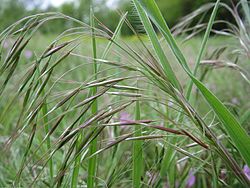
Bromus tectorum
Competes directly with other non-native grasses and weeds for moisture and space in disturbed desert ecosystems.
No trait badges are assigned for this object yet.
No aliases listed yet.
Collections for this object will appear here as more themes are added.
Danger
1/5 · Very low
No special safety notes yet.
Start with the whole plant, then compare leaf arrangement, leaf edges, stems and any flowers or fruit. Opposite leaves grow in pairs; alternate leaves come one at a time along the stem. These details tell you far more together than a single green leaf does. Plant Identifier: upload a photo and compare the visible details.
10-60 cm
1-2 years
As a photosynthetic plant, it manufactures its own sugars and energy using sunlight, carbon dioxide, water, and essential mineral nutrients absorbed through its root system.
Found in dry, disturbed soils, roadsides, fields, and waste areas, often in arid or semi-arid regions.
Zoom in to split clusters and explore where this object has been snapped.
Recent snaps will appear here as new observations are added.
Take the discovery with you
Snap it with Snappit to identify it, learn what makes it special, and add the discovery to your collection.

















