
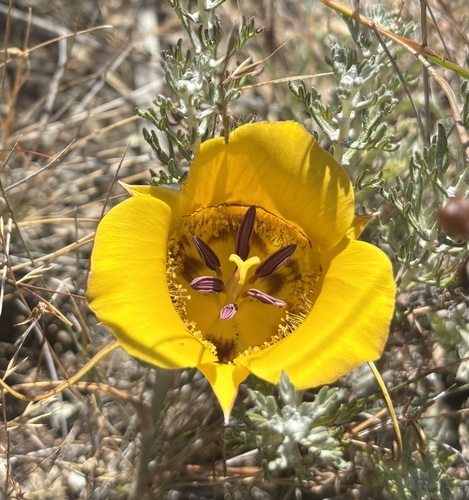


Clubhair Mariposa Lily
calochortus clavatus
The Clubhair Mariposa Lily (Calochortus clavatus) is a striking wildflower native to California's dry hillsides, canyons, and chaparral. Characterized by its brilliant, golden-yellow bell-shaped blossoms, this hardy perennial bulb thrives in harsh, nutrient-poor soils, including serpentine and volcanic formations. It belongs to the lily family and is celebrated for its sheer resilience and dazzling beauty, often emerging as a vibrant highlight in the chaparral landscape during late spring. What makes this species particularly fascinating is its evolutionary relationship with wildfire. While intense summer heat dries out the above-ground vegetation, the bulb remains safe beneath the soil, waiting for the nutrient-rich ash of a fire to trigger a massive, synchronized super-bloom. Spotters love this plant for its bold presence and the delicate, intricate structures hidden within its petals, making it a highly rewarding find for hikers and botanists alike.
Habitat: Typically found on dry, rocky slopes, grassy hillsides, and within chaparral, coastal sage scrub, or open coniferous forests across California.
This lily features robust, zigzagging stems growing up to 100 centimeters tall, topped with one to several upright, bowl-shaped flowers. The three petals are a rich, glossy golden-yellow, measuring 3 to 5 centimeters across, and are accented with a dark red or purple zig-zag band near the base. The defining characteristic is the presence of short, thick yellow hairs with swollen, club-like tips (clavate hairs) lining the lower inner surface of the petals, accompanied by dark purple or brownish anthers.
Category
PlantsRarity
Common
Danger
1/5 · Very low
Snaps
Be the first to snap!
Indigenous peoples of California traditionally dug up and ate the sweet, nutritious bulbs of Mariposa lilies, either raw, boiled, or roasted.
The common name 'clubhair' refers to the unique, tiny hairs inside the flower's petals, which have knobby, club-like tips visible under a magnifying glass.
These plants are highly adapted to fire; their bulbs remain safely insulated deep underground during wildfires and often bloom spectacularly in the ash-enriched soil the following spring.
The plant's underground bulbs survive wildfires and utilize the sudden influx of nutrients and sunlight post-fire to trigger abundant blooms.
The club-shaped hairs inside the petals help trap morning dew and guide specific native bee pollinators toward the nectaries.
The species enters a state of deep dormancy during hot, dry summer months, storing energy safely underground in its bulb.
As a photosynthetic plant, it generates its own energy from sunlight, water, and carbon dioxide, while extracting key minerals through its root system.
Bombus vosnesenskii
Pollinated by native bees that are attracted to the nectar and the bright yellow petals.

Thomomys bottae
Bulbs are dug up and eaten by pocket gophers, which can impact local plant density.

Odocoileus hemionus
Mule deer occasionally graze on the buds and seed pods during early summer.
No trait badges are assigned for this object yet.
No aliases listed yet.
Collections for this object will appear here as more themes are added.
Danger
1/5 · Very low
No special safety notes yet.
Start with the whole plant, then compare leaf arrangement, leaf edges, stems and any flowers or fruit. Opposite leaves grow in pairs; alternate leaves come one at a time along the stem. These details tell you far more together than a single green leaf does. Plant Identifier: upload a photo and compare the visible details.
20+ cm
5+ years
As a photosynthetic plant, it generates its own energy from sunlight, water, and carbon dioxide, while extracting key minerals through its root system.
Typically found on dry, rocky slopes, grassy hillsides, and within chaparral, coastal sage scrub, or open coniferous forests across California.
Zoom in to split clusters and explore where this object has been snapped.
Recent snaps will appear here as new observations are added.
Take the discovery with you
Snap it with Snappit to identify it, learn what makes it special, and add the discovery to your collection.


















