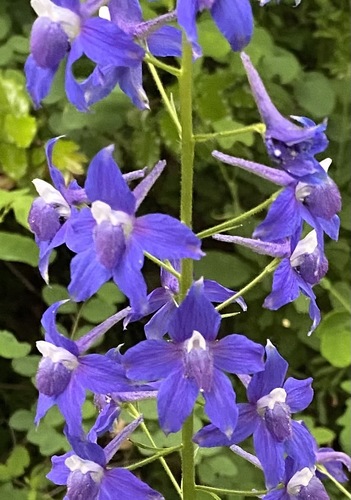


Columbian Larkspur
delphinium trolliifolium
The Columbian Larkspur is an elegant, tall perennial wildflower native to the damp, shady environments of the Pacific Northwest. Rising majestically from the forest floor, it produces striking towers of deep blue-to-violet blossoms that light up understory habitats in the spring. Historically, it has held an important, albeit cautious, place in local ecology due to its potent chemical defenses. It belongs to the buttercup family (Ranunculaceae) and serves as a vital early-season nectar source for specialized forest pollinators.
Habitat: Typically found in moist, shady deciduous or coniferous forests, riparian corridors, and near freshwater seepages in coastal and mountain regions.
This plant stands between 50 to 150 centimeters tall, sporting erect, mostly unbranched stems. Its leaves are deeply divided into 3 to 5 palm-like lobes, giving them a jagged, hand-shaped appearance. The blossoms are arranged in a loose, terminal cluster, showcasing deep blue, purple, or occasionally white petals. A defining visual identifier is the elongated, backward-pointing spur (about 1 to 2 centimeters long) on each flower, which curls slightly at the tip.
Category
PlantsRarity
Common
Danger
1/5 · Very low
Snaps
2
It is notoriously toxic to grazing livestock, particularly cattle, causing coordination loss and respiratory failure if consumed in large quantities.
The distinctive floral spur contains two hidden nectar glands, requiring pollinators to have specialized mouthparts to reach the sweet reward.
The specific epithet 'trolliifolium' means 'leaves like Trollius', referring to its strong resemblance to the globe flower genus.
Produces highly toxic diterpene alkaloids, such as delphinine, to deter herbivores and insects from grazing on its foliage.
Features a specialized deep floral spur that restricts nectar access to long-tongued pollinators, ensuring highly efficient pollen transfer.
Regrows annually from a thick, woody rootstock, allowing it to survive harsh winter conditions and quickly sprout in early spring.
The Columbian Larkspur is a photoautotroph, generating its own energy through photosynthesis by capturing sunlight and absorbing water and minerals from the soil.
Bombus vosnesenskii
Provides rich nectar rewards to this insect, which in turn acts as one of its most effective pollinators.
.jpg&width=800)
Selasphorus rufus
Visits the deep-spurred flowers during spring migration to drink nectar, assisting with cross-pollination.
No trait badges are assigned for this object yet.
No aliases listed yet.
Collections for this object will appear here as more themes are added.
Danger
1/5 · Very low
No special safety notes yet.
The easiest way to identify Columbian Larkspur is to use the Snappit nature identifier app.
50-150 cm
3-10 years
The Columbian Larkspur is a photoautotroph, generating its own energy through photosynthesis by capturing sunlight and absorbing water and minerals from the soil.
Typically found in moist, shady deciduous or coniferous forests, riparian corridors, and near freshwater seepages in coastal and mountain regions.
Zoom in to split clusters and explore where this object has been snapped.

Oregon, US
You might spot Oregon Oak, Pacific Poison Oak, and American Bullfrog.
View guide →

Oregon, US
You might spot Rough-Skinned Newt and Pacific Banana Slug.
View guide →

Oregon, US
You might spot Great Camas, Columbian Larkspur, and Osoberry.
View guide →
Take the discovery with you
Snap it with Snappit to identify it, learn what makes it special, and add the discovery to your collection.











.jpg&width=800)



_001.jpg&width=800)




