.jpg&width=800)





Rufous Hummingbird
Selasphorus rufus
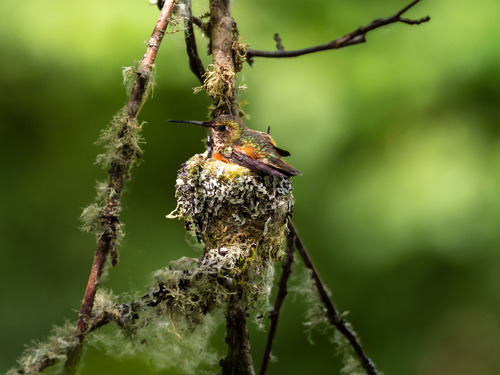
The Rufous Hummingbird is a tiny bird with bright orange feathers. They are known for their amazing flying skills, zipping around and hovering in mid-air to sip nectar from flowers.
Habitat: Forests
The Rufous Hummingbird is a small, energetic bird known for its brilliant rusty-orange plumage, especially on males, covering their back, flanks, and tail. Males also flash an iridescent fiery-red throat (gorget). Females are greener above with rusty flanks and a few iridescent throat spots.
Category
BirdsRarity
Common
Danger
1/5 · Very low
Snaps
8
Its tiny heart beats over 1,200 times per minute!
Males perform amazing 'J-shaped' aerial dives to impress females.
They can enter torpor, a mini-hibernation, to save energy.
This hummingbird is one of the smallest long-distance migrants.
Rufous Hummingbird can hover perfectly still because of special wing joints that help them drink nectar mid-air.
Rufous Hummingbird has an amazing internal compass that helps them migrate thousands of kilometers each year.
Rufous Hummingbird has an incredibly high metabolism that helps them digest nectar quickly for constant energy.
These tiny birds fuel their high energy with sugary flower nectar and tiny protein-rich insects.

Aquilegia formosa
Feeds on nectar, helping to spread pollen.
Bombus occidentalis
Competes for nectar sources, but also shares floral resources.
.jpg&width=800)
Selasphorus sasin
Often shares breeding grounds and overlaps with migration routes.

Empidonax traillii
Eggs and nestlings can be prey for larger insectivores.
Feathered describes animals, primarily birds, possessing a covering of feathers.
Aerial creatures spend a significant portion of their lives airborne, utilizing flight for various activities such as hunting, migration, or nesting.
Colorful describes organisms or objects displaying a wide range of bright and distinct colors.
Forest habitats are terrestrial environments dominated by dense tree cover, supporting a high diversity of plant and animal life.

Diurnal animals are primarily active during daylight hours, typically resting or sleeping at night.

Describes a species whose presence and role have a disproportionately large effect on its environment.

This trait identifies organisms that exhibit exceptional swiftness in movement for hunting, escape, or travel.

Migratory animals undertake seasonal movements from one region to another, typically in response to changes in climate or food availability.

Describes organisms that transfer pollen, enabling the fertilization and reproduction of plants.
Danger
1/5 · Very low
Enjoy watching hummingbirds from a distance and don't try to catch them.
The easiest way to identify Rufous Hummingbird is to use the Snappit nature identifier app.
7-9 cm
10-12 cm
0.002-0.005 kg
3-8 years
50 km/h
These tiny birds fuel their high energy with sugary flower nectar and tiny protein-rich insects.
Forests
Zoom in to split clusters and explore where this object has been snapped.

Washington, US
You might spot Rock Pigeon, American Crow, and Pigeon Guillemot.
View guide →

Montana, US
You might spot Sticky Geranium, White-Tailed Deer, and Common Toadflax.
View guide →

Oregon, US
You might spot Rough-Skinned Newt and Isabella Tiger Moth.
View guide →

Alaska, US
You might spot Forest Bumble Bee and Alaskan Fritillary.
View guide →

Washington, US
You might spot Mule Deer, Yellow Sand Verbena, and Bald Eagle.
View guide →

Colorado, US
You might spot Broad-Tailed Hummingbird.
View guide →
Take the discovery with you
Snap it with Snappit to identify it, learn what makes it special, and add the discovery to your collection.





.jpg&width=800)






