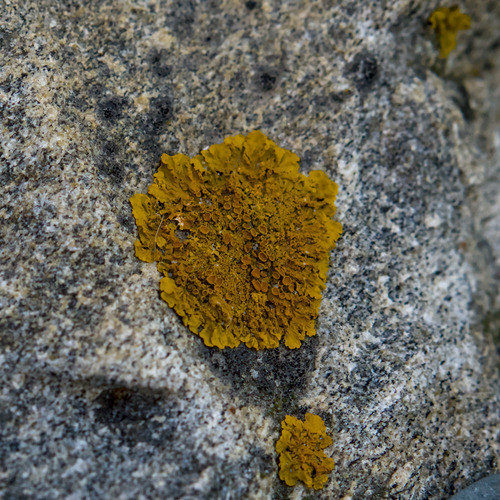
Common Sunburst Lichen
xanthoria parietina
The Common Sunburst Lichen is a bright yellow-orange lichen that looks like tiny sunbursts on rocks and trees! It helps clean the air by absorbing pollutants and is a great indicator of healthy environments.
Habitat: You can find it on rocks, tree bark, and walls in both urban and natural settings.
The Common Sunburst Lichen is a bright, often brilliant orange-yellow to greenish-yellow lichen forming flat, leafy rosettes. Its vibrant, almost glowing color makes it easily identifiable, especially when dry and exposed to sunlight. The lobes are distinct and somewhat overlapping.
Category
FungiRarity
Common
Danger
0/5 · No known danger
Snaps
2
Common Sunburst Lichen can help break down rocks, paving the way for other plants to grow!
Its amazing orange color gets brighter when it gets more sunshine, like a natural tan!
This lichen is actually a perfect team of a fungus and algae working together!
You might spot tiny animals, like mites and snails, munching on this colorful lichen!
Common Sunburst Lichen can dry out completely and then rehydrate, helping it survive extreme temperatures and drought.
Common Sunburst Lichen has special yellow pigments that act like sunscreen, protecting it from strong sunlight.
Common Sunburst Lichen can grow on many surfaces like rocks, tree bark, and man-made structures, colonizing diverse places.
Trebouxia arboricola
provides food for the fungus through photosynthesis
Cepaea nemoralis
grazes on the lichen's thallus, especially when damp
Milnesium tardigradum
tiny invertebrates live within the lichen for protection
Solitary animals live alone for most of their lives, only interacting with others for mating or parental care.
Colorful describes organisms or objects displaying a wide range of bright and distinct colors.
Describes organisms that break down dead organic material, recycling nutrients back into the ecosystem.
Forest habitats are terrestrial environments dominated by dense tree cover, supporting a high diversity of plant and animal life.

This habitat trait indicates species that can coexist with humans in urban and suburban environments, utilizing man-made structures and green spaces.
Danger
0/5 · No known danger
No special safety notes yet.
The easiest way to identify Common Sunburst Lichen is to use the Snappit nature identifier app.
0.1-0.5 cm
5-20 cm
No
None
Perennial
You can find it on rocks, tree bark, and walls in both urban and natural settings.
Zoom in to split clusters and explore where this object has been snapped.
May 10, 2026
Cape Arundel Summer Colony Historic DistrictPhoto attribution
(c) Eli Talhouk, some rights reserved (CC BY)
License: CC BY 4.0 ↗
Image may be shown cropped inside the card frame.

Rhode Island, US
You might spot Great Blue Heron, Painted Turtle, and Sensitive Fern.
View guide →

US
You might spot Rugosa Rose and European Green Crab.
View guide →

California, US
You might spot Valley Oak, Two-Horned Gall Wasp, and Silk Tree.
View guide →
Take the discovery with you
Snap it with Snappit to identify it, learn what makes it special, and add the discovery to your collection.