
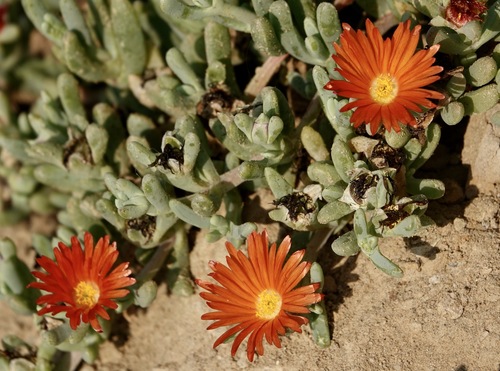


Coppery Mesemb
malephora crocea
Malephora crocea, commonly known as Coppery Mesemb, is a vibrant succulent plant belonging to the Aizoaceae family, native to the Western Cape of South Africa. It's highly admired for its striking, coppery-orange to reddish flowers and its remarkable ability to thrive in harsh, arid conditions. This resilient perennial forms dense, spreading mats, making it an excellent groundcover in suitable climates where it can help stabilize soil and suppress weeds. Its unique coloration provides a beautiful contrast against other foliage, adding significant visual interest to xeriscapes and rocky gardens.
Habitat: This species is typically found in arid and semi-arid regions, coastal scrub, sandy flats, and rocky slopes with well-drained soils, often in fynbos or renosterveld vegetation types in its native South Africa.
The Coppery Mesemb is characterized by its succulent, cylindrical, slightly flattened leaves that are grayish-green, often developing a reddish tint, and growing up to 3-5 cm long. Its most prominent feature is the abundance of daisy-like flowers, typically 2-3 cm in diameter, which bloom in vivid shades of coppery-orange, terracotta, or reddish-yellow. These solitary or small clustered flowers emerge from the leaf axils, opening widely in bright sunlight and closing at night or on overcast days. The plant forms a low-growing, sprawling mat, generally reaching 10-20 cm in height but spreading significantly wider.
Category
PlantsRarity
Common
Danger
1/5 · Very low
Snaps
Be the first to snap!
In many regions outside its native South Africa, the Coppery Mesemb is classified as an invasive weed due to its aggressive spreading capabilities and ability to outcompete native plants.
Its brilliant, daisy-like flowers are heliotropic, meaning they track the sun throughout the day, maximizing their exposure to sunlight for pollination and photosynthesis.
The common name 'Mesemb' is a colloquial shortening of 'Mesembryanthemum,' a genus it was once classified under, which refers to plants with flowers that typically open at midday.
The genus name 'Malephora' is derived from Greek, though its exact etymological meaning is debated, it likely relates to a characteristic of its flowers or fruits.
Its succulent leaves are highly adapted for efficient water storage, allowing the plant to endure prolonged periods of drought in its arid native habitat. This adaptation is crucial for survival in environments with scarce rainfall.
The Coppery Mesemb exhibits vigorous growth and can quickly spread, forming dense mats that effectively suppress weeds and stabilize soil. This makes it an efficient groundcover, though it can also become invasive in non-native environments.
Like many succulents, it utilizes the Crassulacean Acid Metabolism (CAM) pathway for photosynthesis, which minimizes water loss by keeping stomata closed during hot, dry daytime conditions. This allows for efficient carbon dioxide fixation with minimal water expenditure.
As a photosynthetic plant, Malephora crocea produces its own food (sugars) through the process of photosynthesis, utilizing sunlight, carbon dioxide from the air, and water absorbed from the soil. It also extracts essential mineral nutrients from the soil.
Apis mellifera
Provides nectar and pollen, facilitating plant reproduction.
Cornu aspersum
Feeds on the succulent leaves, especially young growth.
Dimorphotheca pluvialis
In non-native environments, its aggressive spreading can displace indigenous flora.
Various species
Supports a variety of soil microorganisms that help with nutrient cycling.
No trait badges are assigned for this object yet.
No aliases listed yet.
Collections for this object will appear here as more themes are added.
Danger
1/5 · Very low
No special safety notes yet.
Start with the whole plant, then compare leaf arrangement, leaf edges, stems and any flowers or fruit. Opposite leaves grow in pairs; alternate leaves come one at a time along the stem. These details tell you far more together than a single green leaf does. Plant Identifier: upload a photo and compare the visible details.
10-20 cm
0.05-0.5 kg
3-7 years
As a photosynthetic plant, Malephora crocea produces its own food (sugars) through the process of photosynthesis, utilizing sunlight, carbon dioxide from the air, and water absorbed from the soil. It also extracts essential mineral nutrients from the soil.
This species is typically found in arid and semi-arid regions, coastal scrub, sandy flats, and rocky slopes with well-drained soils, often in fynbos or renosterveld vegetation types in its native South Africa.
Photosynthesis
Zoom in to split clusters and explore where this object has been snapped.
Recent snaps will appear here as new observations are added.
Take the discovery with you
Snap it with Snappit to identify it, learn what makes it special, and add the discovery to your collection.


















