
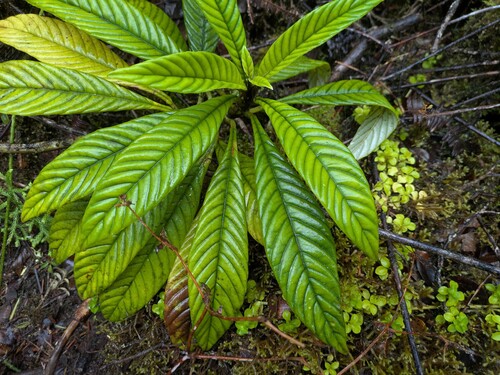


Cyrtandra Longifolia
cyrtandra longifolia
Cyrtandra longifolia, commonly known as a species of ha‘iwale in Hawaiian, is an enchanting shrub or small tree endemic to the wet, cloud-swept forests of the Hawaiian Islands. As a prominent member of the African violet family (Gesneriaceae), it plays a crucial role in the understory of Hawaii's pristine rainforests. This plant is a prime example of island adaptive radiation, showcasing how a single ancestral colonizer evolved into many distinct species across the archipelago to fill unique ecological niches.
Habitat: Typically found in the wet, deeply shaded understory of Hawaiian rainforests and montane wet forests, often near streams or damp ravines.
This species typically grows as a woody shrub or small tree reaching 1 to 5 meters in height. It is easily identified by its oppositely arranged, elongated, lance-shaped leaves that can span up to 20 centimeters in length and feature finely serrated margins. In bloom, it produces clusters of delicate, tubular white flowers that emerge from the leaf axils, which later give way to fleshy, egg-shaped white or light-pink berries that contrast sharply against the dark green foliage.
Category
PlantsRarity
Common
Danger
1/5 · Very low
Snaps
Be the first to snap!
Cyrtandra is the most diverse plant genus in the Hawaiian Islands, serving as a textbook example of rapid evolutionary diversification.
Despite its woody, tree-like form, this species belongs to the Gesneriaceae family, making it a distant relative of the popular African violet houseplant.
The genus name Cyrtandra is derived from the Greek words for 'curved' and 'male reproductive organ', referencing the distinctively curved stamens of the flowers.
Features broad, highly pigmented leaves specifically adapted to capture minimal sunlight filtering through the dense Hawaiian forest canopy.
Produces bright, high-moisture white berries that specifically target native avian frugivores to facilitate seed dispersal across fragmented forest habitats.
Possesses a specialized cuticle layer that prevents fungal rot and physiological stress in extremely wet, high-precipitation cloud forests.
As a photoautotrophic plant, it synthesizes its own organic compounds from carbon dioxide and water using energy from sunlight.
Myadestes palmeri
Fleshy white berries are consumed by this rare endemic bird, which then disperses the seeds throughout the wet forest habitat.
Hylaeus specularis
Native yellow-faced bees visit the tubular white flowers for nectar, acting as key pollinators for the species.
No trait badges are assigned for this object yet.
No aliases listed yet.
Collections for this object will appear here as more themes are added.
Danger
1/5 · Very low
No special safety notes yet.
Start with the whole plant, then compare leaf arrangement, leaf edges, stems and any flowers or fruit. Opposite leaves grow in pairs; alternate leaves come one at a time along the stem. These details tell you far more together than a single green leaf does. Plant Identifier: upload a photo and compare the visible details.
100-500 cm
15-50 years
As a photoautotrophic plant, it synthesizes its own organic compounds from carbon dioxide and water using energy from sunlight.
Typically found in the wet, deeply shaded understory of Hawaiian rainforests and montane wet forests, often near streams or damp ravines.
30-90 days
Zoom in to split clusters and explore where this object has been snapped.
Recent snaps will appear here as new observations are added.
Take the discovery with you
Snap it with Snappit to identify it, learn what makes it special, and add the discovery to your collection.

















