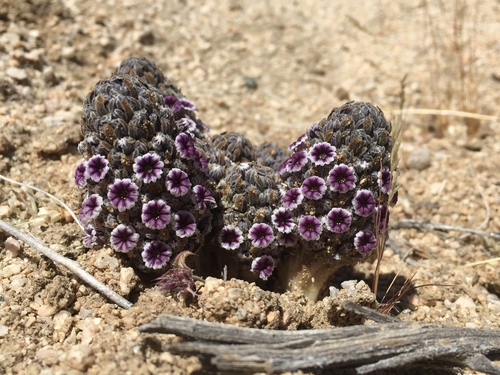


Desert Christmas Tree
pholisma arenarium
The Desert Christmas Tree (Pholisma arenarium) is a bizarre and fascinating botanical wonder of the North American deserts. Lacking chlorophyll, this parasitic plant spends almost its entire life cycle completely submerged beneath shifting desert sands. It survives by using specialized roots to seek out and tap into the root systems of nearby desert shrubs, stealing the moisture and nutrients it needs to grow. In the spring, it makes a brief, dramatic appearance by pushing a fleshy, scaly stem through the surface of the sand. Once above ground, this stem erupts into a dense, crown-like cluster of small, vibrant lavender-to-purple flowers, creating a striking contrast against the stark, sandy dunes. Its unique subterranean lifestyle and festive appearance make it a prized sight for desert explorers.
Habitat: Found in coastal and inland desert sand dunes, sandy flats, and washes, typically growing in close association with the root systems of desert shrubs.
This unusual plant is easily identified by its fleshy, pinecone-like stem that rises 5 to 20 centimeters above the sand, though its underground portion can extend several meters deep. The visible club-shaped stem is covered in tiny, scale-like leaves and topped with a rounded, compact cluster of flowers. These blossoms are small, tubular, and light purple or lavender with white borders, typically arranged in a dense, crown-like ring. The entire plant is covered in sticky, glandular hairs that trap drifting sand grains, giving it a rough, heavily camouflaged, sand-encrusted texture.
Category
PlantsRarity
Common
Danger
1/5 · Very low
Snaps
1
Because it lives buried in shifting dunes, the underground stem of this plant can grow up to six feet deep to reach a host root.
Indigenous peoples of the Southwest, including the Cahuilla, traditionally harvested the succulent underground stems to eat raw or roasted like sweet potatoes.
The sticky sand coating on its stem acts as a natural armor, protecting the tender succulent tissues from dry desert winds and sandblasting.
Lacking chlorophyll, it uses specialized root structures called haustoria to tap into host plants, drawing all its water and nutrients directly from them.
Produces sticky glandular secretions that coat its stem in sand, providing structural stability and camouflage from herbivores.
Spends most of its life cycle entirely underground, avoiding extreme desert surface temperatures and wind-driven erosion.
A root parasite that cannot photosynthesize, obtaining all water, minerals, and organic nutrients from the roots of specific host shrubs.
Ambrosia dumosa
Serves as the primary host plant, providing water and nutrients to the parasitic Desert Christmas Tree.
Lepidospartum squamatum
Another common desert shrub host that supports the development of Pholisma arenarium.
Apis mellifera
Pollinates the small purple flowers when they bloom above the sand.
No trait badges are assigned for this object yet.
No aliases listed yet.
Collections for this object will appear here as more themes are added.
Danger
1/5 · Very low
No special safety notes yet.
The easiest way to identify Desert Christmas Tree is to use the Snappit nature identifier app.
5-20 cm
0.05-0.5 kg
1-5 years
A root parasite that cannot photosynthesize, obtaining all water, minerals, and organic nutrients from the roots of specific host shrubs.
Found in coastal and inland desert sand dunes, sandy flats, and washes, typically growing in close association with the root systems of desert shrubs.
Parasitic Absorption
Zoom in to split clusters and explore where this object has been snapped.
Take the discovery with you
Snap it with Snappit to identify it, learn what makes it special, and add the discovery to your collection.












.jpg&width=800)



_001.jpg&width=800)




