



Disholcaspis mellifica
Disholcaspis mellifica
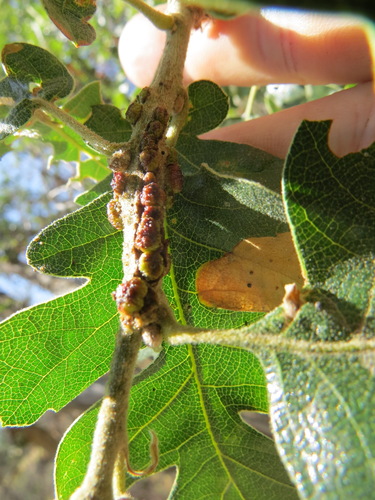
Disholcaspis mellifica is a tiny insect that lives on oak trees. It makes galls, which are like little homes for itself, on the leaves. These galls can look like small bumps or balls on the leaves.
Habitat: Forests
The Disholcaspis mellifica is a tiny, dark-bodied wasp, typically black or dark brown, with delicate, transparent wings. Its small, compact form and relatively short antennae distinguish it from larger, more brightly colored wasps.
Category
InsectsRarity
Common
Danger
1/5 · Very low
Snaps
Be the first to snap!
Galls made by this wasp can sometimes be mistaken for berries!
Some galls contain many wasps, like tiny apartment buildings!
The wasp larvae live safely inside their self-made plant homes.
These tiny wasps are incredible master manipulators of plants.
Disholcaspis mellifica can induce the growth of complex galls on oak trees because their larvae release chemicals that manipulate plant tissue.
Disholcaspis mellifica can switch between sexual and asexual reproduction to adapt quickly to environmental changes.
Disholcaspis mellifica has larvae that develop exclusively within a protective oak gall that provides food and shelter.
Adults feed on plant sugars, while larvae eat nutrient-rich oak gall tissue.
Age differences: Adults consume nectar and honeydew; larvae feed exclusively on the internal tissues of the oak gall.
Quercus agrifolia
for inducing galls that provide larval food and shelter.
Torymus californicus
its larvae are parasitized by this wasp inside the galls.

Dryobates nuttallii
woodpeckers may forage on galls, consuming larvae.
Solitary animals live alone for most of their lives, only interacting with others for mating or parental care.
Arboreal animals live primarily in trees, utilizing them for shelter, food, and protection from predators.
This trait characterizes organisms whose diet consists entirely or primarily of plant material.
Describes a relationship between two different species where they live in close association, often benefiting one or both.
Forest habitats are terrestrial environments dominated by dense tree cover, supporting a high diversity of plant and animal life.
Describes a species whose presence and role have a disproportionately large effect on its environment.
Pertaining to species that are significantly smaller than typical or average for their kind.
No aliases listed yet.
Danger
1/5 · Very low
It's best to look at insects from a distance and not touch them.
Look for six legs, antennae, three body sections and the shape of the wings. Beetles have hardened front wings; flies have just one working pair. Tiny insects may need a close view before their group is clear. Insect Identifier: upload a photo and compare the visible details.
3-8 mm
2-5 mm
14-30 days
3 km/h
Adults feed on plant sugars, while larvae eat nutrient-rich oak gall tissue.
Forests
Foraging
Zoom in to split clusters and explore where this object has been snapped.
Recent snaps will appear here as new observations are added.
Take the discovery with you
Snap it with Snappit to identify it, learn what makes it special, and add the discovery to your collection.