

Druce'S Crane'S-Bill
geranium × oxonianum
Druce's Crane's-Bill (Geranium × oxonianum) is a vigorous, mound-forming herbaceous perennial hybrid that has captured the hearts of gardeners and nature enthusiasts alike. Originating from a cross between Geranium endressii and Geranium versicolor, this resilient plant is celebrated for its long-blooming season and ability to thrive in a variety of challenging conditions. In the wild, it frequently escapes cultivation, naturalizing along hedgerows, woodland edges, and waste grounds across temperate Europe. Its dense, spreading foliage provides excellent ground cover, while its charming, veined flowers offer a vital nectar source for early and mid-season pollinators. Highly adaptable and virtually pest-free, Druce's Crane's-Bill represents a successful evolutionary meeting of two distinct species, combining the hardiness of one parent with the striking aesthetic of the other.
Habitat: Found in woodland margins, hedgerows, roadsides, and garden borders, often thriving in moist, well-drained soils under partial shade.
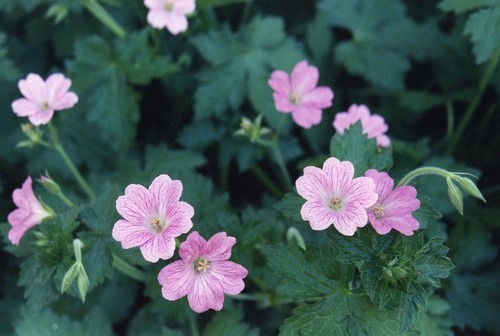
This perennial herb forms dense, leafy mounds reaching up to 60 to 80 centimeters in height. The flowers are typically five-petaled, funnel-shaped, and display a range of pink shades from soft pastel to magenta, characterized by distinctive, darker pink branching veins radiating from the center. Its medium-green leaves are deeply lobed, palmately divided into five segments, often featuring subtle dark brownish-purple blotches near the leaf joints. The stems are slightly hairy, and the dry seedheads resemble the long, pointed bill of a crane, which gives the plant its common name.
Category
PlantsRarity
Common
Danger
1/5 · Very low
Snaps
Be the first to snap!
Because it is a hybrid, it displays a beautiful mix of features from both parents, such as the translucent, veined petals of Geranium versicolor and the robust habit of Geranium endressii.
Its seed dispersal is entirely mechanical; as the pod dries, extreme tension builds up until the five segments curl upward violently, launching seeds away.
The common name 'crane's-bill' comes from the distinctive column-like fruit capsule, which closely resembles the long, slender beak of a crane.
This plant has earned the prestigious Royal Horticultural Society's Award of Garden Merit for its outstanding reliability and performance.
Utilizes a spring-loaded catapult mechanism in its dried, beak-like seed pods to fling mature seeds several meters away from the parent plant.
Spreads rapidly via tough underground rhizomes, allowing it to quickly colonize open ground and suppress competing vegetation.
Exhibits exceptional environmental tolerance and vigor inherited from its parent species, enabling it to survive in both drought and damp shade.
As a photosynthetic plant, it synthesizes its own food using sunlight, carbon dioxide, water, and essential soil minerals.
Apis mellifera
Pollinators visit the flowers to collect nectar and pollen, aiding in the plant's cross-pollination.

Cornu aspersum
Young foliage is occasionally browsed by common garden mollusks, though mature leaves are generally avoided.
Tagetes patula
Competes for soil nutrients, water, and sunlight in garden borders and naturalized forest floors.
No trait badges are assigned for this object yet.
No aliases listed yet.
Collections for this object will appear here as more themes are added.
Danger
1/5 · Very low
No special safety notes yet.
Start with the whole plant, then compare leaf arrangement, leaf edges, stems and any flowers or fruit. Opposite leaves grow in pairs; alternate leaves come one at a time along the stem. These details tell you far more together than a single green leaf does. Plant Identifier: upload a photo and compare the visible details.
30-80 cm
3-10 years
As a photosynthetic plant, it synthesizes its own food using sunlight, carbon dioxide, water, and essential soil minerals.
Found in woodland margins, hedgerows, roadsides, and garden borders, often thriving in moist, well-drained soils under partial shade.
Zoom in to split clusters and explore where this object has been snapped.
Recent snaps will appear here as new observations are added.
Take the discovery with you
Snap it with Snappit to identify it, learn what makes it special, and add the discovery to your collection.